You Can Now Legally Import One Of The Most Savage Sports Cars Ever Made
While measuring speed and acceleration is an empirical, objective pursuit, experiencing it is somewhat more subjective. The Bugatti Veyron was one of the first explosively fast cars that isolated the driver from the sensation of speed. EVs took it to the next level. Aside from the lung-crushing G-forces, you may as well be traveling by bullet train. Drive the new BMW M5 and tell us it’s an engaging experience; it’s not.
At the other end of the scale are cars like the Ferrari F40 and just about every TVR ever made. If the sheer visceral feel of speed is what excites you, then you may be pleased to hear that the mental TVR Tuscan Speed Six now falls under the US 25-year import rule. That means you can finally test your heart’s max BPM on the way to the shops each day and then down an espresso just to calm down.
Related
TVR Griffith Production Hits New Roadblock
Will the returning marque ever get a break?
If this is your idea of what a sports car experience should be, then let us give you some background info on one of the most savage sports cars ever made.
Originally launched in 1999, some early models were technically legal for import as of last year. However, 2025 means a broader range of Tuscan Speed Six sports cars are now available to be imported. The 25-year import rule is applicable to the manufacture date of the car in question, not the broader production span of the model name as a whole.
TVR – The Origin Story
TVR can trace its history back to 1946 when Trevor Wilkinson established a small engineering firm called Trevcar Motors. A few years later, the name was changed to TVR Engineering, and a slow but steady stream of TVR models started being marketed. As with most small independent auto manufacturers, TVR was beset with financial troubles, takeovers, and production issues, but each model remained true to the original concept of a lightweight tubular chassis and front-engine, rear-drive layout.

Add CarBuzz to your Google News feed.
When Peter Wheeler saved the company from financial distress in 1981, he revitalized the brand and introduced some of its most iconic models. Cars like the Griffith, Chimaera, and Cerbera were all giant-killing sports cars, capable of challenging the fastest Porsches and Ferraris at a fraction of the cost. Build quality and reliability weren’t always a strong point, but every TVR made up for it with buckets of character and a soulful driving experience. The last cars rolled off the production line in 2006, but there have been attempts to reboot the brand in recent years.
Now that the history lesson is over, let’s move on to the latest TVR from this era that can finally be imported to our shores.
The TVR Tuscan Speed Six Is A Lightweight Monster
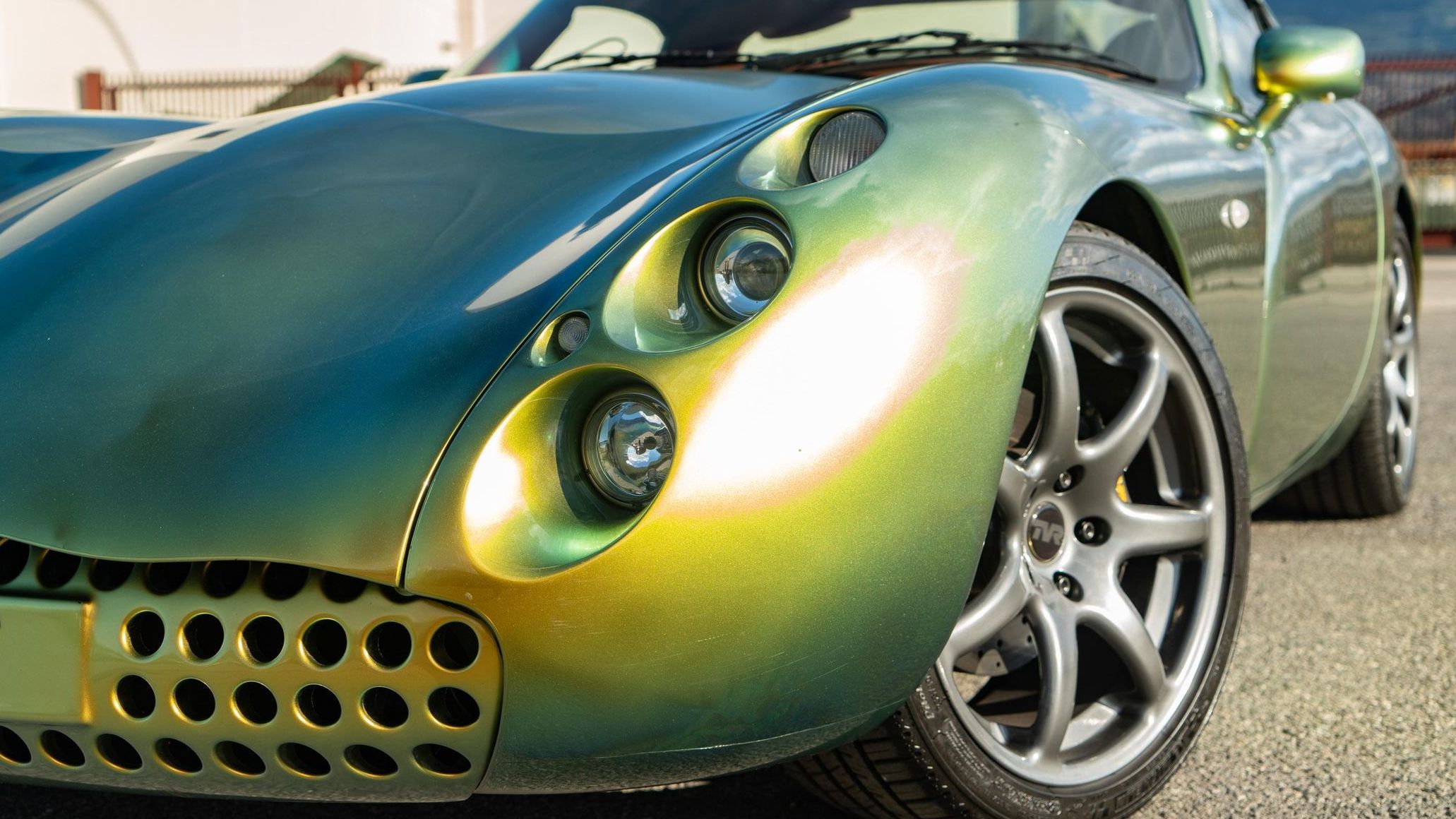
The TVR Tuscan Speed Six was introduced in 1999 to join the aging Rover V8-powered Griffith and Chimaera. It was the third time that the Tuscan name had been used on a TVR, but this one bore the swoopy styling and futuristic interior design that marked this era of TVR apart from just about anything else on the road. Whereas major manufacturers had long adopted ABS and traction control to tame their sportier offerings, the Tuscan Speed Six made do with just power-steering to separate the driver from the true, raw character of the car.
TVR had fitted Rover’s ubiquitous V8 to many of its models for years, but by the time the Tuscan arrived, it had developed its own 3.6-liter straight-six motor that was far more powerful and still sounded awesome, even at idle. It may have shared its inline-six layout with a BMW, but whereas even an M car would sing turbine-like to its redline, the TVR Speed Six engine was more like a barely contained race motor, howling along with barely contained savagery.
|
Engine |
3.6-4.0-liter inline-six |
|---|---|
|
Power |
350-400 bhp |
|
Torque |
290-315 lb-ft |
|
Curb Weight |
2,420 lbs (est.) |
|
0-60mph |
3.9 seconds claimed |
|
Top Speed |
165-180 mph+ |
The first Tuscan released in 1999 had 360 horsepower and a curb weight of just 2,420 lbs. That gave it a power-to-weight ratio way better than a contemporary Porsche 911 Carrera or even a Ferrari F355. A five-speed manual transmission and rear-wheel drive were standard on all models.
Straight-line acceleration was immense, easily capable of seeing off cars costing twice as much, but the Tuscan did have its fair share of shortcomings, too. The lack of traction control and ABS meant that only skilled drivers could access the car’s true potential, and these early Tuscans tended to be tricky at the limit, with contemporary road testers claiming that more development work was needed on the suspension. Driven with the circumspection it demanded, the Tuscan was a thrilling ride that would put a smile on your face even at cruising speeds.

Related
7 Of The Craziest TVRs Ever Built
Like AC Cobras, but nuttier.
The Tuscan Speed Six In Detail
While the Tuscan couldn’t compete with the build quality and ultimate polish you got in a BMW M3 or Porsche 911, it was more than a match in the performance department, and this is where the first upgrades were focused. The Red Rose performance pack was made available soon after the Tuscan went into production. It included uprated brakes and suspension components, unique 18-inch wheels, and engine enhancements that gave it an additional 40 bhp.
The Tuscan S arrived a few years later. It came with a 4.0-liter version of the Speed Six engine and made a nice round 400 hp. The Tuscan Mk2 was introduced in the final year of production in 2005 and had a few cosmetic changes and some mechanical updates. It had a less twitchy front end thanks to a new steering rack, larger brake calipers, and altered suspension mounting points.
The result was a slightly tamer driving experience, but still way more direct and exhilarating than in just about any other car on the road at the time.

Related
World’s Only Street-Legal TVR Cerbera Speed 12 Heads To Auction
The gnarliest TVR of them all is a true collector’s item.
The Tuscan’s Rivals
The Tuscan was produced between 1999 and 2006, with the first models being introduced in 2000. Rivals included the BMW Z3 M Coupe, the closest in terms of driving thrills, and the Porsche Boxster S, a car that was all about handling finesse and unflappable chassis balance. Back in 2000, it cost 40,000 GBP, or around $50,000. That undercut both the BMW and Porsche by a significant margin.
Measured in terms of bang-for-buck value, the Tuscan was leagues ahead. The Germans claimed victory when it came to outright handling and refinement. From the viewpoint of a modern classic, the driving experience tends to be what customers are looking for. If you want to experience what a true analog sports car is all about, then the TVR Tuscan is a pure dose of automotive adrenalin. Values have steadily risen at European auction houses and classic car dealers in recent years, although there is a big gap between concourse-condition garage queens and well-used high milers. Expect to pay at least $35,000 for a decent car, with excellent examples selling for up to $140,000. The sweet spot is somewhere between these two extremes, and while parts and servicing won’t be cheap, with just 1,677 cars built, values are sure to keep rising.
Just be sure to buy a car that was produced 25 years ago as the 25-year import rule is applicable to the date of manufacture of the vehicle. Trying to import one of the last models built is a recipe to get it sent to the crusher.

Related
TVR’s Forgotten Sports Cars Paved The Way For Mercedes’ First Hypercar
Mercedes-Benz used a pair of TVRs with some of the ugliest modifications ever, but it was for a good cause.
Sources:
TVR
,
TVR Blog
,
Classic.com