Why Ford Killed Its Most Famous Inline-Six Engine
Ford’s catalog is full of celebrated and beloved engines. For decades, the American automaker has been a leading name in the V8 engine segment, with engines like the Coyote V8 engine, which has been used across generations of the Ford Mustang, the Voodoo V8 engine that was the highest revving naturally aspirated V8, and the Predator V8 engine, which offers supercar-level power.
Other engines, like the EcoBoost engine used in the automaker’s supercars, have also been worthy of praise. However, the Ford Barra engine, produced by Ford Australia, deserves as much praise as the engines produced in the United States.
Ford
Ford is one of America’s oldest automakers and one of the oldest in the world, popularized for being the first to effectively mass produce the automobile under Henry Ford with the Ford Model T. In over 120 years, Ford has become a sales leader in a variety of segments, with popular nameplates like the Ford F-150, Transit, and Mustang.
- Founded
- June 16, 1903
- Founder
- Henry Ford
- Headquarters
- Dearborn, Michigan, USA
- Owned By
- Publicly Traded
- Current CEO
- Jim Farley
For the engine specs table, the engines have been arranged from least to most powerful inline six-cylinder engines, with the V8 and E-Gas engines listed after.
The Birth Of The Barra
Ford Australia developed and produced the Barra engine, an evolution of the Intech inline-six engine range produced between 1998 and 2002. These previous engines had been used as the core of several Australian models since the 1960s, but by 2000, it became apparent that the engines needed a replacement. Cue the Barra engine. It’s worth noting that two engine configurations were offered under the Barra nomenclature: one was an inline six-cylinder engine, which we’re focusing on, and the other was a 5.4-liter V8 engine that was based on Ford’s Modular V8 engine.
The Barra engine debuted in the Ford Falcon, specifically the facelifted version of the sixth-generation Ford Falcon. Calling it a mere facelift would be a disservice. The BA generation Ford Falcon was an extensive and comprehensive revision of the initial sixth-generation offering. Millions of Australian dollars were invested in developing the 2002 Ford Falcon, which resulted in many changes from its design to the many mechanical underpinnings.
Still, the most important aspect that changed, at least concerning the topic of this article, was the introduction of the Barra inline six-cylinder engine. This engine was characterized by its impressive 4.0 liters of displacement, dual overhead camshaft design with Variable Cam Timing, and 24 valves. Different variations of this engine were offered, including a turbocharged variant and a naturally aspirated version.

Related
This Is The Most Versatile Engine Ford Ever Made
From pickup trucks to supercars, this Ford engine has done its job well across the board.
Ford’s sixth-generation Falcon range featured three engine options. The entry-level models featured a 244 hp version of the 4.0-liter naturally aspirated inline six-cylinder Barra engine. Another engine offered to models higher up on the model range was the Barra E-Gas, designed to operate using liquefied petroleum gas that offered mid-range performance, high reliability, and low maintenance. The most potent inline six-cylinder Barra engine was employed in the Falcon XR6 Turbo, which had a higher compression ratio than the rest of the engine lineup and was coaxed by a Garrett turbocharger, resulting in a total output of 322 hp and 332 lb-ft.
Several other models have used the Ford Barra engine over the years, including the Ford Territory and different derivatives of the Ford Falcon. Both would continue to use the Barra engine in some form or another.
The Fall Of The Bara

2016 would be the Barra engine’s final year as Ford Australia ceased production of the beloved power plant. The reason for producing what was, and still is, a revered and powerful engine was that Ford Australia decided to shut down its Broadmeadows and Geelong production plants.
The Broadmeadows assembly plant was responsible for producing the Ford Falcon and the Ford Territory, but also produced the Ford Capri, Ford Fairlane (which used the Barra V8 engine), and the Ford Cortina. According to Ford Australia executives, these assembly plants, like the Geelong plant, Australia’s first assembly plant, used to build the Ford Model T in 1925, were unprofitable because of high labor costs. Not only was that putting strain on Ford Australia, but its market share had also begun to dwindle, further exacerbating the decline of manufacturing. In the decade and a few years that the Barra engine was in production, there were several iterations of the inline six-cylinder engine.
“Our costs are double that of Europe and nearly four times Ford in Asia. The business case simply did not stack up, leading us to the conclusion [that] manufacturing is not viable for Ford in Australia in the long-term.” – Bob Graziano, former Ford Australia president

Add CarBuzz to your Google News feed.
The Many Flavors Of The Barra Engine
|
Engine |
Barra 182 |
Barra 190 |
Barra 195 |
Barra 240T |
Barra 245T |
Barra 270T |
Barra 310T |
Barra 325T |
Barra 220 V8 |
Barra 230 V8 |
Barra E-Gas |
|---|---|---|---|---|---|---|---|---|---|---|---|
|
Horsepower |
244 hp |
255 hp |
261 hp |
322 hp |
329 hp |
362 hp |
416 hp |
436 hp |
295 hp |
308 hp |
209 hp |
|
Torque |
280 lb-ft |
282 lb-ft |
288 lb-ft |
332 lb-ft |
354 lb-ft |
406 lb-ft |
417 lb-ft |
425 lb-ft |
348 lb-ft |
369 lb-ft |
276 lb-ft |
|
Turbocharged |
No |
No |
No |
Yes |
Yes |
Yes |
Yes |
Yes |
No |
No |
No |
|
Vehicle |
2002-2005 Ford BA Falcon, Ford SX Territory |
2005-2008 Ford BF Falcon, Ford SY/SY II Territory |
Ford FG/FGX Falcon, Ford SZ/SZ II Territory |
2002-2005 Ford BA Falcon XR6 Turbo |
2005-2008 Ford BF Falcon XR6 Turbo, Ford SY Territory |
2004-2009 Ford BA/BF Falcon, Ford FPV F6 Typhoon, Ford Tornado |
2008-2014 Ford FG Falcon |
2014 Ford FC-X XR6 Sprint |
2002-2005 Ford BA Falcon |
2002-2008 Ford BA Falcon |
2002-2011 Ford BA Falcon |
From 2002 to 2016, the Barra engine was designed in several different configurations depending on the models used. Displacement stayed the same for every inline six-cylinder engine, but various engine internals and hardware would be changed. One of the most notable milestones in the development of the Barra engine was the introduction of the first turbocharged gasoline variant, designated 240T, which featured a Garret turbocharger, a lower compression ratio compared to the naturally aspirated engines, different exhaust valves, and a new intercooler.
Power was much higher in the turbocharged variants. As development and production continued, other engines would see revisions to the engine formula, some featuring different camshaft profiles and ECUs, others like the Barra 325T, which was the most powerful Barra engine, featuring an over-boost feature and a high compression ratio compared to other turbocharged Barra engines. Only 500 examples of this engine were created. Different turbochargers would be used for different versions of the Barra engine; some would feature plastic inlet manifolds, and later revisions would utilize revised cylinder head designs.

Related
6.2 Ford Engine: The Pros, Cons, History, And Specs Of An Engine Icon
The Ford 6.2L V8 engine showed the automotive world who’s ‘Boss’.
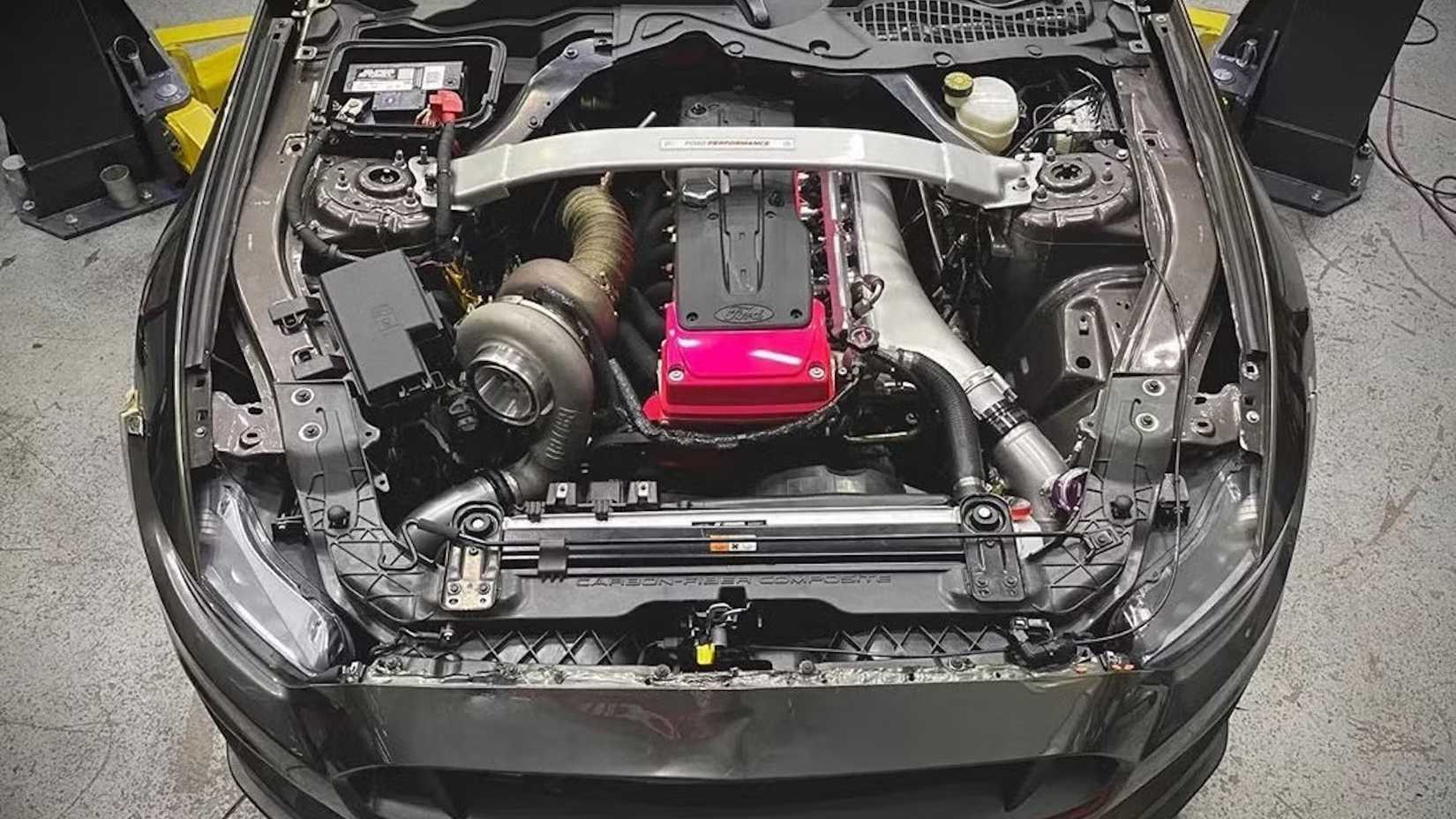
The Barra engine was Ford’s answer to the consumer market’s demand for more power and performance in the early 2000s, and it was extremely successful in doing so. Although production ended in 2016, the Barra engine’s legacy has continued. After its debut, the engine quickly became popular in the tuning community, and it has a reputation for easy power production and tuning potential.

Related
Foxbody Ford Mustang With Barra Straight-Six Is Drag Racing Perfection
The combination lets the Foxbody do 9.2-second passes on the quarter mile.
Often referred to as the Australian 2JZ-GTE, the Barra engine’s legacy was kept alive through its significance in the tuning community. High power was easily achievable, with changes like the turbochargers and some engine internals resulting in significant power increases. Alongside power outputs, the Barra engine could handle high-power outputs similar to the 2JZ-GTE. While it was exclusive to the Australian, New Zealand, and some African markets, the engine had been brought to the United States and has been the core of some of the most ludicrous drag racing weapons and garage projects.