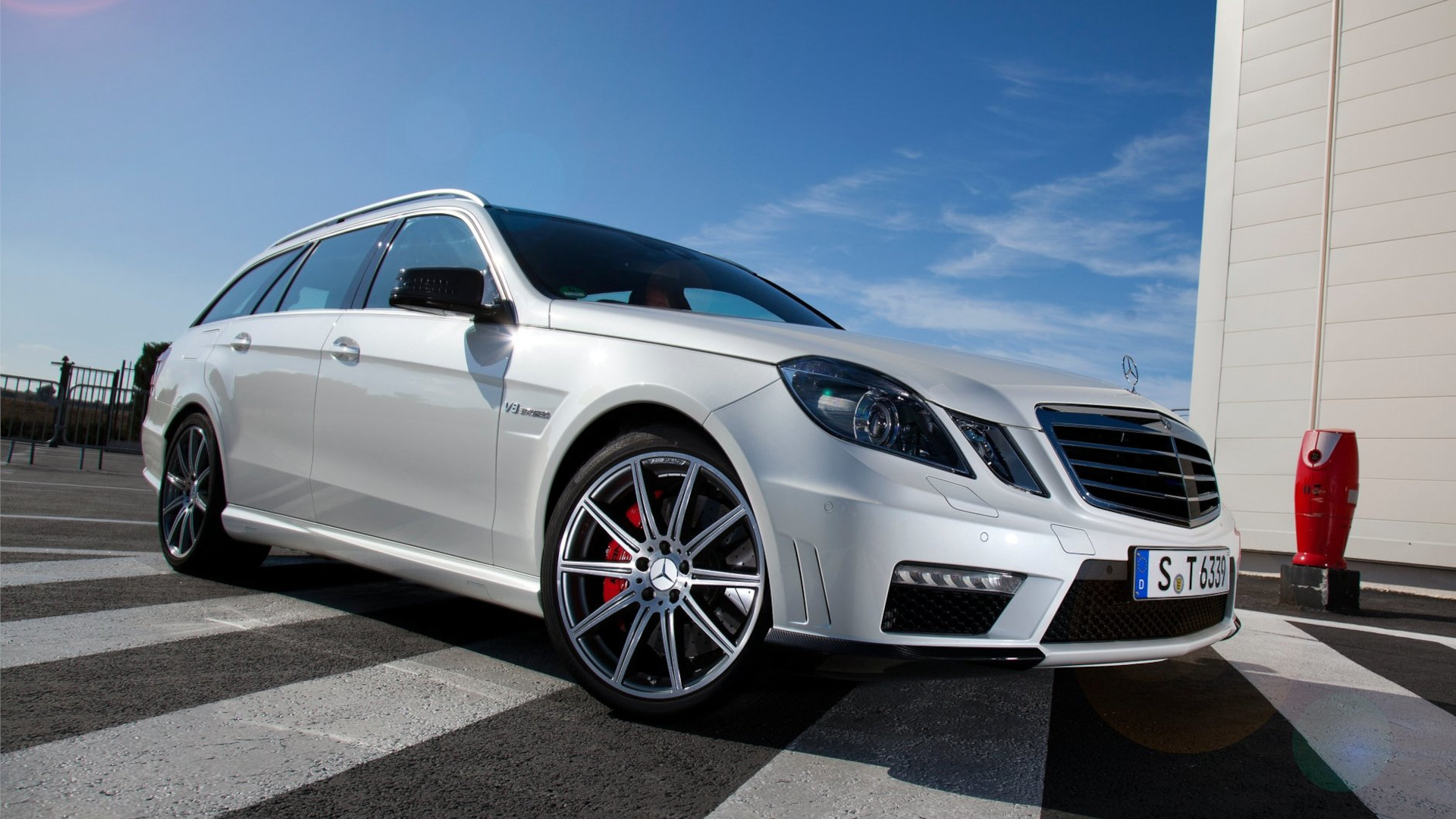
Why Buy A $50,000 SUV, When You Can Have The Ultimate Performance Wagon Instead
Yes, luxury SUVs like the Porsche Cayenne, BMW X5 and Mercedes GLE have conquered our market, providing you with the ultimate tool to park two wheels atop the sidewalk when all available spaces at the local mall are taken. But, there is something way cooler than that, and thanks to the die-hard engineers in Stuttgart, Germany, we can still enjoy the comfort and drivability of an estate, without compromising on looking cool at the traffic lights.
That’s right, we’re talking AMG-wagons. The last of the breed of estates in which you can fit a mountain bike or surfboard, and still challenge any sports car at the traffic light. We’d prefer the E 63 AMG as our weapon of choice, if you would have to choose between a mean SUV or a hot estate. And here are our reasons why.
This article focuses on the S212 series of the E-class, the estates that were produced between 2009 and 2016 for various markets around the globe.
The E 63 AMG Estate: It’s All You need
When looking for something practical enough to transport your lifestyle equipment, whether that be mountain bikes, kayaks or surfboards, people always tend to go for the big SUV. Because, as the name says, it’s a sports utility vehicle – a big thing on wheels, made for sporty people. But two things have happened since the surge of SUVs entered our markets in the late 1990s. First, the SUV isn’t that much of a utility vehicle anymore. Rather, it’s a big, sporty car with decent space. And second, the wagons of today aren’t comparable to what we saw four decades ago. They have evolved into practical – but still sporty and luxurious – people carriers.
Related
Brabus Will Give You The 700-HP Wagon Mercedes-AMG Won’t
Brabus makes V8 horsepower from the AMG inline-six.
A good example of this is the previous generation of the Mercedes E-Class Estate, the S212. In particular, the E 63 AMG, as that was where Stuttgart’s finest tech wizards pumped all their fun-DNA.
More Square Design Giving The S212 A Powerful Stance
The S212 started life shortly after Mercedes showcased its new W212 sedan, the fourth-gen E-Class, to the world at the 2009 Detroit Auto Show. The sedan immediately caught attention for its new, more square design – from the general body shape to details like the twin rectangular headlights on each front corner. The slight bulge above the rear wheels also helped cement the new E-Class’ powerful appearance.

Related
Murderous E63 AMG Wagon by RENNtech
This is one mean mommy-mover.
The estate version, the S212, came onto the market shortly after, in 2010. Thanks to a gently sloping roofline, the S212 immediately alleviated the fears of pundits that Stuttgart would again make the bigger people-carrier version of the luxury car look like a salami on wheels. The new, squarer look worked well for the longer version of the car, giving the rear glass house a strong, forceful look even in the normal versions.

The series kicked off with the usual engine versions. Two diesels, the 2.2-liter inline-4 in two states of tune, and a more powerful 3.0-liter V6 were offered. The gas engine range was quite extensive. There was a 1.8-liter and 2.0-liter (both turbocharged) available at the entry point, along with a 3.0-liter V6 for the more expensive models.
Soon after, in 2011, a newer version of that 3.0-liter V6 – now with a 3.5-liter V6 displacement – replaced the launch version. The top model in the range, the E 500, initially got a big 5.5-liter V8 in the nose, but when it was time for the facelift in 2013, it was replaced with a new 4.7-liter turbocharged V8, now using the E 550 nomenclature in some markets. For the new E 400 Hybrid, an electric motor was added to the 3.5-liter V6.
|
Mercedes E 63 S AMG Estate (S212) |
|
|
Engine |
5.5-liter Twin-turbocharged V8 |
|
Power |
577 hp |
|
Torque |
590 lb-ft |
|
Transmission |
Seven-speed automatic |
|
Top Speed |
186 mph |
When it came time for the much-anticipated AMG versions, launched in 2010, soon after the regular sedan broke cover, Affalterbach first used its 6.2-liter V8 in both the four-door and wagon versions of the E 63 AMGs. But when the facelift arrived in 2011, the group changed over to the newer, more powerful twin-turbo version of the 5.5-liter V8. In the United States, the E 63 station wagon was only available as an AMG S (fitted with the optional Performance Package, which lifted top speed to 186 mph, and bumped power up to 550 hp), and all E 63s were sold with the 4Matic 4×4 system as standard.

Related
German Tuner Transforms Mercedes-AMG E63 Wagon Into 870-HP Supercar Killer
Just in case you thought the standard model wasn’t quick enough.
It’s all a bit technical, but the model you’d really want is the face-lifted AMG version of the S212 E Class. While power stayed unchanged, the new twin-turbocharged 5.5-liter V8 made all the difference when it came down to torque. Producing 590 lb-ft of arm-twisting power, over a flat curve between 1,750 rpm and 5,250 rpm, the new V8 was much more driveable than the old 6.2-liter naturally aspirated V8. With permanent 4×4 traction and a low center of gravity, the Estate was dynamically a very capable car.
Why It’s More Practical Than An SUV
Quick Facts
- Produced between 2009 and 2016
- First available with a 6.2-liter V8, then a 5.5-liter twin-turbocharged V8
- Face-lifted models came standard with air suspension on the rear axle
- Over 550,000 E Class models were sold, of which 50,000 were Estate versions
SUVs have an inherent weak point, and that is their high center of gravity. They were originally designed to drive over things, not around them. Therefore, you sit up high, and have a high ground clearance. Nowadays, the modern SUV is a very different thing. But in essence, it still has two weak points. Which means that, although manufacturers try and negate that with big engines, you can’t turn the high-sided shoebox of a vehicle into a curve-hugging racer. Something has got to give, and in an SUV, it’s usually body roll and understeer.
Put that big V8 though in an estate, and suddenly you have a much better chance of zipping around the same bend at a faster speed. Simply because the vehicle sits closer to the ground, has less body roll, and has a lower center of gravity. Physics is just much more in favor of estates than SUVs.
Clever Tricks Made The Estate Practical, Too
With the S212, in E 63 AMG trim, you had low-profile tires (no need to drive over things, see), a wider track up front, stiffened suspension, and a new front axle. But there were other technical treats available as well. The AMG came standard with electronic damping with three settings, and air suspension on the rear axle, providing a level ride when loaded. The load bay was cavernous at 1,950 liters, and came with Mercedes’ “Easy-pack” system, featuring a folding load compartment floor with two loading levels and collapsible crate, a split rear backrest, and tailgate that could be opened and closed electrically.
All this meant that the E 63 Estate was every bit as practical as an SUV, and then some. With a low riding height, there is no effort required to load things into the luggage compartment. The spacious interior also provided ample seating for five people.
The V8 was coupled to a seven-speed automatic transmission, with paddles behind the steering wheel. Apart from four driving modes and a launch control mode, the speed of gear changes can also be selected in three stages.
Early reports lauded the E 63 AMG Estate for its grip around the bends and powerful acceleration. MotorTrend called it “a greedy girl who flits out of corners to gobble up straightaways with gusto”. But it also issued a warning: “The E 63 will boogie out of turns with spine-crushing acceleration, provided you lead her correctly. Come in too fast, or step in too early, and electronic stability control kicks in, retarding throttle and forward thrust and displaying a flashing yellow triangle in the instrument cluster that subsides once the chassis has stabilized.”
Other Estates To Consider
The major opponents of the E 63 AMG Estate are the Porsche Panamera Sport Turismo, BMW’s M5 Touring, and Audi’s RS6 Avant. All of them have been available at some point in time over the past two decades.
The Sport Turismo was labeled a shooting brake version of the regular Panamera but in essence it was an estate without calling a Porsche an estate. It only came onto the market in 2017, which means prices haven’t had time to drop dramatically yet. The top model, the Panamera Turbo S E-Hybrid Sport Turismo, beats the AMG wagon for power with its 563 hp trumping the AMG’s 550 hp.
Between 2007 and 2010, BMW produced the M5 Touring. Loading space was smaller than the Merc at only 1,650 liters but one could forego that just for the sound of the naturally aspirated 5.0-liter V10’s 500 hp roaring under the hood.
And lastly, Audi’s RS6 Avant was a real sleeper car between 2008 and 2012. The big 5.0-liter V10 with twin-turbocharging was lifted straight from the Lamborghini Gallardo. With all-wheel drive available, the big Audi’s 580 horses could be used to full effect.
SUVS Are So Last Year
In summary, big SUVs have come full circle, now that they are also available in sporty trims like the AMG, M and RS versions. But they are all still top-heavy utility vehicles. If you’re looking for a big family vehicle with ample storage space, a loading bay big enough for all your (and the kids’) toys, and performance to make sports cars envious, sporty wagons are the way to go. Starting with the uber-daddy of them all, an AMG-powered Benz wagon.