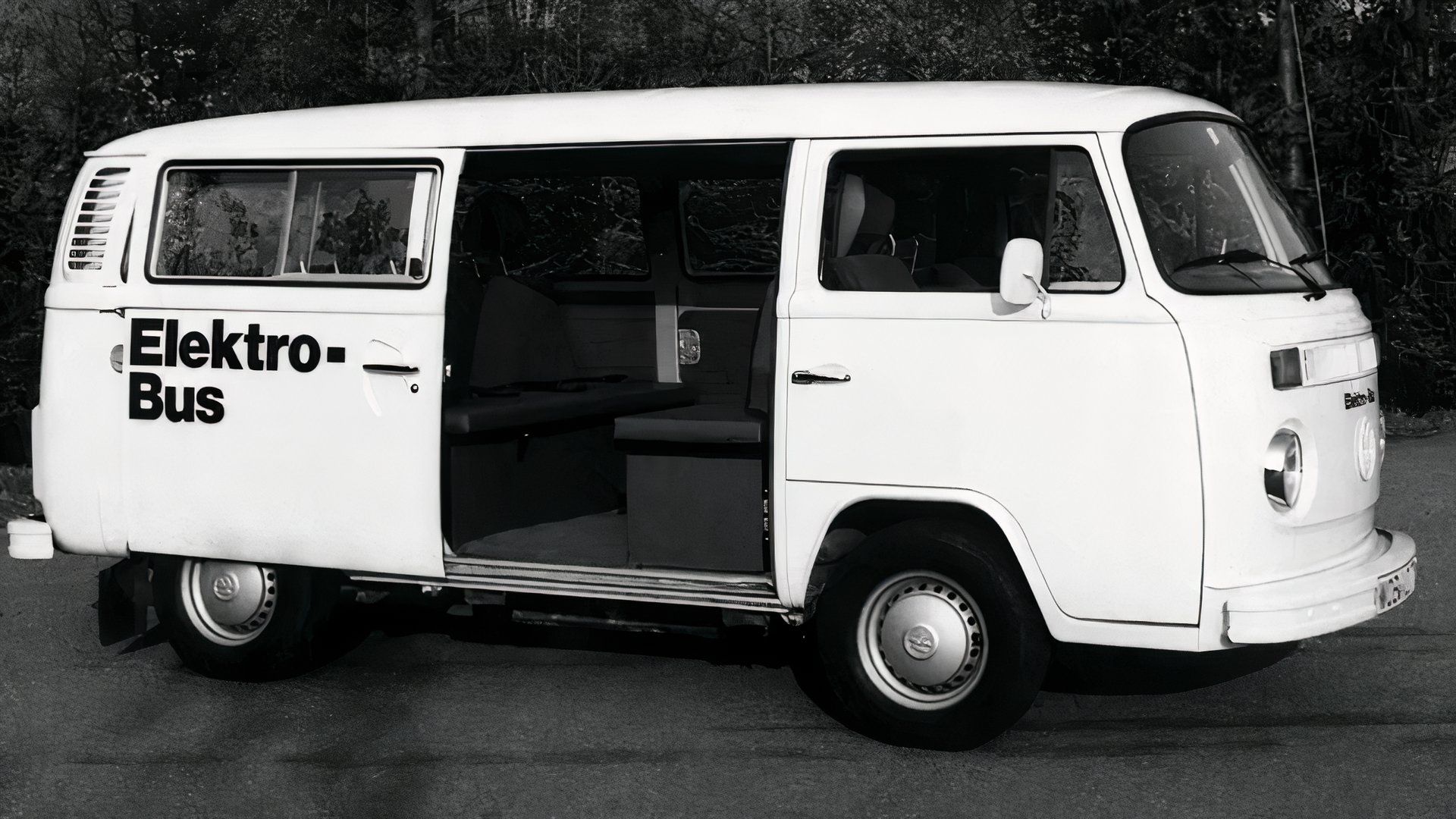
Volkswagen’s First Electric Bus Wasn’t The ID.Buzz
Here in the US, Volkswagen is a brand that’s always had a foot in the counter-culture. Whether you’re talking about Paul Newman’s Beetle muscle car or the VW Minibus’ long history as a people-mover for grassroots political movements, touring rock and roll bands, and devoted Deadheads following Jerry Garcia and the gang from city to city. VW has long been a brand of choice for forward-thinking, outside-the-box types.
VW’s attention towards the electric segment, with EVs like the ID.Buzz and the ID.4, feels like a long time coming. Out of all the drivers out there, who would be more eager to get off gas than a lifelong devotee of Beetles and Buses? You might not be surprised to learn that Volkswagen has actually been trying to go electric for a very long time. We’re not just talking about a single experimental electric car back in the late 90s or anything like that, but a whole history of electric production models dating back to 1972. Here’s what you need to know.
The following is based primarily on information published by Volkswagen. Any opinions offered thereupon are those of the author unless otherwise attributed.
The First Electric VW Bus Went Into Production In 1972
“Production vehicle” is a debatable term. For the most part, the definition of a “production car” is a motorsports thing. They don’t want someone making two hand-built supercars and calling it a “production car,” so they set minimum production runs of 25 or 200 units to ensure a fair race. Some people will tell you that ten cars is enough to make a production run, others will tell you that you need 1,000.

Related
The Only Body Style To Last Volkswagen’s Entire Existence
The Volkswagen minivan is back in the form of the all-electric ID. Buzz. But can this new van recapture that freewheeling magic?
For our purposes, we’re going to say that the 1972 Elektro-Bus’ 120-unit run qualifies it as a production vehicle, because that’s enough units to suggest that the intention was actually to build and sell these things. You don’t need a whole fleet of battery-powered VW Buses just to prove it can be done. This wasn’t a science experiment or a parade float, it was a legitimate product.
As to whether the Elektro-Bus was a viable product, as in, something you could actually sell to the public, well… that’s a whole other argument. Detailed performance specs aren’t available for the Elektro-Bus, but Volkswagen has published a few key stats:
|
1972 Volkswagen Elektro-Bus Key Stats |
|
|
Top Speed |
43 mph |
|
Range |
25 miles |
|
Battery Type |
Lead-acid |
|
Battery Weight |
1,847 lb. |
It Might Have Worked As A Fleet Vehicle
Jeep had some success with electrification in the 1970s with the Electruck, a DJ-5 running on a lead-acid battery with performance specs not unlike those of the Elektro-Bus. It could only go 29 miles on a full charge, and it had a top speed of just 40 mph.
That makes the vehicle effectively useless as a daily driver, as it’s going to be spending more time charging than it spends on the road. But, when you’ve got a couple dozen of them in the garage to swap in and out, and you’re only making short-term trips around town to deliver mail, suddenly the whole thing starts to make a lot more sense.

Related
Best Small Electric Cars Of 2025
Need an EV without the bulk? These are your best options.
Like the Jeep Electruck, the Elektro-Bus was built in response to rising gas prices. The original concept model was created by a team of eleven people at the Centre for Future Research in Wolfsburg, Germany before going on to a limited production run. This was the first official electric Volkswagen, but it’s just one of several such models that have been built over the years.
Volkswagen’s Been Nudging The Electric Revolution Along For Fifty Years
When the Elektro-Bus failed to revolutionize the industry overnight, many automakers would have dusted their hands off and said “we’ll try again next century”. Volkswagen got right back on the horse, and continued to produce another EV every five years or so from then on.
In 1976, Volkswagen built the Electric Golf Mk1, a concept car based on the Golf hatchback, with a 27-horsepower electric motor paired to a four-speed manual gearbox. The car’s 16.6-volt lead-acid battery could get you around 31 miles on a full charge, and VW engineers used to drive this thing around on public roads to collect data that they could use to improve the batteries.

Related
The Volkswagen Golf Is No Longer The People’s Car It Once Was
With fewer than one-third of its former global sales, the Golf is a shell of its former self.
Volkswagen followed the Golf EV up with a 25-unit run for the 1981 Golf I CitySTROMer, which had a range of 37 miles. 1985 saw the production of the Golf II CitySTROMer, with a top speed of 62 mph, and a production run of 70 units, which were sold as fleet vehicles for power utility workers. The 75-mile, 65 mph 1988 Jetta CitySTROMer would follow, and then the 1993 Mk III version, boasting the ability to get an 80% charge in just an hour and a half, and selling 120 units.
VW Electric Enters The Modern Age
Volkswagen didn’t produce any electric vehicles in the ’00s, but 2011 saw the development of the Volkswagen NILS, a concept car debuting at the 2011 Frankfurt Auto Show with a charming, futuristic “bubble” car look, and a 5.3-kWh battery pack going 40 miles on a charge. The NILS could hit 60 mph in just 11 seconds, and reach a full charge in two hours. Not that impressive today, but groundbreaking for 2011.
In 2013, Volkswagen’s electric dreams truly came to fruition with the e-Golf, the first electric VW you could really call mass-production, and the first to go on sale to the general public in the US. The e-Golf had an estimated 83 miles of range, and you could charge its 24.2-kWh lithium-ion battery to 80% in just 20 minutes. For the record, we had plenty of nice things to say about this car the last time we reviewed it, for the 2019 model. The e-Golf was affordable (starting at an MSRP of $31,895 for 2019), fun to drive, and charming. It was everything you like about the Golf, but electric.
The ID.4 Heralds A New Era For Volkswagen
Up until very recently, electric cars have been regarded as something of a novelty. Automakers would develop and market these cars with every intention of creating a viable product, but the general public would still look at them as little more than a “proof of concept.” The ID.4, launched in 2021, was the first electric Volkswagen launched after the tipping point. By 2021, we’d already seen the rise of Tesla, the Nissan Leaf had sold nearly ten thousand units the year prior, and the question wasn’t whether an electric car was viable, but whether we could build the infrastructure to support it.
|
2021 Volkswagen ID.4 Performance Specs |
|
|
Power |
201 hp |
|
Torque |
228 lb-ft |
|
Drivetrain |
Rear-wheel drive |
|
Battery Size |
82 kWh |
|
Range |
260 miles |
So, the technology is here, and Volkswagen has been itching to jump into electric with both feet for longer than most of us have been alive. Ironically, Volkswagen seems to have been struggling to find its identity in the modern age, but significant sales boosts for the ID.4 made the car a top-selling EV in the US earlier this year, selling 7,663 units in the first quarter alone. Meanwhile, the ID.Buzz is off to a solid start, selling a respectable 1,901 units in the first quarter of 2025.
This seems to be the moment Volkswagen has been waiting for five decades now, and while the brand failed to take an early lead in the modern EV boom, they do seem poised to plant their flag as the segment develops. We’ll just have to wait and see what happens from here.
Sources: Volkswagen.