
Volkswagen Desperately Needed A Helping Hand From The USA When They Tried To Build A Minivan
Volkswagen’s past and present forays into the world of cargo and passenger vans have, mostly, been well-documented and resounding successes for the company. Just to name a couple, we think of the iconic Volkswagen T2 Vanagon, or the “Hippy Van” as it’s affectionately known. Today, Volkswagen has recently transformed their iconic van into an electric vehicle, the VW ID. Buzz, although with its rather steep price, only time will tell if it’s as popular as its predecessors.
Volkswagen
Volkswagen is a mainstream automaker founded by the German Labour Front in 1937 as the “people’s car” company. Famous for the Volkswagen Beetle, Type 2 Bus, and modern classics like the Golf and Jetta, Volkswagen has emerged as one of the world’s largest automakers and a subsection of the larger Volkswagen Group, which either directly or indirectly owns controlling stakes in Porsche, Audi, Bentley, BMW, Skoda, Lamborghini, Bugatti, Rimac, Seat, and more.
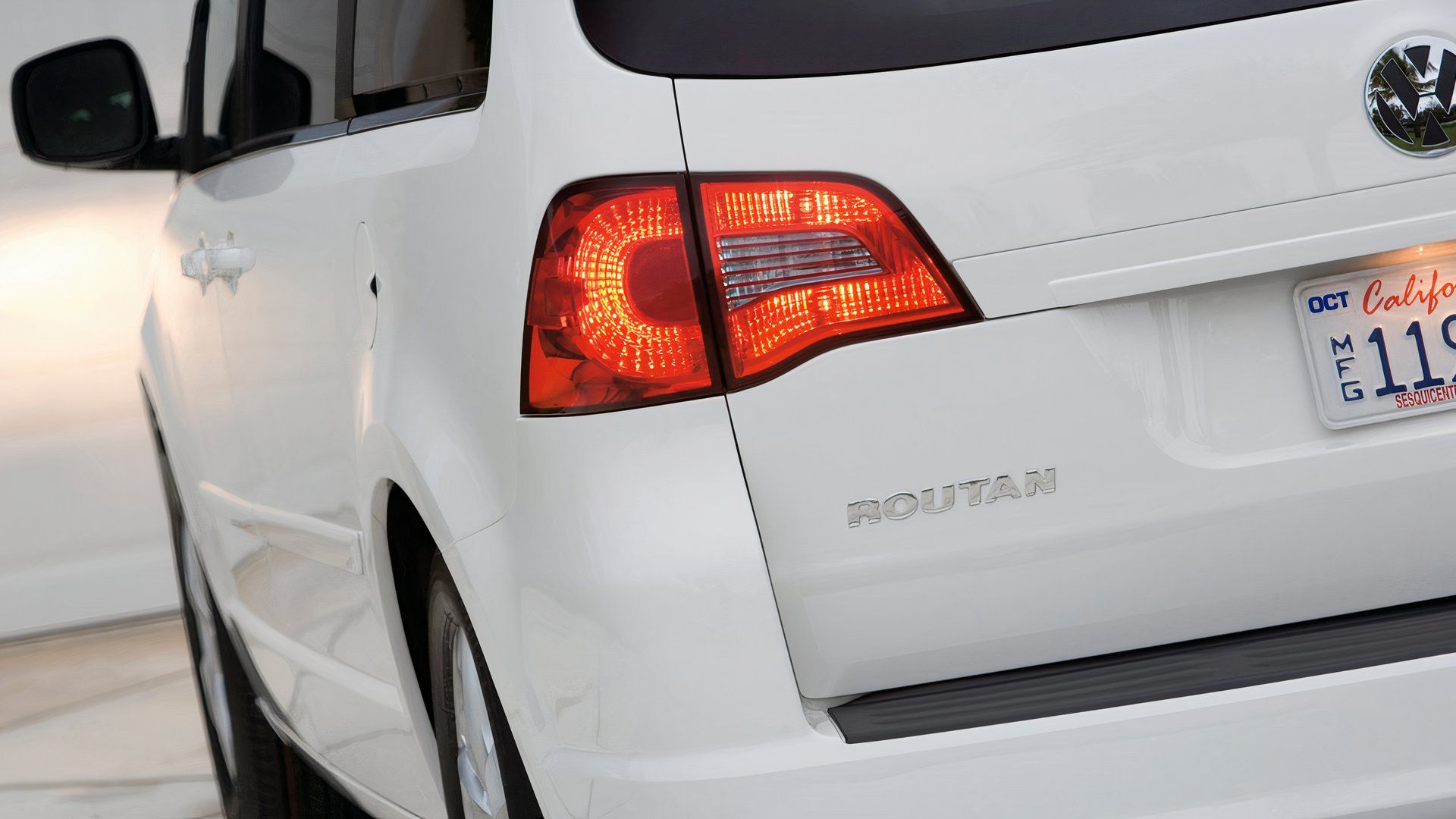
However, one van that Volkswagen wanted to build posed quite an issue for the company. VW knew it wanted to make a typical, all-American minivan, but lacked the tooling and expertise to do it on its own. So, it reached out to a certain American manufacturer whose experience in minivan-making surpasses all other automakers in quite a few ways. So, a deal was struck, and the Volkswagen Routan minivan was created.

Related
So, It Begins: VW Dealer Tries To Sneak In Ridiculously Huge Markup On ID. Buzz
This is not good news if you’re in the market for one.
Chrysler Group LLC’s German Cousin
Quick Facts About The Volkswagen Routan
- Production began in 2008
- Built alongside the Chrysler Town And Country and the Dodge Grand Caravan
- First vehicle offered under VW’s then-new US marketing strategy to offer more American-oriented models
- Production ceased following the 2014 model year
In the mid-2000s, Volkswagen was doing relatively well sales-wise in the US. The company, then the fourth-largest automaker in the world, reported roughly 330,000 deliveries in 2006, up 5,9 percent over the previous year. To capitalize on this increase in attention in the US, Volkswagen launched a plan to offer more US-oriented models to grab a more sizable chunk of the domestic market.

Add CarBuzz to your Google News feed.
The first model to be designed under the new plan was the Routan minivan, an all-new model for VW. However, because VW lacked the tooling and space required to produce this new model, the German company cast an SOS across the automotive world. Chrysler Group, one of America’s Detroit Big Three, answered the call happily. Under an agreement struck back in 2005, Chrysler would handle the production of the Routan, and VW would handle the design.
The result was a minivan which utilized a Chrysler-sourced frame and associated underpinnings, powertrain, and drivetrain. Along with its American heart, the Routan’s interior was also a revamped version of the sort seen in Dodge and Chrysler minivans of the time. VW offered a version of Chrysler’s infotainment system, MyGig, called the Joybox, along with a version of Chrysler’s early UConnect Web in-car Wi-Fi system, which was introduced in 2010.

Related
Ranked: The Most Reliable Minivans You Can Buy
Looking for a dependable and family-friendly used minivan? Find out here what the top contenders are.
Sadly, while the Dodge Grand Caravan and the Chrysler Town And Country were knockouts when it came to sales, the Routan couldn’t hold a candle to its American cousins on the showroom floors. In 2009, VW announced a production halt to allow dealers to sell their Routan inventory surplus as 29,000 units were produced, but only about 11,500 units had been sold by July of that year. In 2013, VW announced the Routans produced would be relegated mostly to fleet sales.

Related
Best All-Wheel-Drive Minivans of 2024
On top of inventory issues, the Routan’s base price of $28,000 was seven grand more than the base Dodge Caravan with just a little bit more equipment, making the Routan appear to be a waste of money to consumers. Following the 2013 model year, Volkswagen decided to ax the Routan, citing underperforming sales as the deciding factor.
The Routan’s Corn-Fed Heart

Of course, the Routan was not designed to thrash records at Laguna Seca or strip away quarter-mile drag titles from the likes of Funny Cars. It was powered by a choice between three Chrysler-sourced V6 engines, two of which were offered simultaneously, while one, the 3.6-liter Pentastar V6, came later on in the Routan’s life, starting in 2011. All three engines were connected to Chrysler’s 62TE six-speed automatic transmission.
|
Volkswagen Routan Specs |
|||
|---|---|---|---|
|
Engine |
3.6L Pentastar V6 (2011–2014) |
3.8L EGH V6 (2008–2010) |
4.0L EGQ V6 (2008–2010) |
|
Horsepower |
283 hp |
197 hp |
251 hp |
|
Torque |
260 lb-ft |
230 lb-ft |
259 lb-ft |
|
Bore x Stroke (inches) |
3.78 x 3.27 |
3.78 x 3.43 |
3.78 x 3.58 |
|
Compression Ratio |
10.2:1 |
9.7:1 |
10.2:1 |
*Specs courtesy of VW
Unfortunately, the Routan was subject to a recall regarding models produced between 2009 and 2010. In the NTSB brief, it was found that 20,767 units were fitted with a faulty ignition switch. When the defective switch was jostled or handled incorrectly, it could allow the ignition key to be removed during operation. If the key was removed while driving, the Routan’s airbags were deactivated, and its power steering and power brakes were shut off, along with the engine.
Why The Chrysler Town And Country/Dodge Caravan Reigned Supreme
Most of you will remember the sheer number of Chrysler, Dodge, and Plymouth minivans that were on the road as recently as ten years ago. Every family in America seemed to have had one, and many of them didn’t even want the thing. That’s how well-sorted and convenient those vans were, and we have to – begrudgingly – thank Dodge for starting it all over 40 years ago.
When Dodge and Plymouth unveiled the first Caravan/Voyager in 1983, it was an immediate hit in the US market. Chrysler’s marketing team employed a musician by the name of Doug Henning to promote the Voyager and its many positive attributes, such as the passenger room, its low-load floor, and its overall ease-of-use. In these initial commercials, the Voyager was referred to as the “Magic Wagon”, due to its many abilities. These early models took advantage of both Chrysler and Mitsubishi engines, along with either a three-speed TorqueFlite automatic or a five-speed manual transmission.

Related
Great-Grandson Of Chrysler’s Founder Wants To Rescue Its American Legacy
Frank B. Rhodes, Jr. has sent a proposal to Stellantis CEO Carlos Tavares outlining his plans to breathe new life into the Dodge and Chrysler brands.
In 1987, Chrysler unveiled a long wheelbase version of the Caravan/Voyager, with the new Dodge version being called the Grand Caravan, and Plymouth’s retaining the same name. Two years later,1989 saw the introduction of the Chrysler Town And Country, which was marketed as a more upscale version of the Caravan/Voyager. Also in 1989, Chrysler produced a turbocharged version of the van lineup, using a 2.5-liter inline-four which produced 150 horsepower. This was a one-year-only option, as it was dropped for the 1990 model year in favor of a revised Mitsubishi V6.
Over the course of the Caravan/Voyager/Town And Country’s life, a combination of good pricing, well-sorted interiors, and a litany of powertrain options, Chrysler’s minivan trio sold exceedingly well. Of course, Plymouth as a brand was discontinued in 2001, marking the end of the Voyager’s life, but the Caravan and Town And Country soldiered on well into the 2010s all while boasting successful sales numbers. These days, though, the minivan’s popularity is a shadow of its former self, for better or worse.
Sources:
AutoBlog.com, VWCup-Files.Track360.com.

