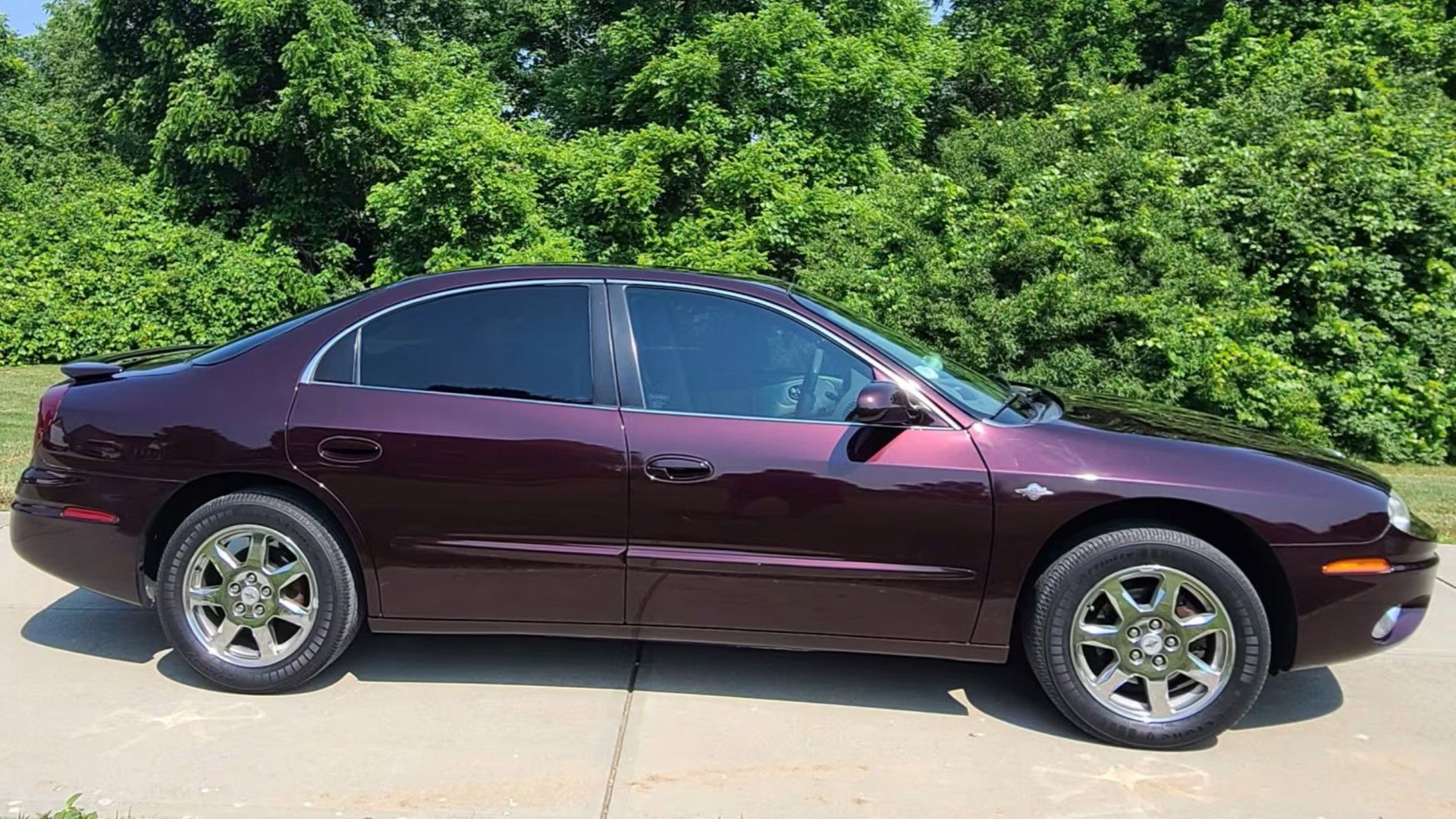
This Car Was One Of Five Models That Wrapped Up Oldsmobile’s 100-Year History
Oldsmobile may have been dead for just over 20 years, but it played a crucial role in shaping American automotive history throughout the 20th century. Introducing countless examples of technical innovation, from speedometers to satellite navigation, the brand was used by GM as an incubator for new automotive technologies that would later go on to become mainstream features in most vehicles worldwide. As the company prepared to close its doors for good in the early 2000s, the last five models it produced were given a limited-run special edition of 500 cars each: collectible items that helped commemorate the long history of a classic American brand.
One in particular, the Aurora, had been around for a decade – a full-size FWD sedan built on the G platform, but cheaper even than mid-size European rivals like the BMW 5 Series and Mercedes-Benz E-Class. It came with both V6 and V8-powered variants being available over the years; the latter was chosen as the basis for the “Final 500 Edition”, which is now a rare animal on the used car market. Let’s dive into the history of the Aurora Final 500, and that of Oldsmobile as a whole.
This feature focuses on the Final 500 edition of the Oldsmobile Aurora, the Aurora model as a whole and the history of Oldsmobile’s final years.
The Aurora Final 500
|
The 2003 Oldsmobile Aurora In Numbers |
|
|
Engine |
4.0L NA V8 |
|
Horsepower |
250 hp |
|
Torque |
260 lb-ft |
|
0-60 |
~7.5 seconds |
|
Top Speed |
~145 mph |
When Oldsmobile began to face the prospect of shutting down for good at the turn of the millennium, it decided the last few models in its lineup would get a limited-production “Final 500” series, consisting of 500 cars per model. As one of the few models still being produced when GM announced Oldsmobile’s imminent shutdown in 2000, the Aurora was selected to get a Final 500 edition.
Related
10 Cars Powered By GM’s Most Notorious V8
General Motors once produced a polarizing series of engines that, despite praise, was flawed. These are ten cars that used GM’s NorthStar V8 engine.
The car was fitted with special commemorative badges and finished in a unique paint color, Dark Cherry Metallic. Owners of an Aurora Final 500 also received some complimentary goodies along with their car, further enhancing its collectible status: these included a special brochure, framed and signed artwork, keychain, letter of authenticity, and a copy of the original window sticker.
The Other Final 500 Series Models
The Aurora was not the only member of the Final 500 club: a total of five Oldsmobile models were given this treatment, as the company gradually phased out its entire lineup during its last few years in business. The other four models were the Bravada, Silhouette, Intrigue, and Alero. Final 500 cars all had some characteristics in common that set them apart from others: aside from the unique Dark Cherry Metallic paint color, they all sported unique emblems that celebrated Oldsmobile’s history. Two models, the Aurora and Intrigue, came with a unique brochure.

Related
Whatever Happened To Oldsmobile’s Luxury Minivan?
This seven-seater promised a future of family cars that felt like stretch limos, but it wasn’t to be (at least not in North America).
One of the five models, the Silhouette, only had 360 “final edition” cars built instead of 500, due to the plant running out of production capacity. An Alero four-door sedan would become the last ever Oldsmobile to roll off a production line in 2004. This car was signed by all workers on the assembly line; it was then kept on display as a museum piece for several years, first at the R.E. Olds Transportation Museum in Lansing, Michigan, then at the GM Heritage Center in Sterling Heights, Michigan.
The Oldsmobile Aurora’s History: First Generation
The Aurora’s history had started back in 1994, when its first generation went into production to be sold for the 1995 model year. Only one engine was available for the Aurora’s first generation: a 4.0-liter V8, based on the 4.6-liter “Northstar” V8 that already powered some Cadillac models. This engine was paired with a single choice of transmission, a four-speed automatic, and sat transversely under the hood, powering the front wheels. FWD V8 cars are a rarity that has completely vanished today, and several GM G-body cars had this powertrain layout.
The first-gen Aurora gained particular notoriety for its structural integrity and safety; it managed to break GM’s testing equipment while being crushed as part of a test to assess its torsional rigidity. In order to accurately conduct the test, GM had to use a larger frame-crushing machine, of the kind normally used for truck frames. The end result of the test showed that the Aurora’s frame was twice as strong as the federal standard for passenger cars.

Related
Oldsmobile’s V8 Diesel Was A Good Idea Gone Horribly Wrong
A classic tale of a good idea with bad execution.
This model remained on the market for four further model years, eventually being discontinued in 1999 and going on a two-year hiatus before the Aurora nameplate was reintroduced.
The Oldsmobile Aurora’s History: Second Generation
The second generation of the Oldsmobile Aurora was introduced in 1999, and went into production in 2000 for the 2001 model year. Although GM’s original idea was to only offer this generation with a V8 engine, these plans were later scrapped, and the second-gen Aurora offered two engine options in its lineup: a 3.5-liter V6 and the 4.0-liter Northstar V8 already seen in the first-gen model. The LX5 V6 engine was also based on the Northstar series, and eventually earned itself the nickname of “Shortstar” among Oldsmobile owners. As had been the case with the first-gen model, a four-speed automatic was the only available transmission option.
The second-gen Aurora was also rich in tech features; keyless entry, automatic climate control, and an early version of an infotainment center were all offered as standard. Optional features included a premium Bose sound system, a power sunroof, and a memory seat package.

Related
This Oldsmobile Beat Even Volvo To One Of The Biggest Safety Advancements
How the Oldsmobile Toronado became a pioneer in the world of safety technology.
This model was very short-lived; when it arrived on the market, the company’s shutdown had already been announced by GM. Two further model years followed; production of the Aurora V6 ended in June 2002, while the Aurora V8 held on until March 2003. The Final 500 edition belonged to the latter category, being produced as a collectible subset of the Aurora V8’s last model year.
A Brief History Of Oldsmobile
Oldsmobile was one of the oldest automakers in the world, with a history that stretches back to the end of the 19th century; at the time of its demise it was the oldest surviving car company in the US. The firm was founded in 1897 by Ransom E. Olds; nine years later, it was acquired by General Motors and became a part of the GM brand roster.
Over the course of its history, Oldsmobile was responsible for hitting several crucial milestones of automotive history, such as the first assembly line (Ford’s assembly line, which many assume to be the first, was actually the first moving assembly line, while Oldsmobile used a static model now considered obsolete). Other “firsts” from Olds’ early history include the first production car equipped with a speedometer, as well as the first fully automatic transmission.

Related
Remembering America’s First Muscle Car, The Oldsmobile Rocket 88
This forgotten hero introduced the muscle car to America and the world.
In the 1940s, the company that had formerly been named Olds Motor Works renamed itself to reflect the nickname drivers had given to its cars, becoming officially known as Oldsmobile. Shortly afterwards, the brand anticipated the rise of the muscle car with a model that can be considered the first in this category: the Rocket 88, powered by the V8 engine of the same name.
Oldsmobile’s track record for innovation continued throughout the 60s: in 1962, the short-lived Oldsmobile Jetfire became the first turbocharged production car in the world, and four years later the Toronado was the first commercially available vehicle to be equipped with airbags.
The company’s popularity remained high until the early 90s, when its fortunes changed abruptly; other GM divisions were increasingly competitive, and Japanese brands were gaining popularity in the States, which meant Oldsmobile’s offering was no longer as popular with American drivers. Oldsmobile continued to exist for around a decade; GM announced its shutdown in 2000, and killed off the brand for good in 2004.

Related
10 Times Oldsmobile Was A Trendsetter In The Automotive Industry
This now-defunct brand is responsible for several leaps forward in automotive innovation. Let’s explore 10 of them.
However, a few years before Oldsmobile shut down for good, it managed to claim yet another title, becoming the first American automaker to offer a car equipped with an onboard navigation system in 1995. At this point in time, only Japanese automakers had introduced the technology on their models, with Mazda pioneering the technology in the 1990 Eunos Cosmo. Oldsmobile’s legacy remains one of innovation and technology, and the Final 500 edition provided a fitting send-off to a company with such a varied, rich history.
Sources: Oldsmobile, OutrightOlds, Automobile Catalog.