The Rolls-Royce Phantom VII Nearly Had A 9.0-liter V16 Engine
High-end luxury cars tend to have the biggest and best of everything, from pure size and interior space to the amount of plush extras that can be crammed into the cabin, as well as how much they cost. They also tend to get the largest and most powerful engines, since a large part of their appeal is to impart status and effortless performance. Rolls-Royce is no different with its V12, though there was a chance it was never meant to be that way.
Rolls-Royce
One of the oldest and most respected ultra-luxury automakers, Rolls-Royce was established in 1904 by Charles Rolls and Henry Royce. The duo quickly made a name for themselves as excellent engineers, and later on developed aeroplan engines through the world wars. In the early 70s, the business was liquidated and some parts of it bought over by a government-owned company. It was sold to the public in 1987, and since 2003, has been a subsidiary of Rolls-Ryce Holdings plc. It is recognized as a leader in ultra-high-end coachbuilt cars that require a substantial outlay to acquire.
The brand toyed with potentially introducing a huge V16 powerplant into the 2003 Phantom VII, though eventually decided against it. CarBuzz looked into why this potential marriage made in heaven never came to be.
This feature explores the possibility of the original Rolls-Royce Phantom being available with a V16 engine. As technical data was never released officially by the manufacturer, the figures used are rough estimates of what the engine would have been capable of.
The Decision Was Made By BMW To Equip The Phantom With A V12
The Rolls-Royce Phantom VII was an important car in the history of the fabled British brand, as it was the first model developed under the stewardship of BMW since it had taken over the marque in 1998 after a tough battle with Volkswagen. Rolls had been struggling to keep its head above water prior to its acquisition due to a lack of financial resources.
BMW looked to re-establish Rolls as the king of the luxury manufacturers, so a lot was riding on the new car. The Phantom name was chosen due to its historical importance to the brand, with six generations of the model having already graced the world in the past. The last had ended production in 1990, so it was well overdue a comeback. The car ended up being a massive success when it launched in 2003, with the rejuvenated Rolls-Royce nailing the looks and interior comfort as well as quality.
|
2003 Rolls-Royce Phantom Specifications |
|
|---|---|
|
Engine |
6.75-liter V12 |
|
Power |
453 hp |
|
Torque |
531 lb-ft |
|
0-60 mph |
5.7 seconds |
Part of this success came down to the smooth and powerful 6.75-liter V12 engine slotted under the long hood, which was a new unit developed alongside the Phantom VII.

Related
Rolls-Royce Tells The Fascinating Story Of The Phantom
Learn all about the world’s finest luxury automobile.
BMW Could Split Development Costs Between Two Versions Of The V12
BMW elected to use a V12 for a couple of reasons, with the most obvious being that its inherent smoothness and powerful nature were ideal for use in a vehicle like the Phantom. The German manufacturer also had experience building V12s in the past, with its M70 and S70 engines powering cars like the BMW 850i coupe and the McLaren F1 supercar.

Add CarBuzz to your Google News feed.
It also wanted to use a smaller 6.0-liter variant of the powerplant in its E65 760i luxury sedan, which sat below the Phantom in BMWs portfolio. It therefore made sense to design two versions of the same engine for different models, rather than plow money and resources into two distinct engines. The 6.0-liter powerplant also made its debut under the hood of the 760i in 2003. While both had a similar level of power, 439 hp playing 453 hp, the Rolls’ larger engine had significantly more torque at 531 lb-ft compared to the 6.0-liter’s 443 lb-ft.
An Idea Was Hatched To Potentially Utilize A V16 In The Phantom
While the V12 performed well in the Phantom, Rolls felt that a V16 would have made an interesting addition to the model. Not only would it have been bigger and more imposing than the V12 – ideal for rich businessmen to show off to their friends and rivals at the golf club – but it would have provided significantly more power too. The brand was so serious about the idea that it completed a full development program of the engine, and built a total of four prototype units to test.
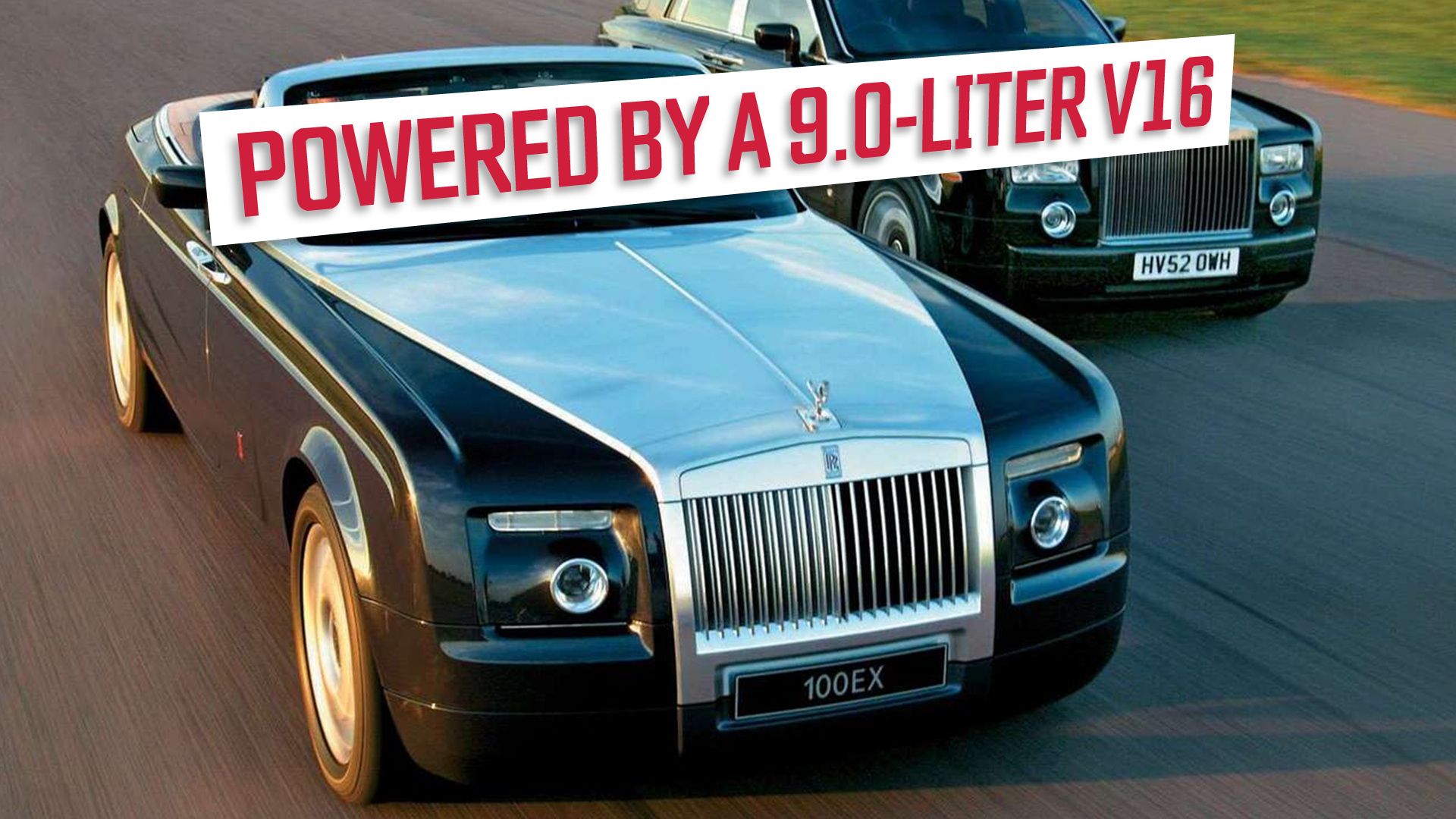
It made its debut in the 2004 100EX concept car, which was built to celebrate the 100th anniversary of the first meeting of company founders Charles Rolls and Frederick Henry Royce. The 100EX took the shape of a convertible coupe version of the Phantom, and was unveiled at the 2004 Geneva Motor Show. Rather than simply being a showpiece, the engine was fully functional and was hooked up to the vehicle so that it was drivable.

Related
BMW Shares Rare Look At V16 “Goldfish” 7 Series
And two other rare 7 Series models fans will love.
Rolls-Royce always denied that it was set for a production debut at any point, though given the lengths it went to build three or four functioning examples and fit at least one of them into a vehicle, it seems it was at least seriously considering it. The E32 BMW 7 Series “Goldfish” is a further example that BMW dabbled with this engine format more than once over the years.
Rolls-Royce Allowed Customers Around The World To Evaluate The V16
While official figures were never released by the brand, it was estimated that the powerplant produced around 700 hp and 700 lb-ft of torque. This would have put it well ahead of the 6.75-liter V12 in terms of grunt, so Rolls wanted to get its customer’s input on it. The car was delivered to multiple of its valued customers around the world so that they could try the car for themselves, and to see whether the V16 could be a viable enterprise.
|
2004 Rolls-Royce 100EX Specifications |
|
|---|---|
|
Engine |
9.0-liter V16 |
|
Power |
700 hp (est.) |
|
Torque |
700 lb-ft (est.) |
|
0-60 mph |
N/A |
While a reason was never given why the V16 project didn’t continue, it can only be assumed that the customers felt the upgrade wasn’t worth it over the V12, especially as extra money would have been demanded to make development worth it. The project was therefore parked following this, and the 6.75-liter V12 remained in the Phantom and Phantom Drophead, the production version of the 100EX that made its bow in 2007.
The V16 Engines Were Used In The Johnny English Movie Franchise
While the V16 never saw official production, it at least got to feature on the silver screen. Having been aware of their existence, actor and gearhead Rowan Atkinson was interested in getting his hands on at least one of the V16s. He wanted to fit one under the hood of a Phantom coupe, which was set to be the hero car of the second Johnny English spy movie. BMW agreed to the project, and the V16 was slotted under the hood of a standard production Phantom coupe.
Two Later Concepts Ended Up Making It As Production Models
While the 100EX would later become the Phantom Drophead in 2007, Rolls would also introduce the 101EX and 200EX concepts in 2006 and 2009 respectively. The 101EX contained the same 6.75-liter V12 as the Phantom, and took the shape of a two-door coupe version of the brand’s flagship. Customer reaction was positive to the concept, which was 9.5 inches shorter than the sedan, and a production Phantom coupe was launched in 2008.
The 200EX took the idea of the Phantom coupe, and made it even smaller. The 200EX, like the concepts before it, was fully functional, and was meant to act as a cheaper and sportier Rolls-Royce offering for those who not only liked to ride in the rear of the car, but also wanted to take the controls every now and again. It was again met with acclaim upon its debut, and eventually reached production as the Rolls-Royce Ghost in 2009.

Related
Ultra Luxury, Ultra Fast Comparison: Rolls-Royce Ghost II Black Badge Vs. Bentley Flying Spur Speed
The latest and greatest versions of the Rolls Royce Ghost and Bentley Flying Spur have arrived, but there can only be one winner in this duel.
While it still had a V12, it was a more modern design than the 6.75-liter N73 unit featured in its bigger Phantom sibling. The 6.6-liter N74 featured twin turbochargers, which provided with 563 hp. The brand continues to run a twin-turbocharged 6.75-liter N74 V12 in its current models today, and so far is yet to be tempted back to the V16 dark side. Bugatti has though, as it’s set to introduce a monster 8.3-liter hybrid V16 powerplant in its upcoming 2026 Tourbillion hypercar. Whether this will be enough to pique Rolls’ interest in revisiting its own V16, we can only hope.
Sources:
Rolls-Royce
.