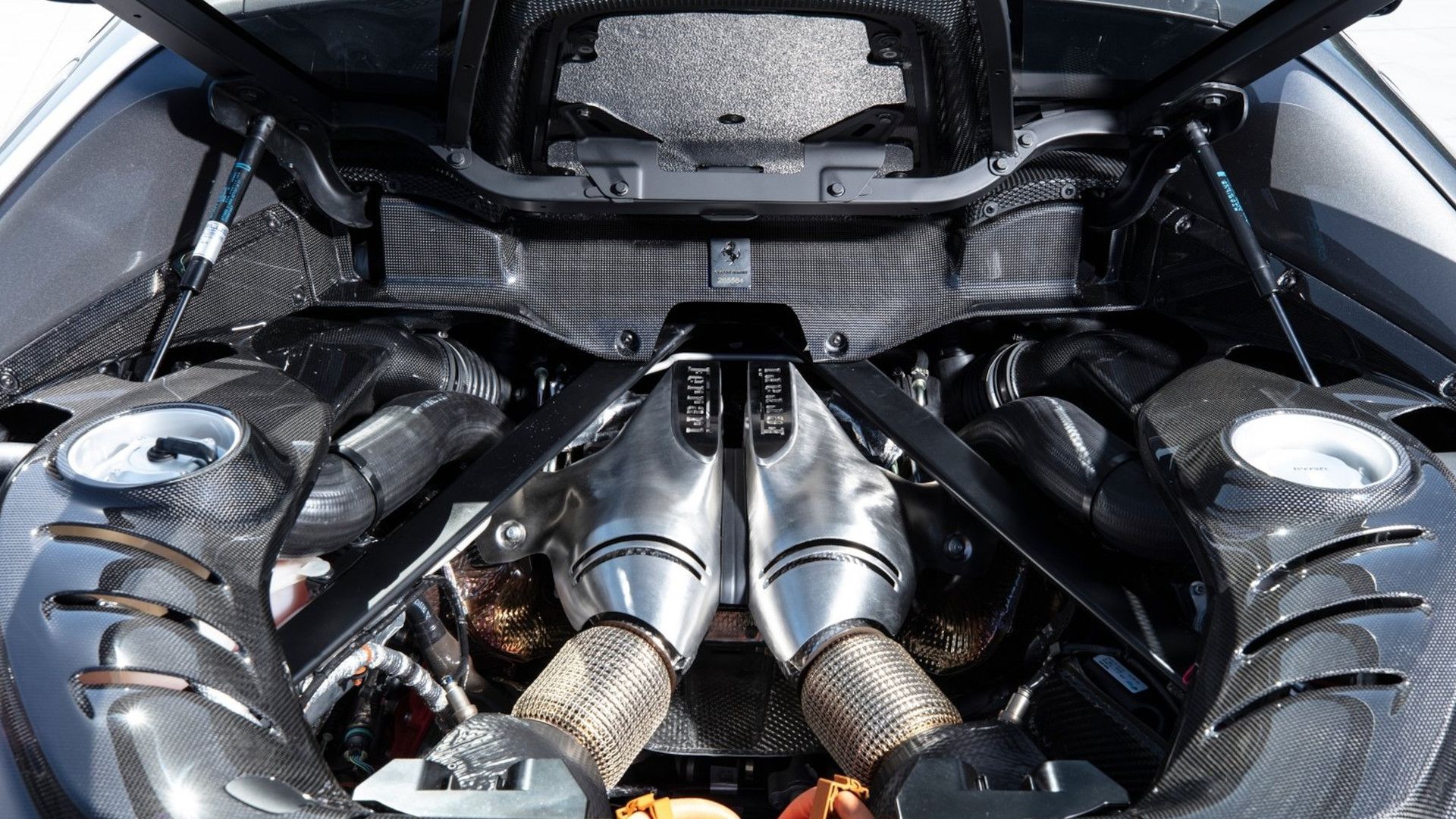
The Most Power-Dense V6 Available In 2024
Making a huge power output from a given engine is all well and good, with manufacturers such as Hennessey able to extract 1,817 horsepower (hp) and 1,193 lb-ft of torque out of a 6.6-liter V8. This is thanks to the incredible work of two turbochargers on a relatively large engine. Power density, however, is all about how much power an engine can make with the least amount of displacement.
Related
The Most Power-Dense Production Engine In The World Comes From America
When it comes to production engines with the most horsepower per liter, it’s not Koenigsegg, Hennessey, or even Bugatti that takes top honors.
Power-per-liter is a common measurement, with one of the first milestones being 100 hp-per-liter. One of the first cars to achieve this was the 1986 Ford Sierra RS Cosworth, followed by other cars including the Daihatsu Charade GTti and Porsche 959. So, when it comes to power density, the size of the engine is not as important as the power it can make from a given size. The Daihatsu Charade GTti only had a 1.0-liter, 3-cylinder engine yet made 100 hp thanks to its turbocharged twin-cam setup.
That was towards the end of the ’80s. Today, there are many hypercars and sedans capable of producing around 200 hp-per-liter, which includes one of the most power-dense car engines ever: the Ferrari 296 GTB’s Tipo F163 hybrid V6.
Most Power-Dense V6 Car: Ferrari 296 GTB (218 HP/Liter)
It may come as a surprise that the most power-dense V6 is from a plug-in hybrid vehicle (PHEV), but this is no average hybrid V6. It’s a twin-turbo Ferrari V6, called the Tipo F163. While the overall power output of the Ferrari 296 GTB is 819 hp, the ICE (internal combustion engine) still offers up to an incredible 654 hp, which means the 3.0-liter engine has a power density of 218 hp. That is enough to win it the title of the most power-dense V6 production car available to buy today.

Related
The Most Power-Dense V12 Available In 2024 Is A Sky-High-Revving Beast
Among the remaining cars available in 2024 that are powered by V12 engines, which of them feature the most power-dense engine?
Aside from its hybrid powertrain, the 296 GTB is also notable for being the first six-cylinder Ferrari road car since the Dino models from the late ’60s and early ’70s. But 2024 is a different place and downsized, turbocharged engines are the new normal. Following in the footsteps of the SF90 Stradale, it harnesses the power of hybrid technology to achieve its remarkable performance: a 205-mph top speed and 0-60 mph in as little as 2.4 seconds. Available as the GTB coupe or the GTS folding metal roof variant, the 296 gets its name from the 2.9-liter displacement and its 6-cylinder engine layout, although the engine is essentially 3.0 liters in capacity.
The F163 Engine In A Little More Detail
|
Ferrari Tipo F163 |
|
|---|---|
|
Engine |
3.0-liter, twin-turbocharged V6 (+ hybrid motor) |
|
Bore / Stroke |
88 mm x 82 mm |
|
Block design |
120-degree ‘Hot-Vee’, DOHC, aluminum block/heads |
|
Power |
654 horsepower (total 819 hp including 165-hp e-motor) |
|
Torque |
546 lb-ft of torque (+232-lb-ft e-motor) |
|
Drivetrain setup |
Rear-mid-engine, RWD (+ e-motor) |
|
Transmission pairing |
8-speed DCT automatic |
This is a noteworthy Ferrari engine for a few reasons, starting with the fact that it’s a turbocharged 6-cylinder. It’s the brand’s first turbocharged V6 for a road car, and it also breaks away from tradition with its 120-degree engine block. The iconic Dino models used a novel 65-degree engine block while the F163 has its cylinder banks separated at a 120-degree angle. This was done to place the turbos in a ‘hot-vee’ between the cylinder banks.

Related
The V6 That Won Engine Of The Year More Times Than Any Other
Nissan’s V6 engine is reliable, powerful, and durable enough to feature in a wide array of different vehicles from trucks to sports cars.
According to Ferrari, it makes the engine more compact and also optimizes the airflow between the turbos and the exhaust. The Tipo F163 has an 8,500-rpm redline and is supplemented by the 165-hp e-motor. The humble little motor can also propel the vehicle on its own, albeit for only 15 miles. So it’s an epic engine and not so much a planet-saving hybrid, but the F163 is an impressive feat of engineering either way and as dense as they come.
How It Compares With Mercedes-AMG One (353 HP/Liter)
|
Mercedes-AMG ONE |
|
|---|---|
|
Engine |
1.6-liter, turbocharged V6 hybrid (4 electric motors) |
|
Power |
566 hp (1,049 total) |
|
Torque |
N/A (not calculable) |
|
Drivetrain |
Mid-engine, AWD |
|
Transmission |
7-speed automatic (automated manual) |
|
Top Speed |
219 mph |
Technically, the Ferrari F163 V6 isn’t the most power-dense V6 to be used in a production road car. That honor goes to the Mercedes-AMG ONE, which takes the crown as the most power-dense engine ever. Sadly, the One is sold out, so it’s no longer available. Even so, it’s worth a look, since it doesn’t so much surpass the Ferrari’s power density as much as obliterate it. It’s all thanks to the ONE’s Formula 1-derived, 1.6-liter, turbocharged V6.

Related
The Most Power-Dense Engine In A Production Car Ever
This engine takes the prize for the most power-dense unit ever produced.
Although it has less power at 556 hp, thanks to its tiny capacity, it is far more power-dense than the Prancing Horse’s V6. Carried over largely intact from a Formula 1 car, the PU106B is modified to last 31,000 miles between rebuilds, which for an F1 engine is no mean feat. Still, it is a complex car that you need to treat with respect. It works alongside a total of 4 electric motors, sending the One to 124 mph in 7 seconds, and on to a top speed of 219 mph. It is one of the most boosted cars ever sold too, with up to 50 psi of pressure. To put the Mercedes-AMG One’s power output into perspective, the Ferrari F163 only makes 15% more power, even though it is 87.5% larger.
Other Powerful 6-Cylinder Cars
Maserati MC20 – 207 hp/liter
|
Maserati MC20 |
|
|---|---|
|
Engine |
3.0-liter, twin-turbocharged V6 |
|
Power |
621 hp |
|
Torque |
538 lb-ft |
|
Drivetrain |
Rear-mid-engine, RWD |
|
Transmission |
8-speed DCT automatic |
|
Top Speed |
202 mph |
At first glance, this Maserati’s spec sheet might seem very similar to the Ferrari 296 GTB, and we’d be right to suspect this, since the two companies have a history of sharing and playing nice together. But the Maserati ‘Nettuno’ V6 from the MC20 – and its folding roof version, the Cielo – is not an F163 with a different name. They do share the same bore, stroke, and cylinder spacing, but the block is 90 degrees rather than 120 degrees like the Ferrari engine. The Maserati MC20 is also not a hybrid, so it sports an overall lower power output. However, with 621 hp on offer from the twin-turbocharged V6, it is one of the most power-dense 6-cylinders on sale, just behind the Ferrari 296 GTB’s 218 hp-per-liter with a 207 hp-per-liter power density. It’s good enough for a 2.9-second sprint to 60 mph and hit 202 mph with a long enough road.
McLaren Artura – 192 hp/liter
|
McLaren Artura |
|
|---|---|
|
Engine |
3.0-liter, twin-turbocharged V6 (+ hybrid motor) |
|
Power |
577 hp (691 hp total) |
|
Torque |
431 lb-ft (531 lb-ft total) |
|
Drivetrain |
Rear-mid-engine, RWD |
|
Transmission |
8-speed DCT automatic |
|
Top Speed |
205 mph |
This $250,000 supercar from the British marque is also a PHEV, with a similar rap sheet to the Ferrari. It is also a 3.0-liter, twin-turbocharged hybrid that sends its power to the rear wheels via an 8-speed DCT. Interestingly, the McLaren Artura also shares the 296 GTB’s 120-degree engine layout. They would be able to play on the same field, too, since the Artura can hit 60 mph in under 3 seconds and go on to 205 mph. The ‘Axial Flux’ e-motor is incorporated into the drivetrain in such a way that it also replaces the reverse gear.

Related
2025 McLaren Artura Spider First Drive Review: Time To Stop Calling This A Baby McLaren
McLaren has taken the top off of the Artura, but this is so much more than a new body style for McLaren’s junior supercar.
Thanks to the boosted V6, the Artura has one of the highest densities of any 6-cylinder on sale, but when it all comes together with the hybrid system, it is also one of the most powerful 6-cylinders too, with 691 hp. When it comes to this level of performance, all the engines on this list are hugely powerful, which makes the 296 GTB’s F163 even more impressive. It is very likely to be somewhat more reliable in the long run than the Mercedes-AMG ONE’s F1 engine. For some, the number of cylinders is still a lens through which to judge a performance car, but these V6 cars prove that it’s no longer the case.