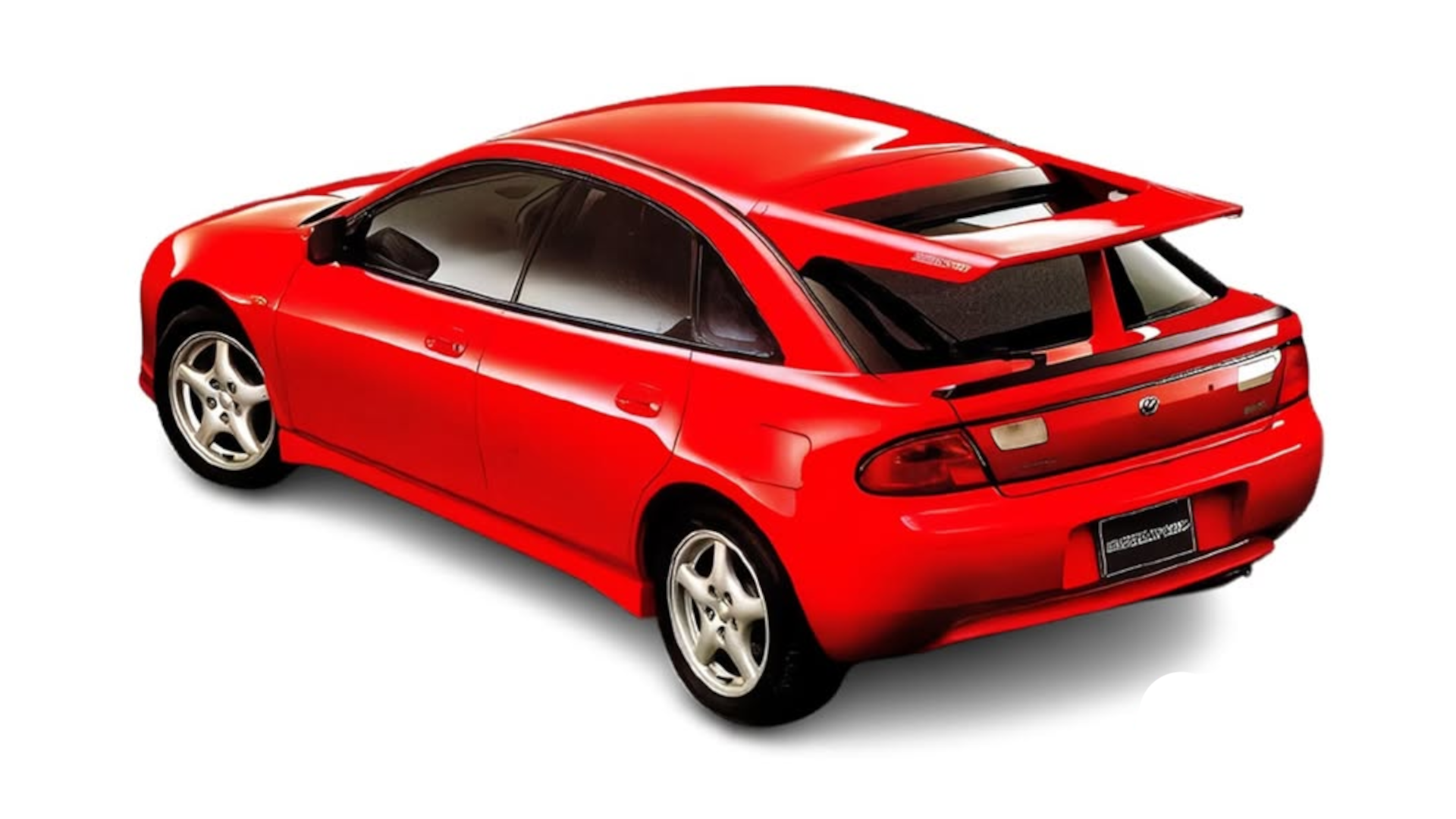
The Mazdaspeed Sedan You’ve Never Heard Of
The world of Japanese cars can be a weird and wonderful treasure trove, rich with models that never made it to the rest of the world (with the exception of the odd import).Today we’re focusing on one particular Mazda model that was only ever sold in Japan, the Lantis Type R.
The Lantis Type R is an even more obscure variety of an already-obscure model; the model was never sold in the US, and elsewhere in the world it was marketed under different names, so the Lantis name will not be familiar to many gearheads outside of Japan (although you can now import one under the 25-year rule). Let’s take a closer look at this high-performance hidden gem.
Mazda
- Founded
-
January 30, 1920 (as Toyo Cork Kogyo Co)
- Founder
-
Jujiro Matsuda
- Headquarters
-
Hiroshima, Japan
- Current CEO
-
Masahiro Moro
Meet The Mazda Lantis Type R
|
Mazda Lantis Type R Specs |
|
|
Engine |
2.0-liter V6 |
|
Power |
168 hp |
|
Torque |
133 lb-ft |
|
0-60 mph |
~7.7 seconds |
|
Top Speed |
~118 mph |
Most of us would normally associate the Type R label with high-performance Honda models, however, Mazda has also used this label for a souped-up version of one of its models: the Lantis. The Lantis is a compact car introduced in 1993 with a lineup of two body styles: a 5-door hatchback or a 4-door sedan. Four engines were available: three inline-four units (1.5-liter, 1.6-liter and 1.8-liter) and a 2.0-liter V6, which also powered the Type R; in the standard Lantis it produced between 144 and 160 hp. A 5-speed manual transmission and 4-speed automatic were available to choose from, for both the standard Lantis and the Type R.
The Lantis Type R was exclusive to the Japanese market; it was equipped with a slightly more powerful version of the 2.0-liter V6, which produced 168 hp. It also came with some mechanical upgrades compared to the standard Lantis, such as a limited-slip differential. A set of cosmetic enhancements were also fitted to the Lantis Type R; around the time the model was released, Mazda was starting to use the Mazdaspeed name for accessories and option packages, and as a result the modification package installed on the Lantis Type R was known as the “Mazdaspeed A-Spec Kit”. This package included features such as a floating rear spoiler, side skirts, colored front indicators, and a front lip spoiler.
The Lantis Type R also made some appearances in the world of motorsport; a Type R equipped with a manual transmission completed a lap of the Tsukuba Circuit in 1:14.17. The model was also employed by Mazda in local touring car races, most notably the Japanese Touring Car Championship. The Lantis Type R’s quarter-mile time has also been recorded at 15.9 seconds.
Different Names: The Lantis Around The World
Mazda has a long history of using different names for the same model around the world; badge engineering isn’t an uncommon practice among carmakers, but the Japanese company was an especially frequent user of this marketing technique in the 1990s. The Familia, for example, was also known as the Protege or 323, while the Capella was also known as the 626.

Related
The 10 Most Successful Mazda Models Ever Built
These are the most successful Mazdas ever made, based on volume.
There are several reasons why an automaker might choose to sell the same model with different names depending on geographical region. Cars sold in different markets can be equipped with slightly different cosmetic features or options, making it necessary for the brand to distinguish them; in other cases yet, names are tailored to local languages and cultures. Sometimes, automakers like to stick to a theme when choosing names for a model family; the Volkswagen Jetta, for example, has had several names in different markets around the world, many of which are centered around the theme of wind (such as Vento or Bora, both words related to wind in a variety of European languages).
The Lantis is an example of the naming technique in action; “Lantis” was the name used in its domestic market of Japan, while in other parts of the world the model was known as the 323F (mainly in European markets), the Artis (in Chile), and the Allegro (in some South American countries).
Mazda’s Foray Into High Performance Motoring: A Brief History Of Mazdaspeed
The Lantis Type R is just a small part of Mazda’s wider history of producing high-performance models. Several members of the brand’s lineup have had a performance-oriented version over the years, most notably through the Mazdaspeed division and, in recent years, through its spiritual successor, Mazda Spirit Racing.
Mazda also has a long history in the world of motorsport, including a victory at the 24 Hours of Le Mans. Motorsport was the source of Mazda’s earliest venture into the world of high-performance motoring, a racing team called Mazda Sports Corner which was founded in 1967. This team was not created by Mazda itself, but by one of its distributors; it competed in both local and international races. In 1983, the name changed from Mazda Sports Corner to Mazdaspeed.
One of Mazdaspeed’s biggest motorsport achievements arrived in 1991, when the team won at Le Mans with the 787B. This was the very first time a Japanese team had won the legendary race; Mazda would remain the only one to do so until Toyota achieved its own first victory in 2018.
Mazdaspeed, however, was not all about motorsport. The brand name was also associated with performance parts and accessories, all approved by the company, of course, which could be fitted to several models in the Mazda lineup, such as the MX-5, the 626, and the Lantis/323. In 1991 Mazda brought Mazdaspeed’s operations in-house, taking full control of the brand. Shortly afterwards, the Mazdaspeed name began to appear on souped-up versions of Mazda production models, eventually becoming a synonym for the brand’s high-performance cars.
The Mazdaspeed division, however, would not last very long; it only continued to produce new models for around a decade. The last Mazda hot hatch (and last Mazdaspeed model), the Mazdaspeed3, was discontinued after the 2013 model year.

Related
Mazda’s Last Hot Hatch Is A Mighty Performance Car At A Great Price
The Mazdaspeed 3 disappeared in 2013, but it still retains a cult following and good value today. Is it a clever idea to buy one of these?
The Legacy Of Mazdaspeed: Mazda Spirit Racing
Last year, at the Tokyo Auto Salon, Mazda announced the creation of a new high-performance division, carrying forward the legacy of Mazdaspeed: Mazda Spirit Racing (MSR). The MSR name has similar origins to Mazdaspeed: it had first been used for a motorsport team, competing in the Japanese Super Taikyu series, and three years later Mazda began to use it for high-performance production cars. Four MSR variants of existing Mazda models have been introduced so far.
MSR MX-5 (MSR Roadster/MSR Roadster 12R): When the MSR brand was introduced to the world, one of the concept cars presented as part of the big reveal was the “RS Concept” a predecessor to not one but two high-performance versions of the MX-5 Miata: the MSR Roadster and the MSR Roadster 12R.
Both are equipped with new brakes, suspension, and tires, as well as several aerodynamic upgrades. The Roadster produces the same amount of power as the regular Miata (181 hp), while the 12R, named after the #12 race car that competes in the Super Taikyu series, produces 197 hp.
MSR 3 Concept: The other car presented as part of the MSR introduction was the 3 Concept, based on the Mazda 3. The 3 Concept drew inspiration from the Mazda 3’s participation in the Super Taikyu racing series; although the full specs of the MSR 3 are still unknown, we do know the race car is powered by a 2.2-liter turbocharged diesel engine powered by biofuel. The 3 Concept is also fitted with a prominent carbon fiber rear wing.
MSR CX-60: The most recent MSR model to be introduced, the MSR CX-60 is a high-performance version of the CX-60 crossover SUV, which is not sold on the American market. It is equipped with bucket seats and a large spoiler, as well as custom decals and badging, but is powered by the same engine found in the standard version of the model.
Sources: Mazda, Curbside Classic