
The Ford Mustang GTD Has Already Trumped The Porsche 911 GT3 RS In One Key Area
The Mustang GTD’s claim to the top step of the Mustang range has been spoken about ad nauseam, but we’re not complaining. It’s one of the most anticipated and interesting vehicles to debut in the last two years, for good reason. The Mustang GTD is not only the most powerful rendition of the Stallion nameplate, but also the most capable. Compared to the standard ranks that line the Mustang stables, the GTD is a thoroughbred racehorse that has more in common with the firm’s GT3 race cars than anything else.
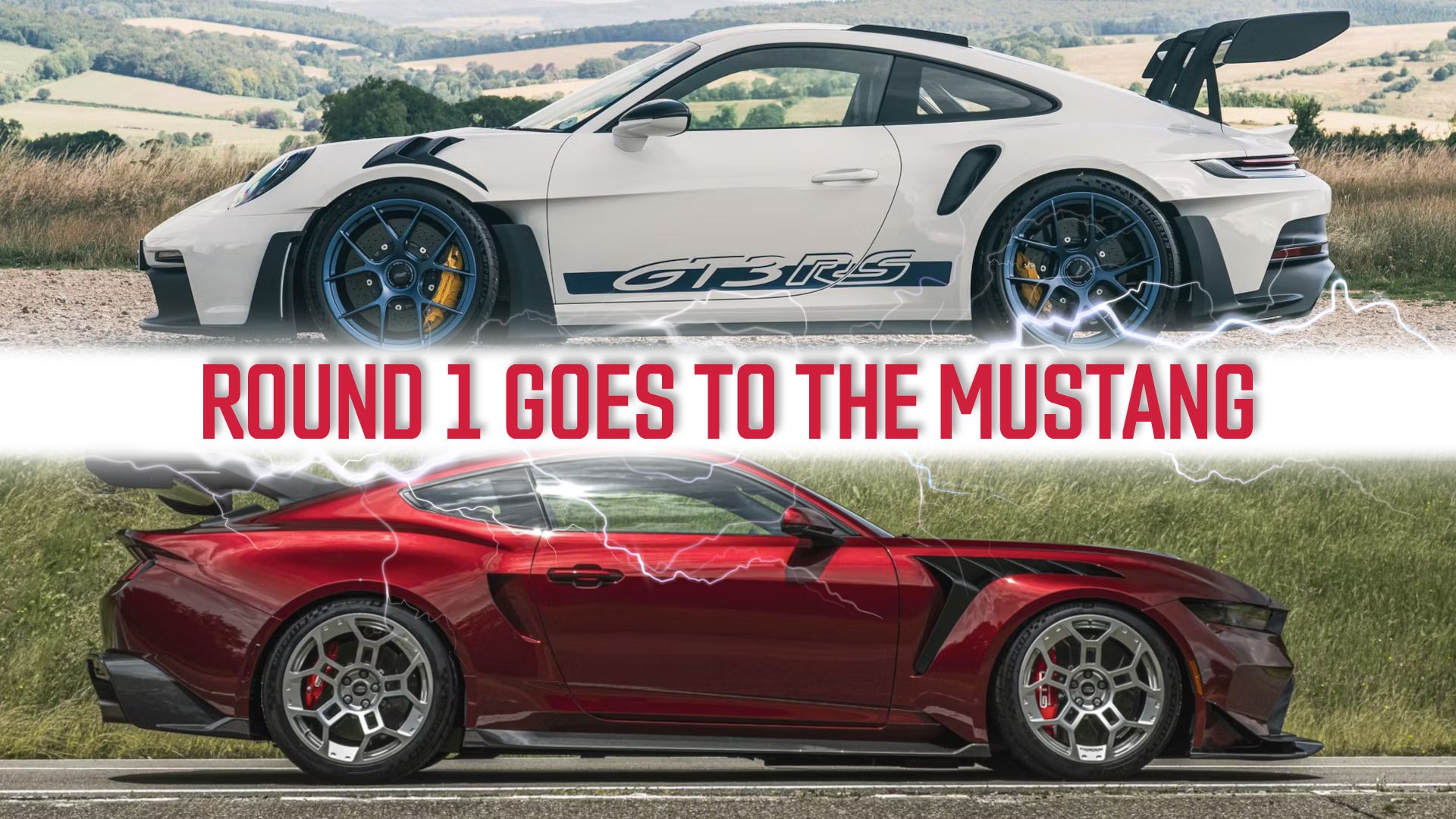
Ford’s obsession with trumping the Porsche GT3 RS with its latest GTD model is no secret. It is kind of one of the selling points of the Mustang GTD and the main thing Ford keeps hammering at is the GTD’s apparent ability to set a sub-7 minute lap around the Nürburgring. The American automaker has offered a glimpse into the performance of the pinnacle of the Mustang family, and has, at least, beaten the GT3 RS in one key aspect. Power. Specific power output, to be more, erm, specific.
Power Is King
|
Model |
Ford Mustang GTD |
Porsche 911 GT3 RS |
|---|---|---|
|
Engine |
5.2-liter supercharged V8 |
4.0-liter NA flat-six |
|
Horsepower |
815 hp |
518 hp |
|
Power Density |
156.7 hp/liter |
129.5 hp/liter |
|
Torque |
664 lb-ft |
342 lb-ft |
Ford’s single-minded desire to outperform the Porsche GT3 RS has yielded some success for the firm. Now that its power figures have been unveiled, the GTD has the GT3 RS beat in pure power output and power density. It shouldn’t come as no surprise as the track-focused Porsche does have less displacement, fewer cylinders, and no whining inhaler strapped to its engine to eke out even more power. That said, the flat-six is capable of generating a maximum output of 518 hp, which means that it generates 129.5 hp/liter, while the standard GT3 musters 125.7 hp/liter.
The Mustang GTD’s power-laden V8, with its rear-wheel-burdening 815 hp output, generates 156 hp/liter, which is more than some exotic supercar engines are capable of. Regardless of the differences in size and cylinder count, it is a small win for Ford in its one-sided contest against the GT3 RS. What will be the real deciding factor will be Ford’s attempt at a sub-7minute lap around the Nürburgring. For context, the GT3 RS has already set an official time around the ‘Ring, netting a time of 6:49.328 minutes. Going around in less than six minutes is a stunning achievement, reserved for only the best. Other cars that managed to do the same include the Porsche 918 Spyder, Lamborghini Huracán Performante and Aventador SVJ, the Mercedes-AMG GT Black Series, and the current record holder, the AMG One.
Whether the GTD’s high horsepower V8 engine, transaxle system, and carbon fiber body will allow Ford’s super stallion to achieve the below 7-minute promise remains to be seen.
At The Heart Of The GTD
Hulking engines accompanied by whining superchargers are almost commonplace within Ford’s lineup, but even so, the Mustang GTD’s V8 is a step above the rest. It is a derivative of the Predator engine subspecies, which itself is an offshoot of Ford’s Coyote engine family. Before the arrival of the GTD, the most potent iteration to spawn from Ford’s lineup was the sixth-generation GT500. Founded on the underpinnings of the S550-generation Mustang, the GT500 was a monster. Apart from its aggressive design, was the powerful 5.2-liter supercharged V8 that afforded its seemingly unending grunt.
Powering the GT500, the supercharged V8 produced 760 hp and 625 lb-ft, an astounding output that no model at the time was able to even come close to. However, as the saying goes, there’s always a bigger fish, and that bigger fish is the Mustang GTD. It employs the same 5.2-liter supercharged V8 as the GT500, although with a few noticeable changes. There were a handful of hardware changes introduced to the GTD’s V8, which include a smaller supercharger pulley, revised intake and exhaust systems, and an accompanying titanium exhaust system. One of the most notable additions was the dry sump oil system, which is the first of its kind to be equipped with a road-going Mustang and allows for a higher redline than what was offered in the GT500. 815 hp and 664 lb-ft is the result of the added hardware, and it can be enjoyed all the way to the 7,650 rpm redline.
It’s hard to get attention at the Goodwood Festival of Speed. You’re literally standing in a pitlane where you can see a Czinger 21C, a McLaren Solus GT, the entire GMA collection, and a Pagani Utopia. But every single time the GTD started its engine, everyone within a 600-foot radius knew about it. It got all the attention because it was so loud and obnoxious. This is not a criticism. To lure people away from all of that unobtanium with a Mustang is quite the feat. As you can imagine, the GTD is extremely loud. It’s that typical old-school supercharged V8 noise, including a little bit of whine followed by Spitfire noises coming out of the exhaust pipes. How this car is road-legal, I don’t know. Ford probably used a GTD to drown out the verbal complaints made by government health and safety minions. – Gerhard Horn, Senior Editor
Flat-Six Stalwart
Porsche’s flat-six engine needs little introduction. The engine configuration has been the driving force of numerous beloved and revered vehicles over the years, with its omnipresence in the range beginning in 1963 and pioneered by the iconic 911 moniker. In the same way, the Mustang GTD is the head of its household and zenith of the Mustang lineage, so is the 992 GT3 RS in the 911 family. Many models have come and gone. The GT2 RS from the previous generations was, and still is, one of the most absurd models offered by Porsche. While it was known for its Turbo S-derived vigor that could split tarmac, the GT2 RS was like a muscle-bound Olympic-level shot-putter, the GT3 RS is a toned and precise javelin thrower.
Unlike the Mustang GTD, the GT3 RS forgoes the need for a forced induction system and relies entirely on the abilities of its flat-six engine. The all-aluminum water-cooled engine features four valves per cylinder, a bore x stroke of 102 mm x 81.5 mm, a dry sump oil system, a variable intake manifold, variable camshaft controls, and a 9,000 rpm redline. The increase in power compared with the non-RS counterpart is mostly a result of the new camshaft featuring modified cam profiles. Its performance is also improved by the introduction of a single-throttle intake system and rigid valve drive which was sourced from the firm’s motorsports offerings.
The 4.0-liter flat-six in the Porsche 911 GT3 and GT3 RS is a masterpiece. Porsche could have saved some cash and used one of the turbocharged engines now available on every other 911, but that would have gone against what the GT3 and its hardcore brother stand for. In the interest of providing the most direct throttle response, the ability to rev to 9,000 rpm, and a noise that gives your soul an erection, the Germans eschewed the easy route and built this model-specific engine. It’s so special, it’s built on the same factory line Porsche uses to produce the engines for its GT3 Cup Racing Car. – Gerhard Horn, Senior Editor
Add CarBuzz to your Google News feed.

