
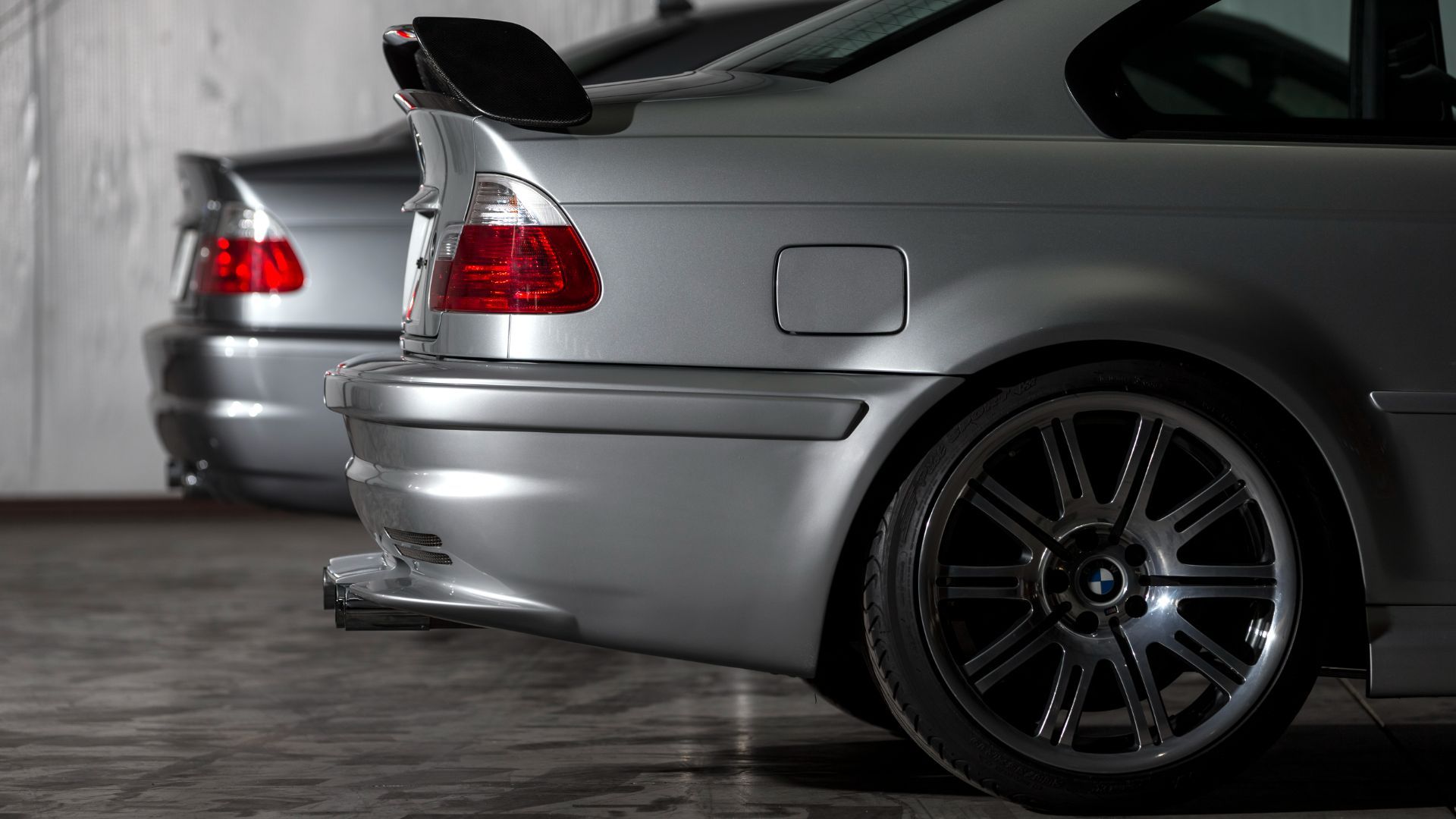
The First Road-Legal BMW M3 With A V8 Isn’t The One You Think
In the same way that flat-six engines are considered stock-in-trade for Porsche 911s, the same can be said for straight-sixes being synonymous with the BMW M3. That is, of course, excluding 1986’s pioneering four-cylinder E30 M3, which had two cylinders short of six, and the E90/92/93, which doubled that count to eight 21 years later.
When BMW had to decide on a successor for the E46 M3 that was retired in 2006, it was facing a crisis and opportunity in equal measures. The M3’s rivals, the Audi RS4 and then-upcoming Mercedes C63 AMG, were both V8-powered, and the Bavarians were suffering from cylinder envy. On the other hand, they already had the V10 from the M5, which they ultimately reapportioned as a V8 in the M3 between 2007 and 2013.
Successively, the E9X’s F80 successor, reverted to BMW’s trademark straight-six engine in 2014, albeit with turbocharging, leaving the fourth-gen iteration as the only-ever V8-engined series production M3.
This article explores the history of the first BMW M3 to be fitted with a V8 engine.
Except There Was One Other. Well, Kind Of
Similar to the Porsche 911, much of the M3’s appeal lies in its legacy of hard-fought racing victories across decades. The Motorsport division used to exist as a parallel affiliate responsible for the company’s competitive and skunkworks exploits.
In response to Porsche dominating the GT class in the 2000 American Le Mans Series (ALMS), BMW grew frustrated with their M3 GTR’s 3.2-liter six-cylinder engine lacking the firepower to outrace the 911 GT3-Rs. The E46 M3 road car, on which the race car was based, had just launched that year and was already being shown a clean pair of heels on track by the pesky Porsches.
Clearly, something had to be done.

Related
Here’s What Makes Every Generation Of BMW M3 Special
If you were to create a single M3 with the best traits from every generation that’s ever existed, what would it look like?
BMW’s response came at the second race of 2001, where they unveiled a four-liter, 460-hp V8 version of the GTR for that season. Only for that car to be eligible to race in its class and not be classified as a prototype, it needed a road-going equivalent as there was no production-based V8 M3.
As the M3 GTR V8’s unveiling at Sebring that year triggered the countdown, under the series’ homologation regulations, the company then had just 10 months to produce a minimum of 10 street-legal versions. Seven months later, on the eve of the ALMS season closing at Petit Le Mans, BMW presented the first showroom-ready M3 GTR Strassenversion (“Street Version”) at a faintly ridiculous 250 000 Euros (about $230 000 at the time) – more than five times the cost of a 3.2-liter M3.
|
BMW M3 GTR |
|
|
Engine |
Four-liter, naturally-aspirated V8 |
|
Power |
350 hp @ 7250 r/min |
|
Torque |
269 lb-ft @ 5000 r/min |
|
Transmission |
6-speed manual, two-disc motorsport clutch, limited-slip differential |
|
Top Speed |
198 mph |
|
Tires |
225/40/19 (F) 255/35/19 (R) |
As the ultimate road-going racing unicorns, from the 911 Strassenversion to the Mercedes CLK GTR, the Toyota GT-One and even the R32 Nissan GT-R, homologation specials are solely devised for compliance – and zero consideration for marketing or profit.
Or production sensibilities, for that matter.
The hand-crafted M3 GTR joins this ultra-exclusive club. Key to its existence is the race car’s dry-sump, 90-degree, PB60B40 V8 engine, which was detuned for noise and emissions to produce 350 hp. The engine was not used in any other production BMW.

Related
The Coolest Classic Cars Were All Homologation Specials
Don’t think so? Then check out this lot.
Other components were direct carry-overs: the slatted hood, roof and bumpers were made from composites. Exquisitely spartan with no stereo, AC or rear seats, the weight was whittled down to 2967 lbs – 408 lbs lighter than its tamer 3.2-liter namesake of the time.
The standard front seats were ripped out and replaced by leather-skinned racing Recaros; the stiffened chassis and near-track-ready suspension all being telltale indicators of the cursory road-legal effort that went into the M3 GTR as nothing but a mere box-ticking exercise.
Why Can’t I Buy An M3 GTR?
On the day of its unveiling at Petit Le Mans at the end of the 2001 season, the M3 GTR Street Version is allegedly to only have been kept on display for an hour before being hurriedly whisked away back to Germany and never to be seen again, with deliveries promised to start the following year.
A rumored 6 examples actually did make production as test mules, but were either eventually crushed or disassembled for parts. The remaining three are all in the company’s possession and can be seen in the BMW Group Classic collection.
All of which cements the rarity of the first-ever road-legal V8 M3.
Yet there was another – outside – intervention that essentially rendered production of any more examples futile. So devastating was the track M3 GTR’s dominance of the 2001 ALMS GT class, that Porsche protested the production version’s low-volume requirement. In the end, they successfully lobbied that BMW must build a minimum of 100 units and a further 1000 engines instead of the then-just 10 examples of the M3 GTR Strassenversion.
BMW refused and chose to withdraw from the 2002 series, thereby unshackling themselves of the burden of having to build any more M3 GTRs.

Related
BMW’s M3 Pickup Concepts Weren’t Just For Show
Not one, but two M3-based pickups have been built over the years. And they weren’t just display pieces, but they earned their keep, too.
Days Of Thunder
Nostalgia and myth aside, considering the fabled beast’s pie-in-the-sky sticker, it’s pretty obvious that BMW never really had any intention of selling the car in the first instance, solely manufacturing it as a measure of compliance to go racing.
Is the M3 V8 Street Version the rarest limited-edition BMW of all? In all likelihood, yes.
The 507 Roadster (252 built), E92 M3 GTS (150 built) and F82 M4 GTS (803 built) all deserve an honorable mention.

Related
The 10 Rarest BMW M Cars Ever Made
All BMW M cars are equal. Some are just more equal than others. This here are some of the more equal ones…
The difference is that all of these are in existence and can be obtained with the right powers of persuasion (and obviously, purchasing power), whereas the M3 GTR was never anything more than just vaporware.
What it will never cease to be, though, is a powerful reminder of BMW’s relentless will to succeed in racing, in a different and simpler time when motorsport success under the once-sacrosanct M badge was hunted at any cost; but also more wistfully – without which the world’s an infinitely poorer place today.
Sources: BMWblog.com, BMW-M.com, BMW Press, BMW Press, Supercars.net

