
The Audi TT Was Almost Turned Into A Porsche
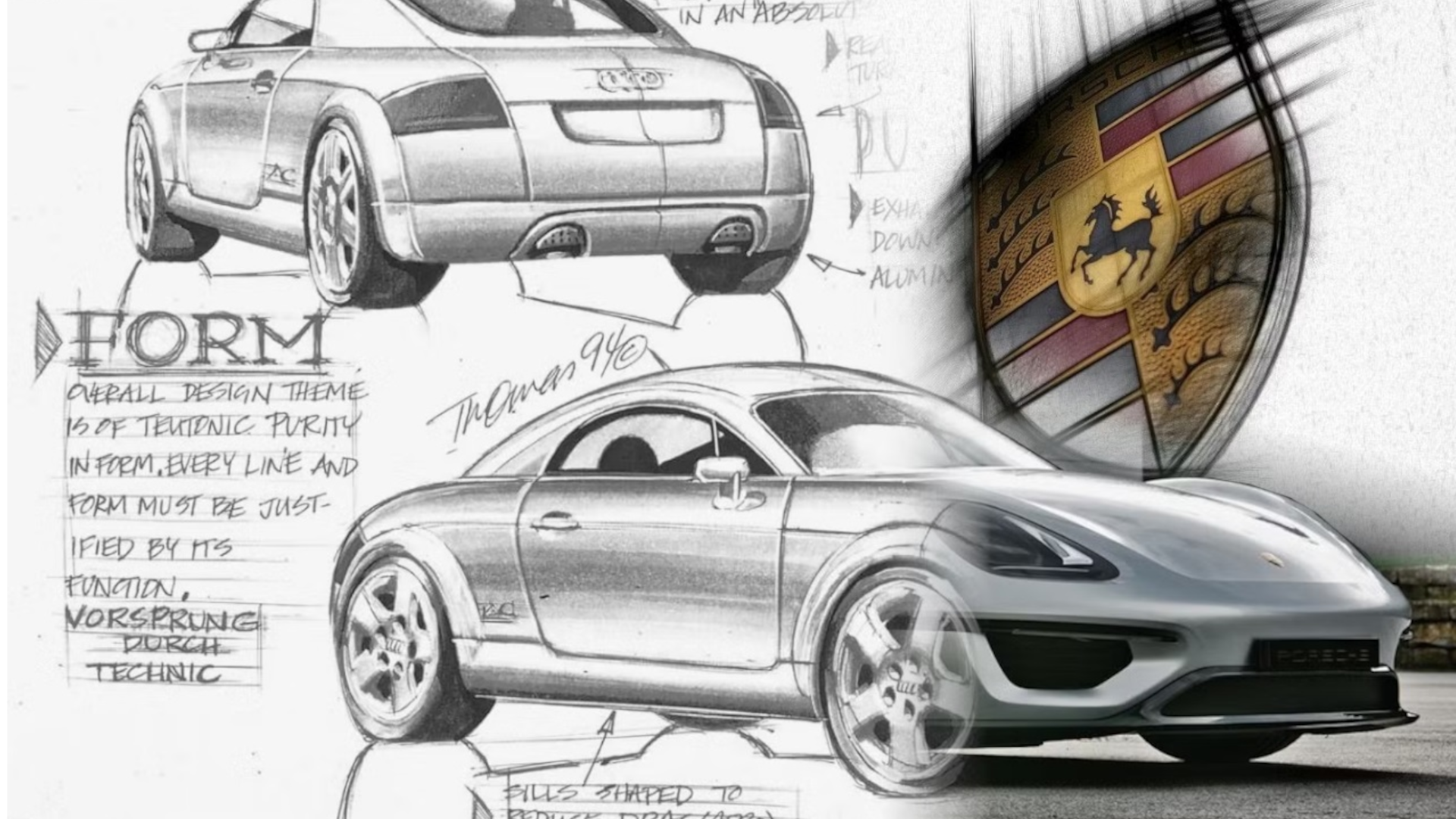
The original Audi TT is arguably the German automaker’s most iconic design, penned by American designer Freeman Thomas. But did you know that the TT almost wore a Porsche Crest? During a driving event to celebrate the TT nameplate (and wave goodbye to it before it goes away), Thomas told CarBuzz that he was asked to sketch the car in two different styles: Audi and Porsche.
“I was asked to do a Porsche version and an Audi version, and [the Porsche designers] in Weissach were also asked to do a Porsche version and an Audi version,” Thomas explained. “And because I came from Porsche, I knew their design language and said to J Mays (Audi’s then-design director), ‘this is what they are going to do, and this is what we are going to do.’ We kept to this Bauhaus absolute design and theirs was very styled.”
-
Audi
Audi is a German automaker that produces a range of luxury vehicles that combine sporty driving dynamics with the latest technology. Its history goes back over 100 years and includes both production cars and a rich racing heritage.
- Founded
-
1909
- Founder
-
August Horch
- Headquarters
-
Ingolstadt, Germany
- Owned By
-
Volkswagen Group
- Current CEO
-
Gernot Döllner
-
Porsche
Porsche is a German sports car manufacturer and part of the broader Volkswagen Group since August 2012. Founded in 1931 by Ferdinand Porsche, the brand is most famous for the 911 line of sports cars, which first launched in September 1963. But it was the Porsche 356 that came first, and subsequently, Porsche has expanded its model lineup to include a variety of sports cars, supercars, SUVs, sedans, and even EVs. Porsche has a rich history in motorsport, with 19 outright Le Mans victories to its name, among various other titles.
- Founded
-
1948
- Founder
-
Ferdinand Porsche
- Headquarters
-
Stuttgart, Germany
- Owned By
-
Volkswagen
- Current CEO
-
Oliver Blume

How Audi Kept Their Design
“We had a big meeting in Ingolstadt. Very private. Just [Porsche’s] group and our group,” Thomas recounted. “We had two scale models, and they had two scale models, both very detailed. If the meeting went well, it would go to the next level. But the meeting didn’t go very well because there was a lot of politics going on.”
Thomas said that the models shown in the first meeting were convertible Spyder models. “We had the coupe too, but the meeting didn’t go well. So we never shared the coupe with [Porsche]. There was a second meeting in Stuttgart; they wanted to limit Audi in not having the all-wheel drive and lower horsepower. We told them everything was off, but we are going to [the Frankfurt Auto Show] and beginning the full-size [model]. Porsche had no idea we were doing this. We developed the coupe first. That was at Frankfurt 1995; it surprised everybody.”
Audi later went to Tokyo with the TTS Roadster Concept and the rest is history. Thomas and his team won the battle to keep the TT under the Audi brand.
Two Very Different Cars From The Same Mothership
“We went to Italdesign and I got to know Giorgetto Giugiaro very well,” Thomas recollected. “I remember presenting the [TT] to him and asking him ‘What do you think?’ He said ‘I wouldn’t change a line.'” That pretty much sums up the Audi TT, which was very much a style over substance kind of car, and the polar opposite of the coupe and roadster that followed from Porsche’s side. We’ll cover the Porsche Boxster first, because its development predates the Audi by three years.
A Mid-Engine Roadster Built With Toyota’s Help
In the early ’90s, Porsche was fairly close to going under. The 928 wasn’t selling very well, which meant the Porsche 911 had to keep the company afloat. The Germans knew that a high-end sports car couldn’t keep the company going, and it needed something more affordable to pay the bills. Before Audi and Porsche collaborated on a design, Porsche already showcased the Boxster concept in 1993. The response was extremely positive, so Porsche decided to go ahead and build the thing. But because money was tight, the Germans approached the masters of mass production. Porsche consulted with Toyota on how to produce the 986 Boxster and 996 911 more efficiently, which caused the design controversy.
You see, the Boxster was a Porsche 911 from the bumper to the A-pillar, and from there it went in a different direction. Although Porsche wanted to save money on the design, it spent cash where it really mattered. It went for a mid-engine setup, which remains the best layout for a low center of gravity, ideal weight distribution, and neutral handling. It didn’t matter that the car looked the same whether you viewed it from the front or rear. The driving experience more than made up for it.
Another cost-saving tactic was to use the same flat-six engine as the 911, albeit in a smaller capacity. The 911 was equipped with either a 3.4 or 3.6-liter naturally aspirated or turbocharged flat-six engine, while the first batch of Boxsters had to make do with a 2.5-liter. Porsche added a 2.7 and 3.2 in 2000. The outputs of these engines were never allowed to anywhere near 911 territory, for obvious reasons. Thanks to the mid-engine layout, the Boxster was arguably a better car than the 911, and if it was equipped with the same engine, customers would no longer have a reason to buy the more expensive car.
The Boxster went on sale in 1996, a full three years ahead of the TT. It quickly became the default sports car, which is a title that it still arguably holds to this day. While many credit the Cayenne for saving Porsche, the 986 Boxster also deserves some credit.

Related
How A Sports Car And SUV Saved Porsche From Bankruptcy
The brand wouldn’t be what it is today without these models.
The Audi TT Had A Rough Start
Audi’s TT is one of very few cars that reached production looking pretty much the same as the stunning concept. That was already a big selling point, which the TT needed because the rest of the car was a bit mediocre. Audi also wanted to save money, so the TT used the same powertrain as the Golf 4. It had a transversely mounted 1.8-liter turbocharged four-cylinder engine in the front in two states of tune. The lesser model only produced 178 hp, and quattro all-wheel drive was only an option. America only received the more powerful 222 hp version, which boasted AWD as standard.
But the TT was lucky to reach the USA at all. Early models became notorious for killing a few people. Apparently, the car didn’t like high-speed lane changes, sharp turns, and was prone to lift-off oversteer.

Related
Audi TT Coupe Generations: Everything You Need To Know In One Place
Audi’s curvaceous sports car never lost its Bauhaus design roots as it matured over the years, giving us three generations along the way.
Audi recalled the car and equipped it with stability control and a rear spoiler. Some changes were made to the suspension, too. This kind of bad reputation should have killed the car, but it once again proved that if you look good enough, you can basically get away with everything.
Like the Boxster, the Audi was an instant hit, but for very different reasons. The Porsche had substance, but the Audi had style. Less than a year after the coupe went on sale, the roadster followed. It was the go-to car for young urban dwellers who didn’t have kids. It announced to the world that you were trendy above all else. Looking back, there’s nothing really special about the TT. It was a glorified Golf, and yet we still want to own a first-generation model. Badly.
Why Did Porsche Wait So Long To Make A Coupe?
If we look at the first-generation TT’s sales figures, we see that the coupe consistently outsold the roadster by a ratio of 2:1. That’s probably because it looked better, but we can’t discount the additional safety and practicality. Those rear seats don’t look like much until you chuck the first bag of shopping back there because you’re too lazy to open the trunk. Why didn’t Porsche follow the same route with the Boxster?
Porsche has never stated why, but it’s easy to figure out. The facelifted 986 Boxster made its debut in 2002, at which point Porsche was already busy developing the 987. It was showcased for the first time in 2004 and went on sale in 2005. The first-generation Cayman went on sale a few months later. It has been a part of the range ever since, so the Germans obviously saw the upside of selling a coupe in addition to a roadster.
Again, Porsche followed the same recipe with the Cayman. It was powered by two flat-six engines, but not powerful enough to give the 911 a headache.
Audi Also Tried The Sporty Route
It seems Audi was perfectly happy selling a mediocre sporty-looking car that presented no threat to the Mazda Miata, which was the reigning champ at the time. The Boxster was in a price bracket slightly above, competing in its own little niche.
Audi tried to make the TT more sporty twice, however. The first was a one-off Audi built to celebrate 30 years of quattro. Since the TT was its most high-profile car in 2002, it was chosen to carry the flag. The 2.7T Quattro Concept wasn’t actually a TT, but rather a shortened B5 Audi RS4. Audi tried to transplant the 2.7-liter twin-turbocharged V6 from the RS4 to the TT, but it didn’t work. So the engineers shortened the RS4, and basically built a TT on top. There was no way this was going into production, so it tried again in 2003.
The 3.2 VR6 also wasn’t a great sports car, but it moved the segment forward in another way. The TT VR6 was introduced a few months after the Golf 4 R32, and both were equipped with something new called a DSG gearbox. The Volkswagen Group was the first to mass-produce a dual-clutch transmission, and the Audi was the second car to get it. Because of the heavier engine, the car wasn’t that much faster, but the DSG gearbox was widely praised as the next step forward in gearbox technology. You’ll find it in basically every supercar on sale today, but it made its debut in a humble hatch with which the TT shared most of its components.

Related
This Manual 5-Cylinder Turbocharged Sports Car Is A Superb Used Buy
You may have forgotten about it, but this little sports car deserves your attention.
The World Was Lucky To Have Both
The TT is now dead because the appetite for sports cars no longer exists. The next-generation Boxster and Cayman will go electric, but we guess that’s the price of progress. We don’t know whether they’re any good because we haven’t driven them yet, and if anybody can figure an EV roadster out, it’s Porsche.
As for the TT, we’re sad to see it go. In terms of design, Audi never topped the first-generation, but each generation after was a little bit more fun, culminating in the ferocious TT RS and its mega turbocharged five-cylinder engine.

