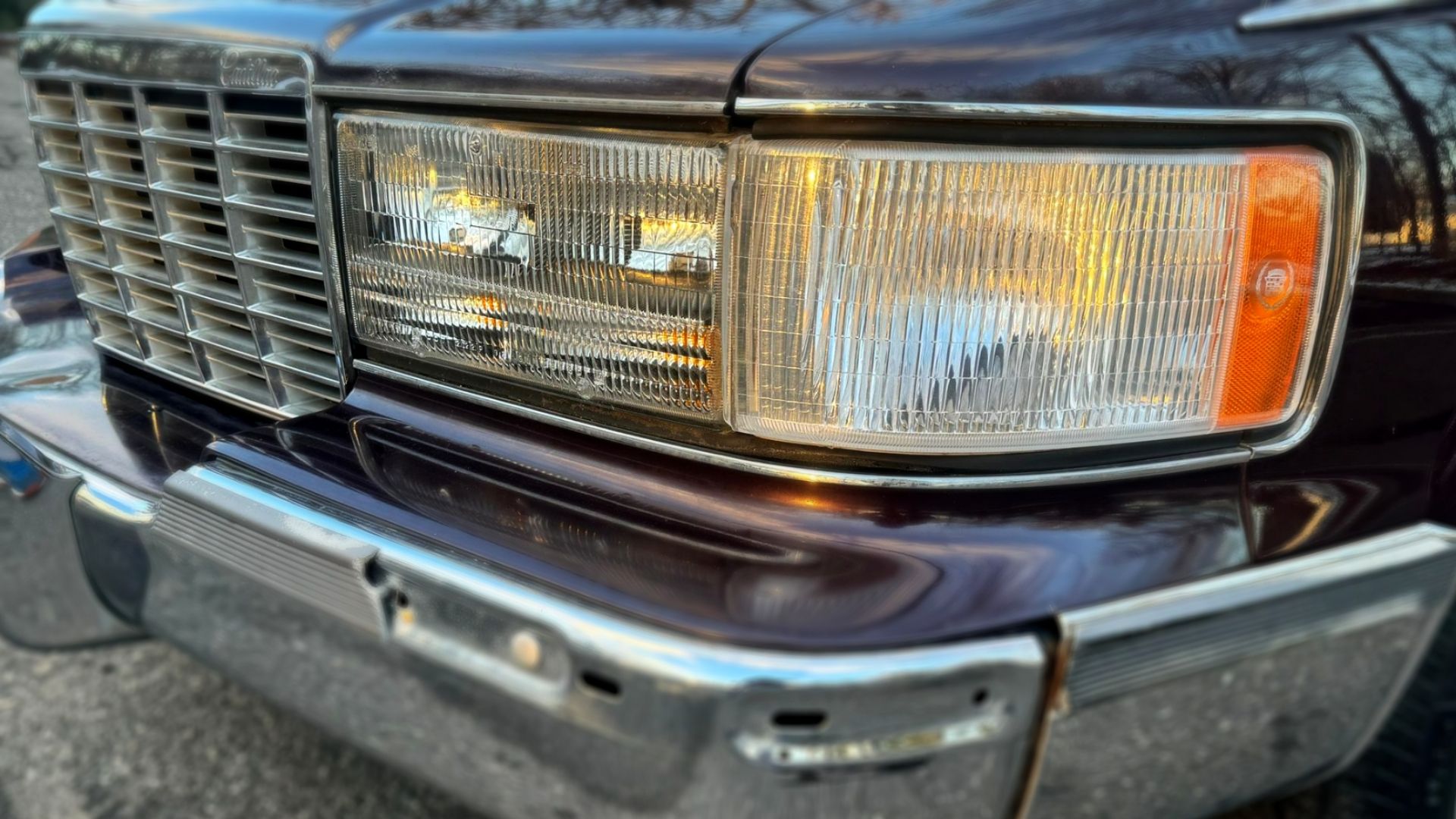
The 1990s Cadillac Fleetwood Was A Big Rear-Drive V8 You Can Buy For Cheap
Once upon a time, the rear-wheel-drive V8 sedan was the king of the road in the United States. Before the days of SUVs, minivans, and crossovers, the full-frame sedan was the transportation of choice for virtually every family in America. Some of these big four-doors were luxury-oriented, and Cadillac was the crème de la crème when it came to American luxury. The fact that everyone who didn’t have a Caddy wanted one in those days speaks a lot to the marque’s reputation.
As the 20th century drew to a close, more and more people were choosing SUVs and minivans for their family needs, and luxury buyers were beginning to lean more towards the sportier, sleeker European luxury model. The big-bodied American premium car market was quickly losing its grip. There were a few holdouts, and by 1996, Cadillac had just one old-school land yacht on offer. The model in question was the Fleetwood, and it still clung to the old ways regarding luxury cars. There was a V8 up front, a full frame underneath, and rear-wheel drive at the back.
A Nod Toward The Old Ways Of Luxury
1996 Cadillac Fleetwood Key Points
- Carries a current average used price of $4,671
- Features a 5.7-liter V8
- Offered in two trim levels
- Constituted the longest production car on sale at the time
- Built on GM’s D-Body platform
While the Fleetwood name saw its final use in 1996, it had been around for over 80 years at that point. The story of the moniker begins in 1925, when the GM-affiliated Fisher Body Company purchased the Fleetwood Metal Body Company. Back then, Fleetwood Metal was involved in metal fabrication, but once purchased by Fisher, the company began to produce bodies exclusively for Cadillac out of its Fleetwood, Pennsylvania, manufacturing plant.

From 1935 to 1985, Cadillac offered bespoke bodies produced by Fleetwood on many of its models, namely flagships, such as the forward-thinking Cadillac Eldorado Biarritz, Sixty Special, and Series 75 models. Being “Fleetwood-bodied” was a sort of badge of honor for Cadillac owners, as the builder’s stamp meant they owned the best of the best when it came to what Caddy had to offer. In 1985, the Fleetwood-bodied Cadillacs ceased to exist.
However, the Fleetwood name lived on. In 1985, the moniker arrived as a standalone model for the first time. The model was a front-wheel drive sedan riding on GM’s C-Body platform, which was also underneath the Oldsmobile Ninety-Eight and Buick Electra full-sized sedans. In 1993, Caddy introduced a new generation that switched to a rear-drive layout as a replacement for the automaker’s Brougham flagship model. The D-Body underpinnings were now specifically for this vehicle.

The ’93 Fleetwood was the longest mass-production vehicle to be sold in the US during this time. When it hit the market in 1993, the sedan was hardly inexpensive with a base price of $35,160, or about $75,691 in today’s money.
Detailed Specs & Features

Living underneath the 1996 Cadillac Fleetwood’s long hood was one of GM’s most famous mills, the LT1 V8, which replaced the earlier L05 V8. The LT1 belonged to the famous small-block V8 engine family, a grouping of motors that could trace its roots back to 1955. Because of the 1996 Fleetwood’s healthy amount of grunt, it was officially rated to be able to tow up to a maximum of 7,000 pounds, a rating that rivaled some light-duty pickup trucks produced at the time. Handling all the LT1’s power was a GM-built 4L60E four-speed automatic transmission.

Due to the exclusivity of the Fleetwood’s D-Body chassis, its suspension was unique when compared to other large, rear-wheel-drive sedans produced by General Motors at the time. Up front, the sedan took advantage of independent coil springs, deflected disc shock absorbers, and an air ride setup for the rear suspension. Stopping was taken care of courtesy of a pair of ventilated disc brakes up front, and a pair of drums at the rear.

At the time of its release, the Cadillac Fleetwood was the most powerful, rear-wheel-drive American sedan for sale. When compared to competitors like the Lincoln Town Car, which could only manage 210 horsepower and a 0-60 mph time of just under 10 seconds, the Fleetwood seemed like a sports car, even though it was a bit longer and roomier. Chrysler’s competing model, the LHS, wasn’t very close to being an adversary due to its use of front-wheel drive.
We’ll lay out the 1996 Cadillac Fleetwood’s detailed engine and performance specs, along with its original MSRP, in the table below:
|
Engine |
5.7L NA V8 |
|---|---|
|
Horsepower |
260 hp |
|
Torque |
330 lb-ft |
|
0-60 MPH Time |
8.5 seconds |
|
Top Speed |
108 mph (est.) |
|
Curb Weight |
4,448 lbs |
|
Original MSRP (1996) |
$38,420 |
*Specs courtesy of Kelley Blue Book & CarFolio.com
Features

The ’96 Cadillac Fleetwood came with a choice between two trim levels: base and Brougham. At the base level, buyers were treated to standard features such as leather seats, dual-powered front seats, a CD player, and automatic climate control. Side-stitched leather seating surfaces were seen, as well. The Brougham grade upped the luxury ante a bit with the addition of things like a full vinyl roof, gathered leather seat stitching, special C-pillar badges, and a six-way power driver’s seat.

Current Pricing
These days, you can find one of these old-school luxury Cadillac Fleetwoods for relatively cheap prices. We’ll include the 1996 Fleetwood’s average used pricing, along with pricing seen with the 1993, 1994, and 1995 model years, in the table below:
|
1993 |
1994 |
1995 |
1996 |
|
|---|---|---|---|---|
|
Current Average Pricing |
$3,844 |
$3,899 |
$3,979 |
$4,621 |
*Pricing courtesy of Kelley Blue Book
How The RWD, Body-On-Frame, V8 Luxury Sedan’s Legacy Continued

When the Cadillac Fleetwood retired following the 1996 model year, the sole remaining American sedan that fit the old-school bill of rear-wheel-drive, V8 power, and boasting a ladder frame was the Lincoln Town Car. Arguably, it was more popular than the Cadillac Fleetwood was in terms of sales.
Beginning in 1991, the V8 under the hood of the Town Car was a 4.6-liter mill. Specifically, the engine was the first of Ford’s Modular engine family to be released, and the powerplant has won a few spots on Ward’s 10 Best Engines list during its tenure. There were several reasons for this, primarily the 4.6-liter Modular V8’s under-stressed nature, which meant it produced less power than it could have with more aggressive tuning. An under-stressed engine can typically last longer and take more abuse. Not to mention, the 4.6-liter V8 was easy to work on, the parts were cheap, and the smooth operation garnered it a large fanbase over its lifetime.

The Lincoln Town Car served the American luxury market for a total of 21 years, with only two generations spanning that timeframe. In the late 2000s, writing was on the wall regarding the Town Car’s departure from the American market, as more and more buyers were shifting away from old-school luxury and into a more Euro-minded and SUV-dominated niche. So, in 2011, Ford pulled the plug on the model, along with the Crown Victoria and the Mercury Grand Marquis, two other models that shared the Town Car’s Panther platform architecture.
With Lincoln’s departure, the rear-wheel-drive, V8-powered, full-framed sedan was, effectively, dead. However, at least when it comes to the Town Car and its platform mates, their popularity still lives on today, with many people using them as their daily drivers. Cadillac Fleetwoods, though, are much rarer these days, in part because the model didn’t last as long as the Town Car.
Sources: Lincoln, GM Heritage, Kelley Blue Book, CarFolio, Curbside Classic