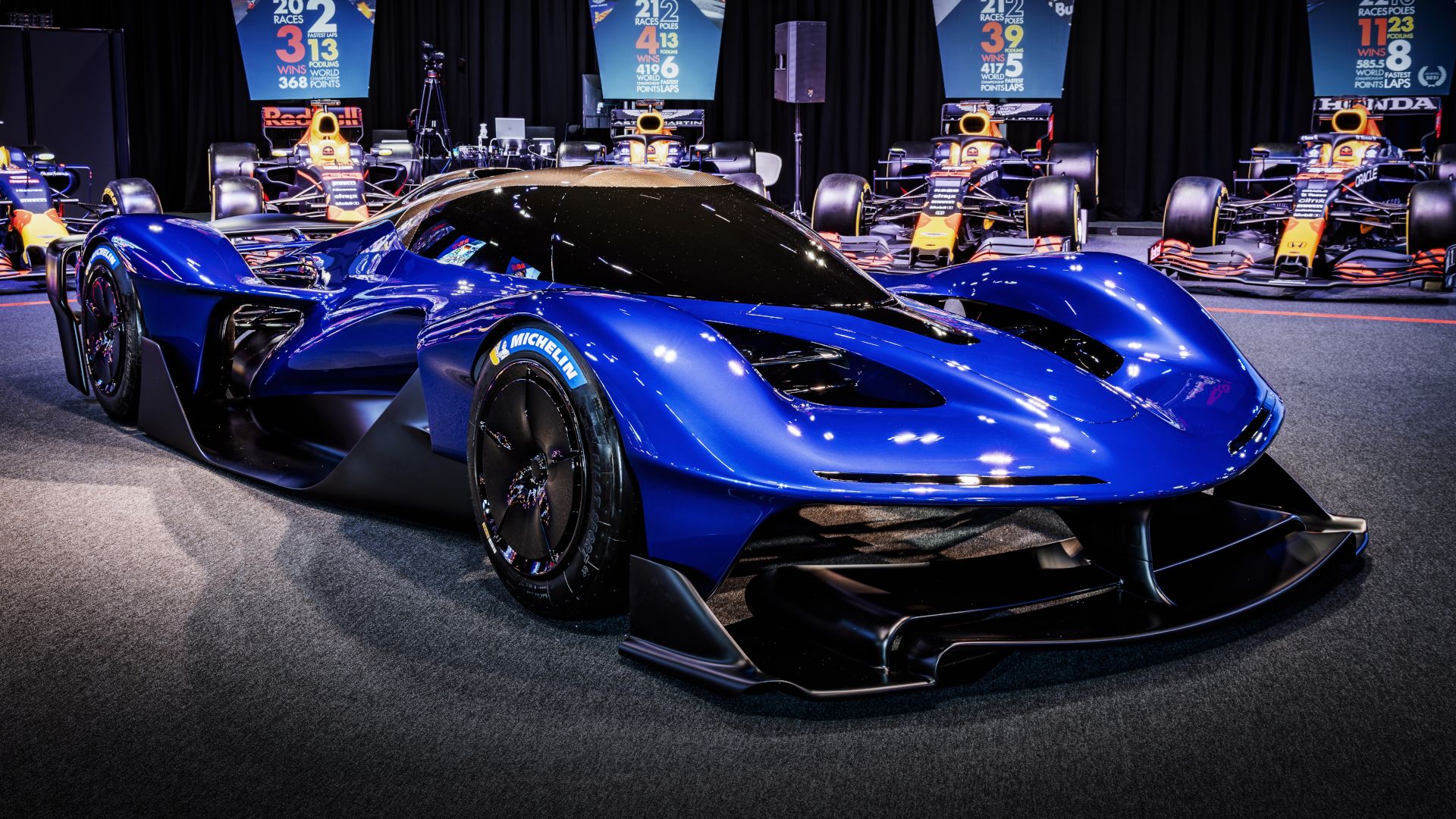
Red Bull’s $7.7 Million RB17 Hypercar Almost Had A Ford Badge
Key Takeaways
- Red Bull RB17 almost wore a Ford badge but didn’t fit Ford’s EV image.
- A successor is possible.
- RB17 beats F1 car speed, boasts hitherto unseen aerodynamics package, and costs around $7.7 million.
Shortly after the unveiling of the all-new F1-inspired Red Bull RB17 hypercar today, Red Bull Racing CEO Christian Horner spoke to media, including CarBuzz, at the Goodwood Festival of Speed, and he revealed plenty of interesting details about the new creation, including how it almost wore a Ford badge. As reported last year, Ford and Red Bull are collaborating on a 2026 F1 entry as the latter prepares to produce its own engines for the first time. Simultaneously, the two are working on an electric vehicle together, so it’s only natural to assume that Ford would want to capitalize on the fanfare. Or is it? According to Horner, not quite.
“It’s funny. We discussed the project with Ford early on, but it didn’t really fit with their criteria, with EV. This is […] a 4.5-liter V10. I’m sure [Ford CEO] Jim Farley would love to drive one, but it didn’t really fit with their current lineage, so it’s a full Red Bull car.”
– Christian Horner – Red Bull Racing CEO
What About A Roadgoing Version?
Regardless, Ford has the Mustang GTD as a halo car, and perhaps Jim Farley will get to have a go if he makes friends with celebrity chef and automotive enthusiast Gordon Ramsay, who quipped to us that he has no clue how he is going to fit into his RB17 (using slightly more colorful language, of course). The doors are little more than portals through which occupants must clamber, but could there ever be a more practical version that runs on the road?
Add CarBuzz to your Google News feed.
Horner himself previously suggested as much, but at Goodwood, he made it clear that Red Bull Advanced Technologies wants to remain a motorsport-focused entity that spearheads advanced innovations, not a mass producer of several hundred cars. Truly committed buyers can make it happen, though, as Horner says a road conversion “is possible” with the aid of other outfits. We’re sure Lanzante is listening closely. After all, one-upping this year’s McLaren P1 GTR-style drift car and the world’s only pair of road-legal Porsche 935 racers – not to mention past creations like the Lanzante P1 Spider – is nearly impossible. That being said, Horner didn’t shut the door entirely: “We’ll have to see because there [are] already lessons from this car that I’m sure could be applied to a follow-up.”

Quicker Than F1 Cars
Isn’t it refreshing to talk about a hypercar and not even care about the 0-60 mph time or the top speed? That’s because of the singular focus of Adrian Newey, but unlike say, the Gordon Murray Automotive T.50, this car isn’t based on one man’s favorite road car characteristics but one genius aerodynamicist’s favorite innovations from the world of Formula 1. Horner says the RB17 has “all the good stuff [the FIA] got rid of,” adding that the only thing it doesn’t have is McLaren’s controversial, rule-bending, and highly effective F-duct, which was basically a sneaky drag reduction system.
“The biggest thing that struck me is when I lifted off… It’s like somebody’s thrown an anchor out, the amount of aerodynamic braking, particularly with a blown diffuser. It’s like heavy braking in a road car. And then you hit the brakes and you’re struggling to keep your chin out your chest. I enjoyed it so much, I missed the pit lane [entry] and managed to squeeze in an extra lap.”

Related
Most Aerodynamic Cars: Exploring The Pioneers Of Automotive Aerodynamics
We look at some of the industry’s cars made to slice through the air.
The RB17 is designed to be highly adaptable and customizable for all skill levels, with adjustments possible for downforce, mechanical grip, engine output, and more. There are even three different tire options, including a bespoke new Michelin Confidential compound. The greatest limiting factor in a car like this is how much speed, heat, and lateral deformation the rubber can take, but whatever the French tire experts developed for the RB17 must be off the charts. According to Horner, in the hands of a professional driver like Liam Lawson, “RB17 will be quicker than Formula 1 cars at certain circuits, such is the level of downforce.” The limits are so high that even F1 World Championship leader “Max [Verstappen] will struggle” to extract the full performance potential of the car. Similar sentiments have been uttered with respect to the Valkyrie, so how does it compare to that?

RB17 & Valkyrie – Same Same, But Different
The RB17 is slightly longer and wider than the Valkyrie but fits into the same area as an Aston Martin DBX SUV, albeit while being much lower. The RB17 is not huge, but it’s not tiny either. And while the Valkyrie cost around $3 million, this is more than double. That’s not because this is some sort of cash grab but because Red Bull refused to cut any corners. Horner said that approval for the project was acquired long before customers were sought, and there are far more interested parties than build slots (50 RB17 hypercars will be built at RB’s Milton Keynes facility in the same process as F1 cars). Even if there hadn’t been any interest, “this isn’t a project that’s dependent on deposits or anything like that,” with Horner saying both majority of Red Bull’s majority shareholders back the project fully, with each being customers. Aston Martin didn’t take the same approach.
“Aston Martin actually lost money on that project. That was a £3 million-£4 million car, not a £2.2 million car. We said, ‘Look, if we’re going to do this project, we’re going to do it properly, the Formula 1 way, with all the [same] applications in how we design and build a Formula 1 car.’ Therefore, it’s going to come with a price tag that is comparative with that technology.”
When pressed on exactly how much it cost, Horner said “just under £6 million,” which is about a million more than the last estimate and equates to around $7,773,720 at the time of writing. Is it worth it? This car may be the most aerodynamically innovative automobile ever to touch a track or piece of road and boasts roughly double the aerodynamic efficiency of the most cutting-edge LMP1 designs of yesteryear’s Le Mans prototypes, “approaching aircraft levels.” It’s designed to evolve as your skills do, and it looks stunning thanks to its ingenious designer, who said its performance needed to be presented as “a work of art.” Most importantly, it’s been created by the most celebrated engineer in the ultra-competitive world of F1. This is Red Bull’s tribute to Adrian Newey’s boundless brilliance at mastering the rulebook’s loopholes, rewarding years of excellence with the one thing F1 cannot provide: a high-performance project that has no rules. As Christian Horner says, “This is basically Adrian off the lead. No FIA regulations, no cost cap – which is why it’s so f***ing expensive!”