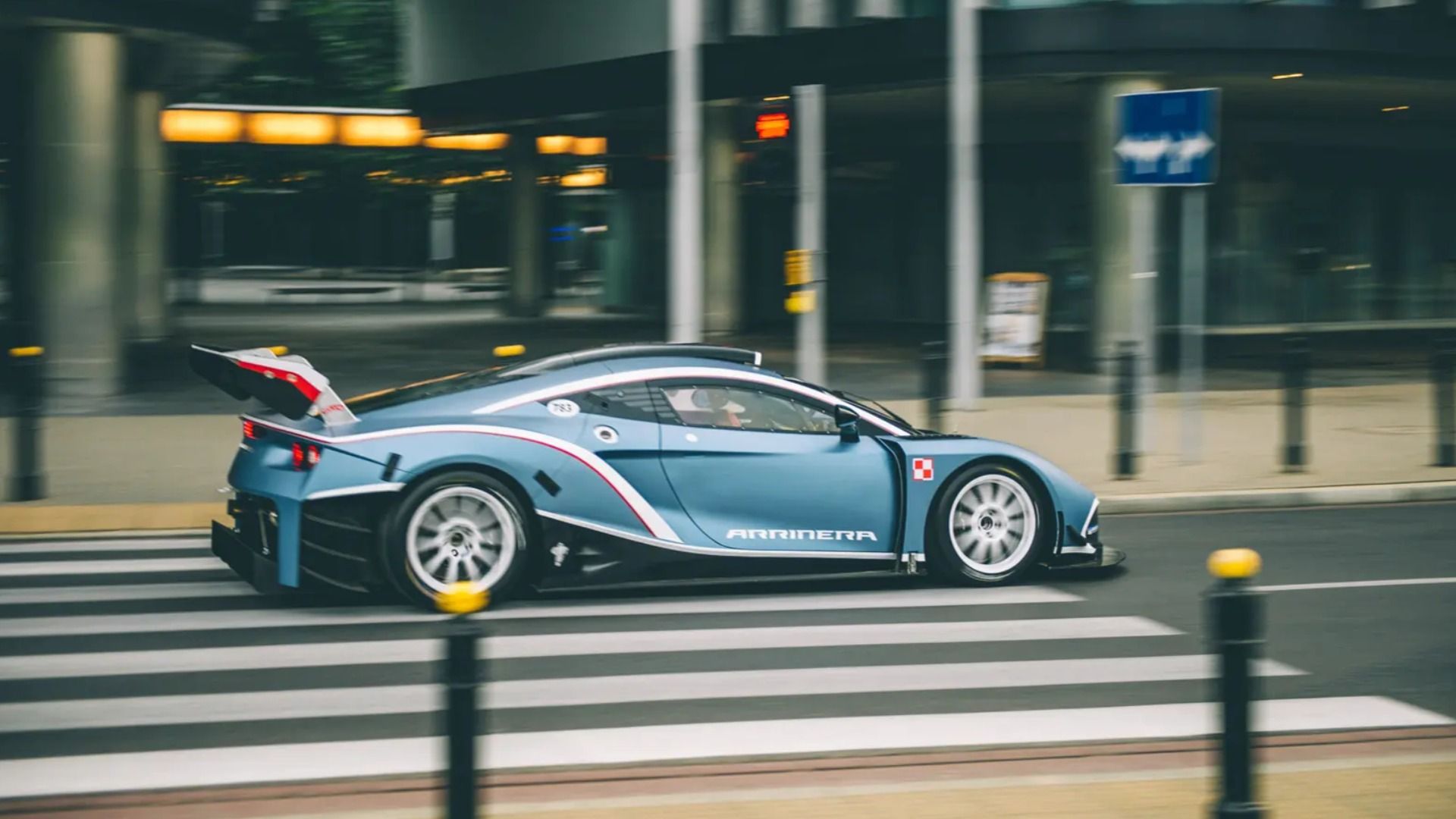
Poland’s First And Only Supercar Was Powered By An All-American V8
When thinking of nations associated with supercars, Western European brands like Ferrari, Lamborghini or Porsche usually come to mind; however, in recent years, there has been the odd supercar coming from unexpected locations – remember Russia’s attempt with the Marussia B-series? Nearly 15 years ago, a company based in Poland announced its intention to join the fray and build the very first Polish supercar. The result was the Arrinera Hussarya, a short-lived project that did not lead to a full production run.
After a period of confusion regarding what the new model was going to be called (some sources mentioned the name “Venocara”, even though the company never officially used it), in 2012 Arrinera officially presented its new creation as the Hussarya, named after Poland’s 16th century Hussar cavalry. One notable characteristic was the Hussarya’s GM-sourced engine, which made it the result of a Polish-American collaboration.
Although not much is known about this relatively obscure model, and the project ultimately fizzled out around a decade after its introduction due to financial issues, it is still fascinating to look into a car originating in a country not famous for its automotive heritage.
Lamborghini
- Founded
-
1963
- Founder
-
Ferruccio Lamborghini
- Headquarters
-
SantÁgata Bolognese
- Owned By
-
Audi
This article focuses on the history and features of the Arrinera Hussarya, the first Polish supercar. All information has been obtained from reputable sources.
An Overview Of The Arrinera Hussarya
|
The Arrinera Hussarya In Numbers |
|
|
Engine |
6.2-liter supercharged V8 |
|
Horsepower |
650 hp |
|
Torque |
604 lb-ft |
|
0-60 |
3.0 seconds |
|
Top Speed |
217.5 mph |
The Arrinera Hussarya was designed with aerodynamics in mind as the number one priority: its style is said to be inspired by the movement of air, and “created by the flow of air streams moving around the body of the supercar”. The result is a design that gives a dynamic feel, rich in sweeping, criss-crossing lines. The bodywork is made of carbon fiber and kevlar, making the car lightweight, nimble and strong enough to protect its occupants.
The Hussarya’s steel space frame chassis was developed with some input from a high-profile figure of the automotive world: Lee Noble, who founded the British automaker that bears his name before leaving in 2008 and working on other automotive projects.
When it comes to powertrain, the Hussarya may be the first Polish supercar, but it was also the result of an international collaborative effort: it was powered by GM’s own LS3 engine, famously used in cars such as the Corvette, Camaro, and several other minor GM models. In the Hussarya, this engine sent its 789 hp to the rear wheels via a six-speed automated manual transmission. The transmission itself was also sourced internationally: it was produced by Italian firm CIMA (“Costruzione Italiana Macchine Attrezzi” or “Italian Machine Tool Company”). CIMA is also responsible for creating the transmission of several high-profile supercars and hypercars, including the SSC Tuatara, the Hennessey Venom F5-M, and the NILU Hypercar.

Related
Every Hypercar Gunning For The 300-MPH Crown
And before you ask, no, Bugatti didn’t do it with a production-spec Chiron.
The Hussarya’s interior is decidedly focused on performance, with few creature comforts available aside from a sound system and an air conditioning system. Arrinera has stated the interior will make use of “high quality leather and composite materials”. One optional feature is a thermal camera, which scans ahead of the vehicle to assess for potential hazards.
The Hussarya’s History And Development
The Hussarya had a somewhat convoluted history: it debuted in 2011, when an early prototype was introduced to Arrinera’s investors and shareholders. At that stage there was still a certain degree of uncertainty among the press regarding the car’s name: some online sources referred to the new prototype as the Venocara, others left it nameless. The company let them stew, only clearing things up the following year, publicly announcing the Hussarya name and its cultural connection to Poland’s military history.
Shortly after the initial announcement, the Hussarya became the subject of controversy and a unique automotive conspiracy theory: a Polish journalist stated that, rather than being an original vehicle, the Hussarya was in fact a cheap Lamborghini replica, built using parts from an Audi A6 and an Opel Corsa. A lawsuit from Arrinera followed, but the journalist was eventually acquitted of slander.
A few years later, the Hussarya also made an appearance at the legendary Goodwood Festival of Speed, tackling the Hillclimb at the 2016 and 2017 editions. Around this time, the Hussarya GT, a GT4-spec race car revealed in 2016, also made its debut and was tested extensively by racing drivers on UK circuits such as Donington Park and Snetterton.
Over the course of the decade that followed, Arrinera encountered financial difficulties that made it impossible to achieve a full production run, as the company had originally envisioned. Arrinera wanted to build 100 units per year of the “standard” Hussarya, plus 33 units of a limited-run launch edition called the “Series 33”, featuring unique visual touches. However, the economic struggles faced by the company proved to be insurmountable, and the Hussarya project ultimately fizzled out in the fall of 2021, just over 10 years after the first prototype had been built.
The Hussarya’s Unusual Door Layout: What Are Scissor Doors?
One of the most striking visual characteristics of the Hussarya is its doors: rather than being fitted with conventional doors that open outwards, the car has what the industry refers to as “scissor doors”. This door type is generally considered a luxury feature: scissor doors are often informally referred to as “Lambo doors” due to their association with several models produced by the Italian carmaker.
Frequently confused with the more famous gullwing doors, which open outwards and upwards like a bird’s wings, scissor doors open upwards without extending out, in a way that visually resembles the blades of a scissor. These doors usually open at a 90–130-degree angle, and remain parallel to the car’s body. This door type is an ideal option for parking in narrow spaces, however if the car is frequently parked indoors in a space with low ceilings, it may cause issues for passengers getting in and out.
Of course, the safety aspect is another element to consider. Scissor doors look stylish and sleek, but they do pose an increased risk in the event of an accident, in a similar way to other unconventional door types (like the gullwing or the swan). This is because they make it more difficult for the car’s occupants to get out quickly and safely after a crash.
Poland’s Automotive History
The Hussarya may have been a brief blip in global automotive history, but it did gain one important title: it was the first ever supercar produced by a company based in Poland, a nation not frequently culturally associated with car design and production.
Despite its small role in the global automotive industry, Poland is a major player on a more local level in the Central and Eastern European markets; automotive production accounts for about 10% of the nation’s industrial output. Its motoring heritage started in the late 19th century, when a company called Ursus began producing tractors. The industry experienced a lull until after World War I, when production started to pick back up, although at this point, most vehicles produced were still of a military nature. However civilian cars were starting to gain popularity.
World War II interrupted most areas of industry, including automotive production. After the end of the war, the newly-created socialist People’s Republic of Poland started to develop its car industry once again. Soon, the nation became the 13th biggest producer of cars around the world, and the eighth-biggest in Europe. One of the most prominent brands of the postwar era was Fabryka Samochodów Osobowych (FSO). This company produced several popular passenger vehicles, including cars derived from Russian GAZ models and rebadged Fiats (such as the 126p).

Related
How Porsche Helped The Soviets Build Cars During The Cold War
The story of an the unlikely collaboration between Porsche and Lada.
Poland’s automotive industry continued to grow from the early 90s onwards, following the fall of communism. In 2004, the country joined the European Union, further increasing its industrial output. As of 2022, Poland was the 24th biggest car producer in the world, with nearly half a million vehicles built every year.
Sources: Arrinera, Itkey Media, World Population Review