Least Powerful Cars Ever Made With Gullwing Doors
Gullwing doors are typically associated with a certain type of car in the mind of the automotive enthusiast that offer luxury, speed, and sportiness. From timeless classics like the Mercedes-Benz 300 SL, to out-of-this world hypercars like the Pagani Huayra and the Aston Martin Valkyrie, gullwing doors instantly convey an image of ultra-high-end motoring. However, over the course of automotive history, there have been some cars whose looks haven’t quite matched their performance, sporting gullwing doors alongside an underpowered engine and not-so-great acceleration and speed.
Here are the five least powerful cars ever built with gullwing doors, ranked from the highest to the lowest power output. This being a list of low-power cars, the one with the least is in the number-one spot.
5 Mercedes-Benz C111-IID
When most people think of Mercedes models with gullwing doors, the legendary 300 SL immediately comes to mind. However, another far lesser-known Mercedes model also sported this unusual door design: the C111, an experimental model that only resulted in 16 cars built.
Although the first version of the C111 was first introduced in 1969 at the Frankfurt Motor Show, the least powerful variant of it was the third generation, the C111-IID. This version was not created until the global oil crisis had hit in 1973, and Mercedes engineers turned to diesel as a way of making their concept car more efficient. The C111-IID was fitted with the OM617 engine, which in its original form only produced 79 hp; however, thanks to some clever tuning and the addition of a turbo, this was bumped up to 188 hp.
|
Engine |
3.0-liter five-cylinder turbo-diesel |
|---|---|
|
Horsepower |
188 hp |
|
0-60 |
6.8 seconds |
|
Top Speed |
173 mph |
The car was used for testing purposes at the Nardo test track in Italy, where it managed to set several diesel-related records. Mercedes later created a more powerful third-generation C111, the C111-III, which was fitted with the same engine, now producing 228 hp. Like its predecessor, this car was also used for testing at Nardo.
Related
This Is The Most Reliable Mercedes-Benz Ever Made
The W123 can survive anything, including humanity.
A fourth generation of the model also followed, this time ditching diesel in favor of a far more powerful gas-powered V8. Only a single example of the C111-IID was ever built: out of the 16 cars from the C111 series, thirteen were from the first two generations (I and II), two were from the third generation (the IID and III), and the last was a single fourth-gen V8-powered car.
4 Bricklin SV-1 (1975 version)
Though Malcolm Bricklin was an American business executive, primarily known for being the first to import Subaru models into the States in the late 1960s, his own creation, the SV-1, was not built in the US but in Canada. His original idea was to build an affordable car with gullwing doors but this proved to be more complicated than expected.
Although a variety of engines were used in the initial prototypes, including an Opel four-cylinder unit and a Chrysler Slant-6, eventually two V8s became the final choice: early models were fitted with a more powerful 5.9-liter AMC V8, which produced 220 hp, later ones came with a 5.8-liter Ford V8 which produced only 175 hp. The SV-1 was officially unveiled in New York in June 1974.
|
Engine |
5.8-liter V8 |
|---|---|
|
Horsepower |
175 hp |
|
0-60 |
9.9 seconds |
|
Top Speed |
111 mph |
The car’s name, SV-1, stands for “safety vehicle 1”, as Bricklin’s company placed great importance on safety as well as sportiness: the SV-1 was equipped with energy-absorbing bumpers and an integrated roll-over structure to keep passengers safe in the event of a crash. The SV-1 was only built for one year, and sold between the 1974 and 1976 model years. With internal issues plaguing the company and the car itself building a reputation for quality-control issues, production eventually ended in mid-1975 and the Bricklin company was acquired by Consolidated Motors, who finished assembling and sold off the remaining stock.

Add CarBuzz to your Google News feed.
3 DeLorean DMC-12
The most famous entry on the list, the iconic DeLorean DMC-12, is instantly recognizable even to non-car enthusiasts thanks to its starring role in the Back To The Future movie trilogy. Its cinematic role as a time machine is connected to its futuristic image, with an angular stainless steel body (designed by none other than Giorgetto Giugiaro and his legendary Italdesign firm) and its gullwing doors.
The only model ever to be produced by the original DeLorean Motor Company, the DMC-12 was plagued with issues from the start, as was the company itself. Although the first prototype for the DMC-12 appeared in 1976, production was delayed until the beginning of the ’80s, and the car’s space-age design was not matched by its performance.
|
Engine |
2.85-liter V6 |
|---|---|
|
Horsepower |
130 hp |
|
0-60 |
8.8 seconds |
|
Top Speed |
130 mph |
The DeLorean’s heart, originally meant to be a Citroën rotary engine, was eventually downgraded to a Ford V6, and by the time the car actually went into production, this had been dropped too, in favor of the Peugeot-Renault-Volvo (PRV) V6. The unit only produced 130 hp for cars sold in the US market, and 140 hp in the rest of the world.

Related
World’s Most Powerful DMC DeLorean Is A 630-HP Time Machine
You won’t believe what it’s powered by (hint: it’s not an EV).
Being underpowered wasn’t the DMC-12’s only issue either: due to poor facilities and lack of staff training, build quality was lacking. Only around 9,000 units were built in total, before the company went under and John DeLorean was arrested on drug-trafficking charges.
2 Melkus RS 1000
The second least powerful car on the list looks a lot faster than it is. Dubbed the “Ferrari of the East” for its sleek silhouette, inspired by Ferraris and other sports cars of its era, this car was created in East Germany in 1969 by an enterprising racing driver, Heinz Melkus, who had made the jump from racing to building his own cars. Though he mostly focused on racing single-seaters, he did manage to produce one road car – the RS 1000, powered by a diminutive three-cylinder engine sourced from local manufacturer Wartburg.
The RS 1000 was very light, weighing in at just 1,500 pounds (98 lbs less than the first Lotus Elise), which somewhat made up for its low power output. Only 101 examples were built in total. A small number of cars, built in later production years, were powered by a 1.2-liter version of the same engine, which bumped top speed up to 109 mph.
|
Engine |
1.0-liter three-cylinder |
|---|---|
|
Horsepower |
68 hp |
|
0-60 |
12 seconds |
|
Top Speed |
103 mph |
Although Melkus shut down in 1986, Heinz Melkus’ son Peter made an attempt at bringing the company back in 2009, with a new model, the RS 2000, being introduced at the Frankfurt Motor Show. The RS 2000 had a very limited production run, with around 25 units per year built until the company filed for bankruptcy in 2012.
1 Mazda Autozam AZ-1
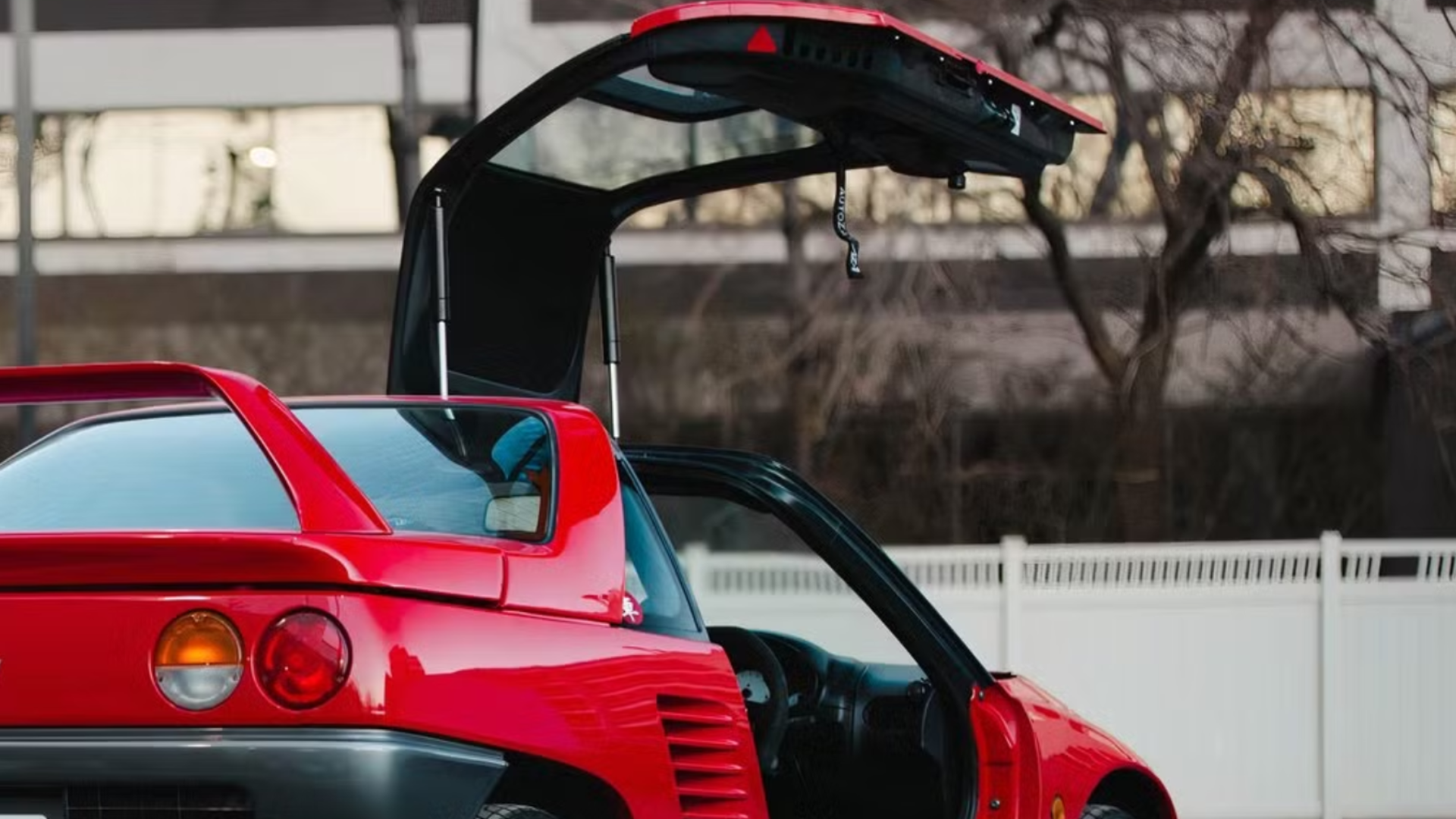
The crown of least powerful car with gullwing doors goes to the pocket-sized Autozam AZ-1, a kei car produced by Mazda but sold under its Autozam sub-brand. Created in 1998, Autozam was focused on small city cars and kei cars, selling Mazda-built models through an independent dealership network that also imported some Lancia models to Japan. Though the Autozam name still exists, the brand was reabsorbed fully by Mazda in 1998, with its dealerships now bearing the name “Mazda Autozam”.
As for the AZ-1, it developed somewhat of a cult following, not just in Japan but in the US as well; thanks to its quirky looks and small dimensions, it was quite unlike anything else in the automotive world. It also remained a rarity, thanks to the unfortunate circumstances under which it was released: shortly after it hit the market, Japan was hit by a recession, and the model was taken out of production the following year with only 4,392 units produced.
|
Engine |
657 cc three-cylinder |
|---|---|
|
Horsepower |
64 hp |
|
0-60 |
11 seconds |
|
Top Speed |
87 mph |
Throughout the AZ-1’s brief production run, Mazda produced a handful of special editions, including a Mazdaspeed version. A Suzuki-badged variant, the Suzuki Cara, was also sold; however, this is even rarer than its Autozam counterpart as only 531 were built. In the present day, 3D modeler Vladimir Panchenko has created a rendering of what a modern successor to the AZ-1 could look like, combining styling cues inspired by the Miata and, of course, a set of gullwing doors.
Sources:
Supercar Nostalgia, Bring a Trailer, Asahi-net.or.jp, Toronto Star.