How To Road Trip A 600 hp Porsche 917 Race Car
The Porsche 917 is one of the greatest racing cars of all time. And maybe not surprisingly, the man running Porsche’s motorsport division at the time was one Ferdinand Piëch. The brilliant engineer, who also lacked some social skills, would not only go on to run the entire Volkswagen Group, but would also be the main driving force behind the acquisition of brands like Lamborghini and Bugatti, and the creation of the Veyron, the fastest car in the world.
When Piëch and his team spotted a loophole in the World Sports Car Championship rules in 1968, Porsche set about creating a new racing car powered by a 4.5-liter flat-12 engine producing around 500 hp. There was always only one aim for this new contender: win the 1970 Le Mans 24 Hour race. This was exactly what the 917 achieved, becoming the first Porsche to win the most prestigious race in the world.
When Piëch and his team spotted a loophole in the World Sports Car Championship rules in 1968, Porsche set about creating a new racing car powered by a 4.5-liter flat-12 engine producing around 500 hp. There was always only one aim for this new contender: win the 1970 Le Mans 24 Hour race. This was exactly what the 917 achieved, becoming the first Porsche to win the most prestigious race in the world.
Porsche
Porsche is a German sports car manufacturer and part of the broader Volkswagen Group since August 2012. Founded in 1931 by Ferdinand Porsche, the brand is most famous for the 911 line of sports cars, which first launched in September 1963. But it was the Porsche 356 that came first, and subsequently, Porsche has expanded its model lineup to include a variety of sports cars, supercars, SUVs, sedans, and even EVs. Porsche has a rich history in motorsport, with 19 outright Le Mans victories to its name, among various other titles.
- Founded
-
1948
- Founder
-
Ferdinand Porsche
- Headquarters
-
Stuttgart, Germany
- Owned By
-
Volkswagen
- Current CEO
-
Oliver Blume
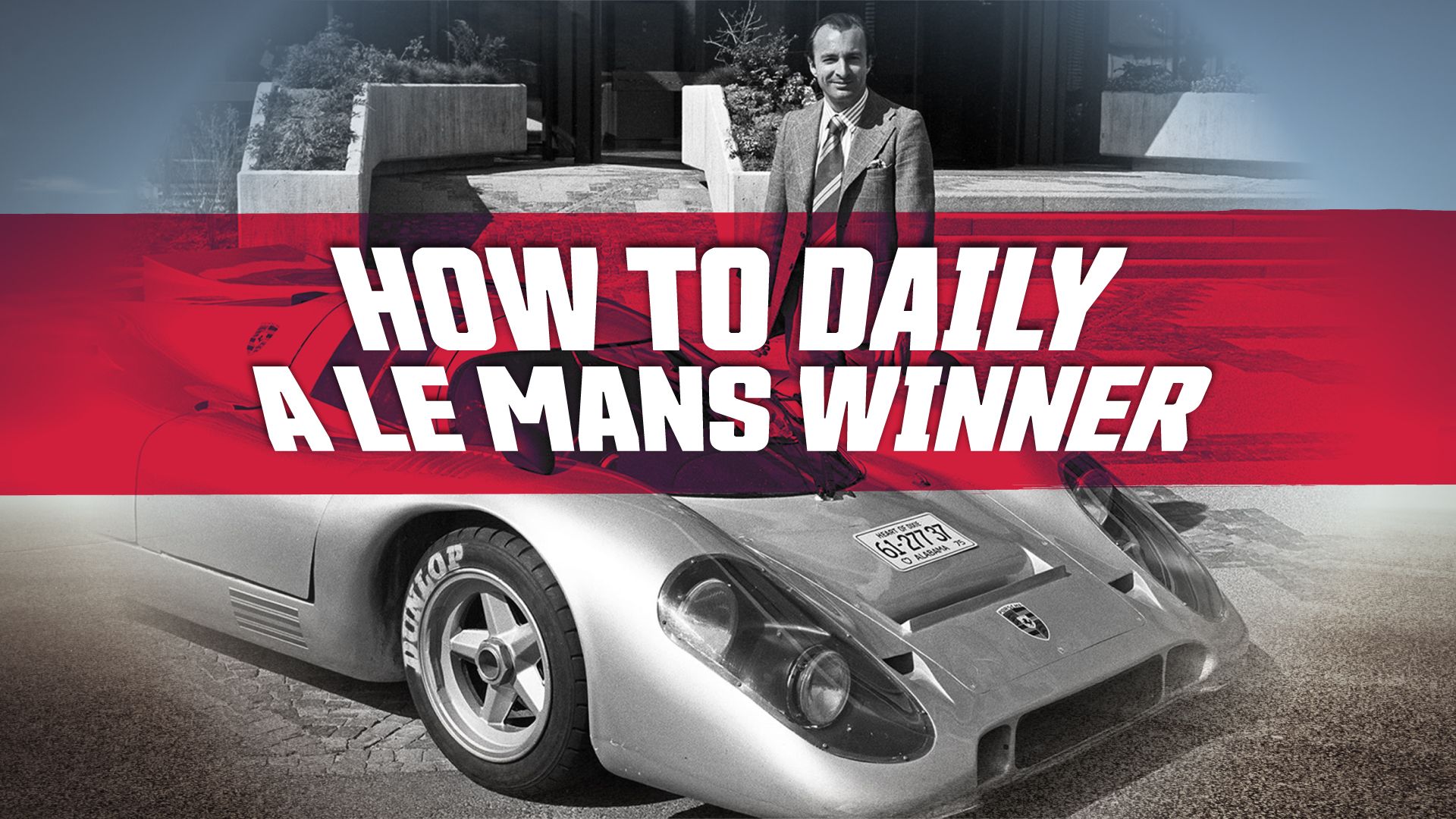
Italian business mogul and Martine heir Gregorio Rossi di Montelera, commonly referred to as Count Rossi, took a special interest in the 917. He hatched a plan to acquire a Porsche 917. Not to race, but to take extended road trips. In 1975, Count Rossi’s plan finally came to fruition, after Porsche built him a custom car that was based on a racing chassis, but that was also fully road legal. Now, 50 years later, the bespoke Porsche 917 is still going strong. This is that car – and the 917’s – story.
We head back to 1975 when the Porsche 917 was the king of the sports car racing world, and one man had a dream of turning a 917 into his dream road trip car.
Porsche Delivers A Masterstroke
|
1970 Porsche 917K |
|
|---|---|
|
Engine |
4.5-liter flat-12 |
|
Power |
520 hp @ 8,000 rpm |
|
Torque |
331 lb-ft @ 6,800 rpm |
|
Weight |
1,800 lb |
|
Top speed |
199 mph |
In 1968, when the FIA’s international sporting commission introduced new rules and regulations to get more manufacturers involved in sports car endurance racing, some car companies were quite taken aback by the new regulations. For one, the new regulations attempted to slow down the likes of Ford’s GT40 and Lola’s T70 by limiting engine capacity to three liters, a move that also opened the door for companies campaigning Formula One teams to enter the fray. The Ford, for instance, was producing around 500 hp, and reached a top speed of 213 mph on the Mulsanne Straight at the Le Mans race – a speed that gave it a distinct advantage on the track with miles and miles of straights.
The rule makers had also specified that the new sports car class would also require at least 50 cars to be built to be eligible to compete. With almost no takers, the governing body sharpened their rule pencil, and came up with a new plan: engines were to be limited to five-liters, and only 25 cars needed to be built. Porsche motorsport, with Ferdinand Piëch at the helm, saw a loophole in the rules, and conceived a brand-new version of its already successful 2.2-liter 908 racing cars. In 1969, Porsche invited the FIA inspectors to its motorsport facility in an effort to get the green light for its participation in the 1970 Le Mans 24-Hour race in France with its all-new 4.5-liter flat-12 contender.

Related
Porsche Teases A Roadgoing Racecar In The Same Vein As Its One-Off 917
Porsche is cooking up something special to celebrate the car that won its first-ever Le Mans title.
Porsche had to demonstrate that 25 cars were, at the very least, in the making. But according to urban legend, they had only three cars fully completed, there were 18 cars on the assembly line in various states of completion, and there were parts for an additional seven cars available for the inspectors to look at. In theory then, Porsche had 27 cars in the making. This apparently did not best please the French inspectors, who insisted on seeing 25 completed, fully operational Porsche 917s for the car to be eligible to compete at Le Mans.
Porsche virtually had 10 months to develop the 917 for Le Mans, and build 25 complete cars. With Piëch and legendary Porsche engineer Norbert Singer pushing as hard as ever, the 25 cars were built in record time. The inspectors were invited back, and 25 Porsche 917s were perfectly lined up, Piëch even telling the inspectors they were welcome to drive any car in the line-up. And so, the officials had no option other than to give Porsche the green light to compete in the French endurance race.
The Porsche 917 Racer
|
1970 Porsche 917L |
|
|---|---|
|
Engine |
5.0-liter flat-12 |
|
Power |
620 hp @ 8,800 rpm |
|
Torque |
350 lb-ft @ 6,800 rpm (estimated) |
|
Weight |
1,800 lb |
|
Top speed |
225 mph |
The 1970 Le Mans 24 Hour was Porsche’s main focus for its new 917 race car. After some development work on the first 917K model in 1969, Porsche created the 917L specifically for the Le Mans race. At the time, the Le Mans circuit had far fewer corners than it does today, and the average speed was much higher over one lap. So Porsche motorsport not only gave the 917 more horsepower, it also gave the aerodynamics a major overhaul, with a long-tail package specifically developed for Le Mans.
The result was a car that achieved a top speed that was 25 mph faster than any other car in the 1970 race. During pre-race testing, Porsche driver Jackie Oliver became the first driver to complete a lap with an average of more than 155 mph. In the actual race, Oliver set the fastest lap too, with an average speed of 152 mph. It was the fastest car the legendary race had ever seen. Ironically, the 1970 Le Mans race was not won by the fast 917L. Instead, it was the reliable 917K from 1969, which may have been slower down the straights but had better handling and stability, that brought the silverware home, piloted by Hans Hermann and Richard Attwood.

Related
These Are The Rarest Porsches Ever Made
These Porsches are so rare that they make the 918 Spyder feel commonplace.
Nevertheless, Porsche and Ferdinand Piëch had amazingly achieved their goal. The team had created a brand-new racing car, and in just 10 months it had created a Le Mans-winning car. The box was comprehensively ticked. Porsche took the 917 back to Le Mans. With the flat-12’s capacity increased to five-liters and the power raised to 620 hp, the 917 was even faster. Despite upgrades to the 917L long-tail, including much improved handling, it was again the shorter and better-handling 917K that took the victory after 24 hours.
Amazingly, the long-tail driven by English legend Derek Bell, had reached a staggering 396 km/h (246 mph) down the Mulsanne Straight. It was the stuff of legend, and one of the greatest racing cars ever conceived.
A Man With A (917) Dream
By 1975, with the Porsche 917 firmly embedded in the history books as one of the greatest racing cars ever made, Italian business executive and Martini & Rossi heir Gregorio Rossi di Montelera, a renowned powerboat racer, bobsledder and Porsche enthusiast, decided he should, just like actor Steve McQueen, have himself a 917. He approached Porsche, and told them about his plan. But when they heard the details, they almost fell off their chairs. Count Rossi, as he was commonly known, didn’t want a Porsche 917 to race. He wanted one to go on road trips with. So a fully road-legal version that was still very much a 917.
Undeterred by the strange request, the team at Porsche’s Weissach development center set about turning racing chassis number 30 into a road-legal car. The 5.0-liter flat-12 was fitted with exhaust mufflers to reduce the delightfully pleasant engine noise to legal levels, and mirrors, side indicators and a horn were fitted. Road laws required a spare wheel to be carried, and this was located underneath the rear clamshell bodywork. Endurance racing rules of the time required that two seats be fitted, so that was sorted. The seats were recovered in the finest Hermes leather, along with suede for the roof-lining, doors and dashboard. The 917 body was finished in Martini Silver.

Related
The Rarest Version Of Porsche’s Rarest 911 Generation Is Wild
And it wasn’t discovered for years.
Count Rossi took delivery of his one-off Porsche 917 on 28 April 1975… and immediately took it on an epic 375-mile road trip from Weissach in Germany to Paris, France. The 917 presided in Paris for many decades, but Count Rossi actually used the 917 for the purpose he had commissioned it… to go on amazing adventures, with that flat-12 engine providing glorious sound effects along the way.
Interestingly, the 917 was ‘registered’ in the state of Alabama, USA, as none of the European countries would permit it to legally be registered as a road car. So far, it seems the car never made it to Alabama. The car still lives in France, but is now registered in the United Kingdom. The 917K was recently restored, although the original paint and interior remained untouched. And more good news… it still regularly goes on road trips, just as Count Rossi had initially intended it to do.
Value, you ponder? Here’s a hint: Jerry Seinfeld recently put up his 1969 Steve McQueen-owned Porsche 917K (racing car), which was also the star of the iconic 1971 film Le Mans… and declined an offer of $25-million, preferring to keep it.
Sources: Porsche, Mecum.