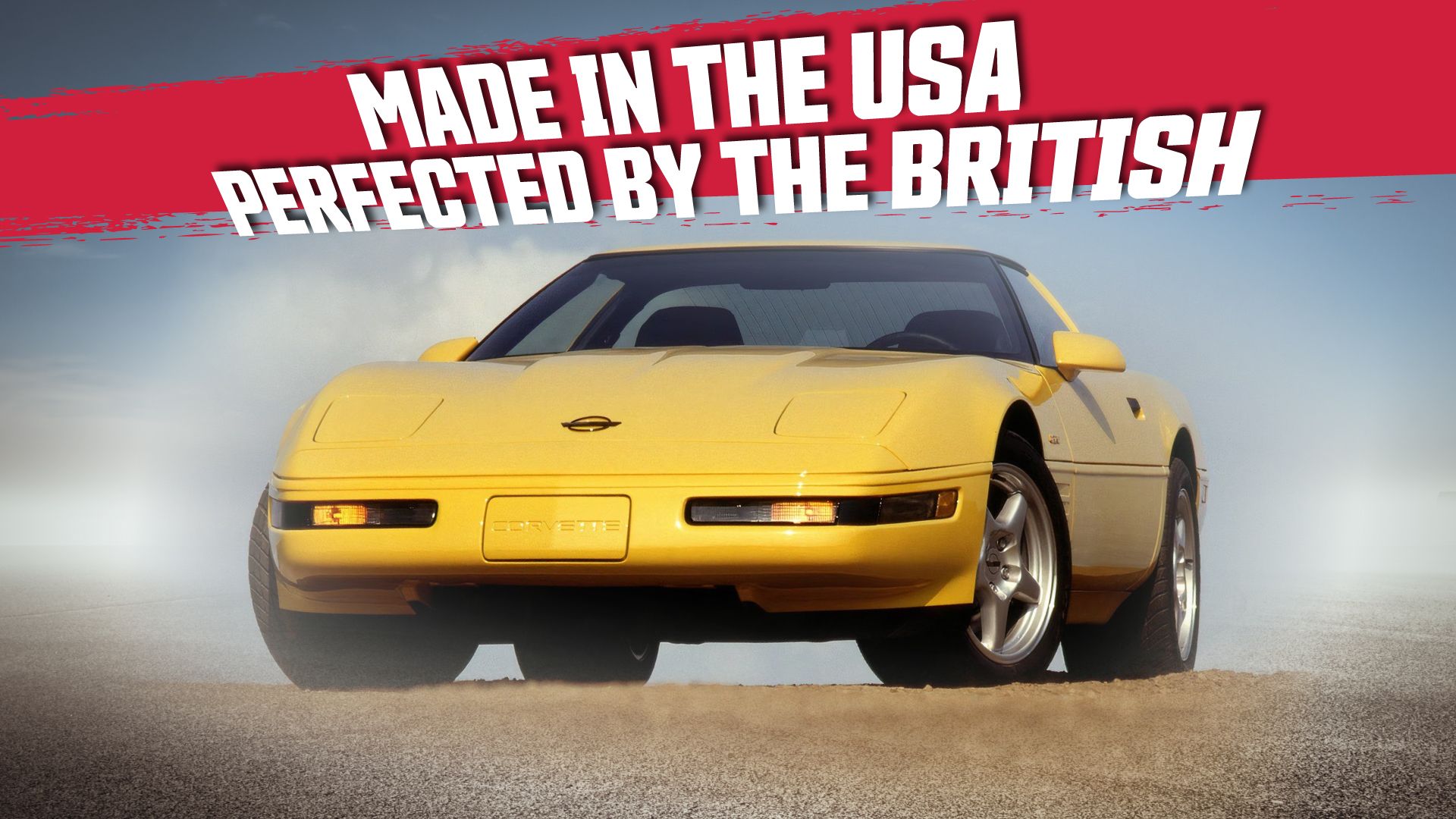
How The British Helped Turn The Corvette ZR1 Into A Legend
The Chevrolet Corvette is one of the most legendary and recognizable sports cars in the history of the breed, the model having first graced US roads in 1953. Since then, Chevy has continually developed it to ensure it can take the fight to its rivals that fly in from around the world in an attempt to give it a bloody nose. As part of this development process, a series of ultra-high-performance variants have slipped out.
Chevrolet
Founded in 1903, Chevrolet is one of America’s oldest remaining legacy automakers. Acquired by General Motors in 1918, Chevrolet is the core GM brand responsible for the bulk of GM’s US sales. As a mass-market manufacturer, Chevrolet competes in multiple key segments, primarily the SUV and truck segments, but also sports cars and mainstream sedans and hatchbacks (until recently). Core models for the brand include the Silverado, Colorado, Suburban, Camaro, and Corvette.
- Founded
-
November 3, 1911
- Founder
-
Louis Chevrolet, Arthur Chevrolet, William C. Durant
- Headquarters
-
Detroit, Michigan, United States of America
- Owned By
-
General Motors
- Current CEO
-
Mary Barra
One of the most commanding is the early 1990s C4 ZR1, the peak of the Corvette hierarchy in the period. We don’t just have the Americans to thank for the model though, as a plucky British brand played a crucial role in ensuring the car had the power needed to gain its reputation.
This piece covers the Chevrolet Corvette ZR1, and how British manufacturer Lotus had a big hand in the final design of the legendary performance car. All data used was sourced from reputable providers.
The Corvette Had Matured Nicely By The Late 1980s
By the time the late 1980s arrived, the Corvette had been there and got the T-shirt. The model was over three decades old by then, and was in its fourth generation. Called the C4, it made its debut in 1984 and Chevy wasn’t shy about trying to raise its profile. It had more power and technology than its C3 predecessor, as well as sleeker and more purposeful styling, unlike the more muscle-car-like C3.
It also came with enhancements to its cockpit, with a fully digital setup being introduced to reflect the rise in technology, though it wasn’t particularly reliable as a result. For the bulk of its life, the base C4 remained the only one you could get. That meant you got a naturally aspirated 5.7-liter V8, which got steadily upgraded during its life. Early 1984 examples only made around 205 hp, but by the time the 1990s rolled around, the ‘Vette’s rear wheels had 300 hp to brag about.

Discussion
Discussion: Is the 2025 Chevrolet Corvette ZR1 the best bang-for-buck supercar ever built?
The 2025 Chevrolet Corvette ZR1 is set to be a monster, with 1,064 horsepower, rear-wheel drive, a top speed of 233 mph, a quarter-mile time of 9.6 seconds, and a sticker price of $173,300. There is arguably no supercar that delivers that much performance for so little money, but the court of public opinion will always be the toughest challenge it faces. Do you think there’s ever been a better bang-for-buck supercar than the new ZR1?
GM Decided To Take Over Lotus Around The Same Time
While the C4 was being fettled, GM was busy with other engagements. In 1986, the American giant decided to purchase British manufacturer Lotus, which had been struggling to survive following the tragic death of company founder Colin Chapman in 1982. GM had worked with Lotus on various projects in the past, and elected to take up a purchase option when Lotus’ non-executive chairman Alan Curtis floated the idea of selling the brand.
This decision turned out to be a crucial one in the history of the C4 Corvette. A crazy M5-challenging sedan even came out of the partnership later, so gearheads were in for a treat.
Soon after GM completed the acquisition, it approached Lotus about building the world’s fastest production car. Wanting to use the C4 Corvette as a base, GM felt Lotus contained all the talent and expertise needed to make the project a success. Lotus agreed, and work began on upgrading the C4. The British brand’s first marque was ditching the standard L98 V8 engine powering the car, and developing a new powerplant based on the venerable Chevy small block.
|
1990-1995 Chevrolet Corvette ZR1 Specifications |
|
|---|---|
|
Engine |
5.7L NA V8 |
|
Power |
375-405 hp |
|
Torque |
370-385 lb-ft |
|
0-60 mph |
Approx. 4.5 seconds |
|
Top Speed |
180 mph |
The new engine produced 375 hp, well over 100 hp more than the standard L98 could when the ZR1 was released in 1990, and it was later developed to make 405 hp for the 1992 model year. Due to the extra grunt the C4 had to deal with, Lotus also developed an upgraded braking and steering setup, while an all-new, fully independent suspension was also brought along to the party. It was developed jointly by Bilstein and Lotus’ Formula 1 operation, and ensured the later-christened ZR1 was stable enough to make use of all the extra go-faster juice. It was fully adjustable, with six different settings available to suit a range of driving styles and roads.
The ZR1 represented a huge step forward in performance when compared to the standard C4 it was based on, and a big chunk of this progress came courtesy of Lotus. It was arguably the LT5 engine that was the star of the show, though.

Related
The Fastest Corvette Ever Made Came Out Over 35 Years Ago
Meet one of the greatest Corvettes ever made.
The ZR1’s LT5 V8 Was Revolutionary
The fully-aluminum LT5 retained the same 5.7-liter displacement as the L98 featured in the standard Corvette C4, but now with four overhead camshafts instead of two, and with 32 valves rather than 16. Its main party piece was a multiple throttle induction system, which consisted of a throttle body that featured three butterfly valves rather than the two featured on the L98, as well as 16 runners instead of the usual eight. A new and more modern version of the engine powered the C7 variant of the ZR1.
Two runners worked on each cylinder, and each cylinder had its intake ports, cam lobes, and valves split into two separate groups. Some were placed towards the front of the component, and the others towards the back, which allowed them to work independently. Below 3,000 rpm, or at half-throttle, only the primary ports and other components worked to ensure the engine ran efficiently and quietly when pootling around. Upon full throttle, the secondary ports kicked in to allow all injectors and valves to function, allowing the LT5s full 375 hp fury to be utilized. The LT5’s 1992 enhancement saw new cylinder heads, pistons, and other refinements carried out to boost power to north of 400 hp. The LT5 was never featured on any other GM road car other than the ZR1 either, making it ultra-exclusive.

Related
How The Symbol Of America’s Favorite Sports Car Evolved Over 70 Years
Much like the car it’s attached to, this badge has evolved quite a bit over the last several decades.
The ZR1 Ended Up Breaking Records
Lotus’ hard work ultimately paid dividends, as the finished ZR1 ended up breaking multiple speed records. Most notably, it secured new records for the highest average speed across 12 and 24-hour periods, the ZR1 managing just over 175 mph at both points. The records were verified by the FIA in 1990, and the ZR1 held these records until Volkswagen snatched them away in 2002 with its mental W12 Nardo supercar.
The C4 Corvette may not be the best-remembered Corvette for a number of reasons, but the efforts of GM and Lotus mean the C4 ZR1 will be revered as one of the most forward-thinking and effective sports cars in history.
Securing Your Own C4 ZR1 Isn’t As Costly As You Might Think
For gearheads wanting their own slice of Corvette history, picking up the awesome C4 ZR1 is more affordable than you’d expect. According to Hagerty’s Valuation Tool, even later 1995 models in good condition with the more powerful LT5 engine should only set you back around $28,000, while older models can be had for around $23,000. Later examples in mint condition will exercise your bank account a bit more, with these valued at closer to $80,000.
|
1990-1995 Chevrolet Corvette ZR1 Values |
|
|---|---|
|
Concours |
$60,000-$79,800 |
|
Excellent |
$42,500-$56,100 |
|
Good |
$20,800-$28,900 |
|
Fair |
$12,500-$18,300 |
|
Average Auction Cost |
$38,395 |

Related
All The Crazy Numbers Behind The Chevrolet Corvette ZR1
The upcoming ZR1 boasts some of the wildest numbers ever attached to a Corvette.
These values are reflected by Classic.com, a site that collates action listings from around the globe. The resource reports that the average sale price of a ZR1 is just $38,395, with even ultra-low-mileage specimens currently for sale for around $40,000. If you’re pretty handy and fancy picking up a project to work on, ropier cars can be had for as low as $20,000. For such a unique and effective weapon, this is truly a small price to pay.
Sources: Chevrolet.