How BMW Turned Motorsport Into The Most Powerful Letter In The World
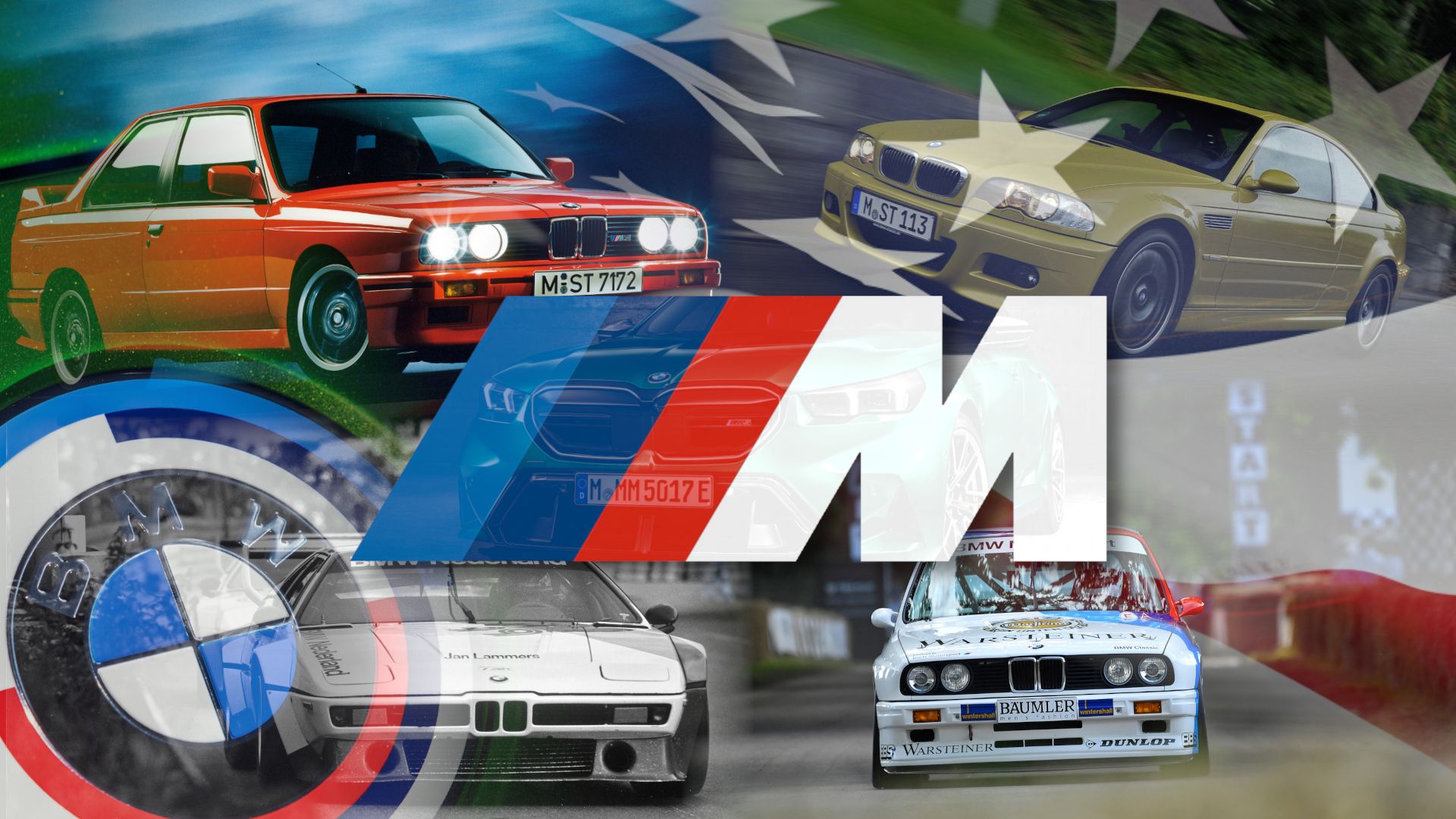
35 employees. That’s how many people were involved when BMW officially established the M Division in 1972. Back then, the idea was only to go racing with the goal of establishing BMW as a sporty brand. Little did they know that the small department would evolve into a massive division dedicated entirely to building some of the best sports coupes, performance sedans, and SUVs the world had ever seen.
And to think the car that essentially started it all didn’t even have the letter M in its name. It was the original 3.0 CSL, and it started winning almost immediately. The Batmobile won the European Touring Car Championship five years in a row, it took a class victory at Le Mans, and it won several races in the IMSA GT Championship in 1975. Clearly, those 35 people knew how to build a track car, which is why the bean counters decided to give them the budget to produce a supercar using the M badge.
BMW
- Founded
-
1916
- Founder
-
Karl Rapp
- Headquarters
-
Munich, Germany
- Owned By
-
Publicly Traded
- Current CEO
-
Oliver Zipse
In 2025, BMW North America celebrates its 50th anniversary. In honor of that, this week is BMW Week here at CarBuzz, where we’ll be looking at BMW North America’s greatest achievements, interesting stories, and some broader looks at the BMW brand, its history, and some of our most and least favorite models.
Genesis: The First M Was A Flop
The First Mass-Produced Mid-Engine BMW
BMW went all out with the first-ever production M car, aptly named the M1. It was built to be a homologation car for the FIA’s Group 5 category, but the M department still wasn’t large enough to handle the required 400 road-legal examples, so it turned to Lamborghini. But Lamborghini was in financial trouble and only completed seven prototypes before it handed the entire operation back to Bimmer. This caused massive delays, and by the time the M1 was ready to go racing, the regulations had changed. But the head of BMW Motorsport, Jochen Neerpasch, had a brilliant idea. Instead of competing with other cars, why not introduce a one-make series? And to get the most traction out of it, why not make it a support series for Formula 1, and have actual F1 drivers compete?
Despite famous names like Niki Lauda and Nelson Piquet competing in the series, it only lasted for two years. The series also failed to spark interest in the M1, of which only 453 were made. Basically, the customer base BMW had in mind did not understand the car. Because it was a hand-built homologation special, it was more expensive than equivalent Ferraris and Lamborghinis of the time, both of which had more prestige (and cylinders). So that’s what customers purchased instead. Meanwhile, the M1 had to wait a few decades to be fully appreciated. It’s quickly gaining traction as a highly collectible piece of automotive history, with the most recent sale fetching $685,044.
But back then, the project was a failure. However, BMW had a little something left over. The M88 3.4-liter straight-six engine was designed in-house by the same person responsible for the famous S70 V12 engine. The development had already been done, so why not use it to power something else in the range? And that’s when BMW dropped the M88 under the hood of the 5 Series, creating the first M car as we know it: the BMW M5.
Finding The Right Recipe: The E28 M5 Got M On The Right Path
It Wasn’t The E30 M3 That Came First
Many out there believe the E30 M3 was the first time BMW produced the first real M car, but it was way too aggressive. The E30 M3 and its various versions were lightly disguised racing cars that came standard with a dogleg gearbox. The high-revving S14 engine was a magical thing, but the addition of a catalytic converter took some of the magic away. It was also a stiff and unforgiving car, only available with two doors. For us, a proper M car needs to shine on the track, but also during daily use. That’s why we’ve always thought of the E36 M3 as the proper genesis of small M cars.

Related
Opinion: The E36 Is The True Genesis Of The BMW M3
The E30 is arguably a standalone product, and we should stop considering it the benchmark.
The first M car that mixed practicality, luxury, and huge amounts of fun was the E28 M5, which came out two years before the E30 M3. BMW used the E23 535i as a starting point, and bolted the M1’s M88 engine under the hood. The result was the fastest production sedan the world had ever seen. It came standard with 286 horsepower, a five-speed manual, a limited-slip differential, and it could reach 62 mph in 6.5 seconds. That was supercar-like acceleration in the mid-80s, and you could do it with four people on board, plus all the luxury amenities of the day.
That’s the true spirit of a BMW M car. They are everyday luxury cars with an anger management problem. They’re civilized and well-spoken, but they can rip your head off. Maybe that’s why James Bond drove BMWs for a few years…
The Golden Era: M Starts Hitting Its Stride
Hit After Hit
Many will argue that BMW M’s golden era was from the introduction of the E28 M5 to the mid-2000s. The Motorsport division kept on churning out winners in every formula, including the pinnacle of the sport, Formula 1. It was also partly responsible for one of the greatest Le Mans victories of all time, building the famous M70 V12 for the McLaren F1.
The road car division churned out a series of sensational cars, mostly with model-specific engines. Let’s just list a few iconic cars from this era: The E36 and E46 M3 (and the CSL), Z3M and M Coupe, the glorious E39 M5, and the V10 M6, M5, and M5 Touring that followed afterward.
This era kind of leaves you pondering if there ever was a bad M car. The folks in the M department had a set of rules and regulations, which they stuck to religiously for a time:
- M doesn’t do turbocharging
- M doesn’t do all-wheel drive
- M doesn’t do SUVs
All three of these rules would be broken in the next generation, and it added another division, which turned out to be smart, but angered a lot of people.
When M Broke All The Rules
An M SUV? Heresy!
BMW M had concrete rules in place, but it started breaking them as time went by. This angered loyalists, but it made BMW a lot of money. The first BMW to break cardinal rules was the 2010 BMW X5 M. There had been fast X5s before, but they were not allowed to wear the M badge. So that was the no SUVs and no AWD drive rules broken. The X5 M also broke a third rule. It was the first turbocharged M car, which upset many people until one of the best M cars ever turned out to be turbocharged.
In 2012, BMW M introduced a new subdivision called M Performance. These cars weren’t quite as gnarly as the full-fat M models, but they were still pretty rapid and fun to drive. Many said that it was only BMW cashing in, but some of these cars were really good. The ones that stand out to me are the M135i and the later M140i, which were unfortunately not sold in the USA. These cars gave you 90% of the thrills, but at 70% of the price.
But the one that really upset people (me included) was the first FWD-biased M model. The F40 1 Series and 2 Series Gran Coupe were built on a Mini platform and made use of a front-biased AWD system, unlike BMW’s own xDrive. Oddly, the one FWD 1 Series built was a magical thing to drive. The mass market didn’t care, and these M Performance models, AWD, FWD, or otherwise, sold really well.

Related
America Missed Out on BMW’s First Proper Volkswagen Golf GTI Rival
The BMW 128ti was a front-wheel-drive hot hatch rival to the Golf GTI, praised for its handling but limited in salesbut unavailable in the U.S. marke
The other big change in the 2010s was the introduction of turbocharging. The X5 M and X6 M were the first, but the 1M Coupe proved that loyalists didn’t have to worry. If you had to make a list of the best M cars ever, this tiny menacing machine would easily be in the top five. This made turbocharging more palatable, which turned out to be great because the big hitters were about to go the forced induction route, too. The F10 M5 used the same 4.4-liter twin-turbocharged V8 as the X5 M, and the M3 went turbocharged in 2014.
These new turbocharged cars put up higher power and torque numbers than ever before, forcing BMW to eventually add AWD, in some cases with no RWD option at all. Did this detract from the driving experience? Not at all. The rear-biased systems used in the various models still feel very much RWD, and you can completely disengage the front axle if you want to partake in some sideways action.
To many, these changes changed what BMW M stood for, but we need to circle back to the beginning and remind ourselves what these M cars are supposed to do. Yes, performance plays a big role, but the addition of AWD and electronic trickery made the cars even more accessible to more people.
And let’s not forget that the turbocharging era gave rise to the smaller M cars, widely regarded as the best of the bunch. Without the 1M, we wouldn’t have had the M2 and the brilliant M2 CS, and the 2025 M2 CS and its 523-hp blown inline-six. But not every M to break the rules would be regarded as a success…
The Halo That Proved BMW M Can Also Get It Wrong
The Second Standalone M Is A Fail
The M1 was the first standalone M car. Every M car since has been a derivative of an existing model, until the XM came along in 2023. The XM is what happens when you let marketing design a car. The people want an SUV? Let’s give it to them. The people want a car to have the most power and the most expensive sticker price? We’ll do that, too.
The XM is proof that people sometimes need to be shown what they want, rather than given what they want. The best example in automotive history is the Mazda Miata. As cars got bigger, heavier, and turbocharged, Mazda simply refused to buy in. The current Miata adheres to the same principles as the first-generation, and it’s still selling. The XM is not.

Related
In The Metal: The 2023 BMW XM Is A Great Luxury SUV But A Poor M Car
If it weren’t badged as a bespoke M car, it would have a few redeeming qualities.
BMW still gets it right more often than not. The original guiding principles are still around, but tweaked a bit for the modern world. What’s the best M currently on sale? Probably the M3 Touring, which is sadly not sold in the USA. It’s a Swiss Army Knife of a car. It will happily take the kids to school and thrill you on a track on the same day.
Does The Motorsport Legacy Live On?
Only In Endurance
BMW’s actual on-track antics have died down over the years. These days, it focuses mainly on endurance racing in various classes, ranging from LMDh hypercars to basic entry-level track cars that you can buy directly from the factory; the new M2 Racing is a prime example, even with a four-cylinder engine. It’s a little sad, though, as the brand used to compete in F1, F2, WRC, Formula BMW, Touring Cars, and even superbike racing.
But the racing DNA lives on in amateur racing. If you look at any list of the best used project cars for track days, there will always be four cars on it; the Miata, the E36 or E46 M3 (or just the standard models), a Nissan Z car of some sort, and a C5 Corvette.
The spirit of BMW Motorsport mostly lives on in the hands of the people, which is quite fitting. BMW M started out as a racing team, started producing track-ready cars for the road, and now those cars are being purchased by a new generation of enthusiasts who are keeping the spirit alive at cheap race events across the country.
The M might now have turned into Marketing instead of Motorsport, but from humble beginnings, BMW turned its motorsport operation not a single letter recognizable and revered almost anywhere in the world.