
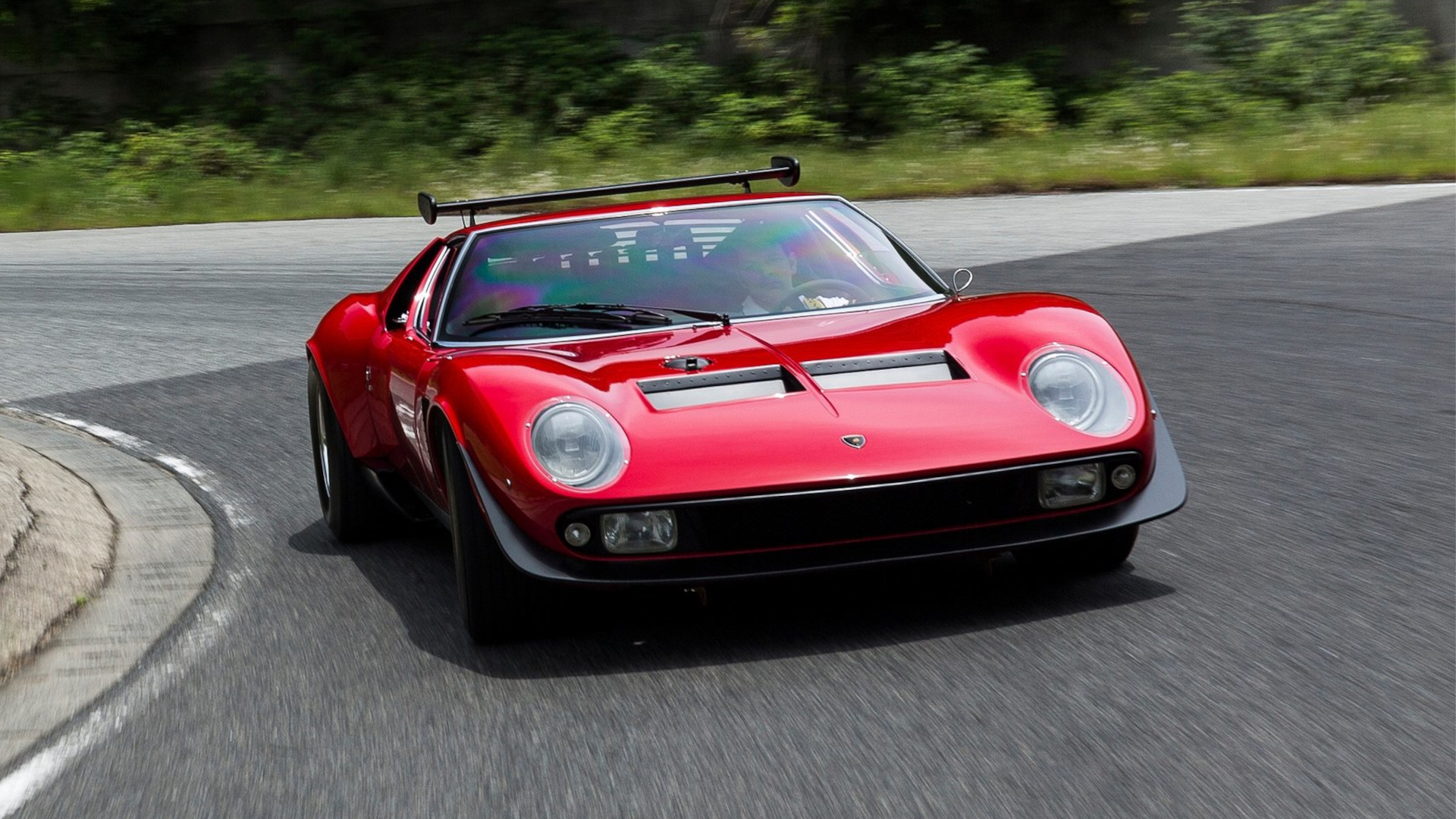
Here’s What Happened To The Only Lamborghini Miura SVR Ever Built
When automotive enthusiasts list the most beautiful and historically relevant cars throughout the decades, the Lamborghini Miura is always mentioned, and for good reason. With its striking, ahead-of-its-time design, it became an instant automotive icon of the late 60s and early 70s, gaining some major pop culture credentials along the way thanks to its starring role in the opening sequence of The Italian Job. It’s also widely regarded as the first supercar ever built.
While several special editions of the Miura have been produced over the years, only a single car in the world can call itself a Miura SVR, thanks to the effort of its enterprising owner and Lamborghini’s willingness to think outside the box and do something a little different. Here is the story of the one-of-a-kind Miura sporting chassis number 3781, and how it became different from every other Miura in existence.
Where It All Began: The Miura Story
While today the Miura is one of the most famous classic Lamborghini models, it started out in life as a side project rather than an official development effort on the part of the company. Three of the firm’s top engineers, Giampaolo Dallara, Bob Wallace and Paolo Stanzani, started developing what would become the Miura in their own free time, working on the project at night. Eventually, Ferruccio Lamborghini himself was made aware of their idea, and was convinced it could be a viable opportunity for the company to pursue.
Even after Lamborghini had been brought on board, the development of the car was not without its ups and downs. Legendary Italian design firm Bertone was recruited to take care of the styling aspect, and the team worked around the clock to make sure they had a finished car ready to present at the 1966 Geneva Motor Show. Even though they succeeded in their aim, it was only a partial success as the car that was presented at Geneva couldn’t possibly move under its own power.
This was because the engineers had not checked if there was enough room to fit the engine inside the engine bay; in an effort to present the car at the show anyway, they packed the engine bay with ballast instead. Despite the lack of an engine and all the challenges it encountered on the way to Geneva, the Miura immediately made a dazzling impression, and orders started to come in quickly.
Three years after its introduction, the Miura became a pop culture sensation when it made an appearance in the opening sequence of The Italian Job. Driven on the Great St Bernard Pass in the Alps by actor Rossano Brazzi and stunt driver Enzo Moruzzi, an orange Miura became a cinematic icon, boosting the model’s popularity. (The actual car from the movie was lost for decades before eventually being sold to a collector and restored in 2018.)
Variants And Special Editions
After the arrival on the market of the original Miura, dubbed the P400, several different variants and special editions of the model soon followed. In 1968 a slightly revised version, the Miura S or P400S, was introduced at the Turin Motor Show. This variant was upgraded with some cosmetic and comfort features such as chrome trim and power windows, plus mechanical updates such as larger engine intake manifolds. This version produced an additional 20 hp, for a total output of 365 hp. Three years later, in 1971, the P400SV version arrived: this Miura produced 380 hp, thanks to a few mechanical modifications including modified carburetors and different cam timing. Thanks to the implementation of two separate lubrication systems for the engine and gearbox (a feature which previous Miuras did not have), the SV could use the optimal type of oil for each respective component, ensuring the best possible level of functionality.
Several small-scale or one-off variants of the Miura were also produced over the years. The legendary Jota test mule, named after the Spanish pronunciation of the letter J, was built in 1970 to conform to the FIA’s Appendix J racing regulations, hence the name. Aluminum replaced steel in several body components, resulting in a considerable weight reduction of around 800 lbs. The engine was modified as well, resulting in a power output of around 440 hp. Every aspect of the car, from the suspension to the wheels and the fuel tank, was reworked to optimize it for the world of motorsport; however, the Jota would sadly never get to have the racing career it was built for, as only a year after its creation it was involved in an accident and burned to the ground. A handful of one-off tribute vehicles, built to the same or similar spec, have since been produced (although not by Lamborghini itself).
Other notable special editions include the SVJ (only six of which were built), a one-off Bertone-built Roadster version, and an open-top SVJ, not built by Lamborghini but created as a show car for a Lamborghini importer in Switzerland.
The Journey Of #3781: From Factory To Home To Factory
One particular Miura, more specifically, a Miura S (at the start of its life, at least) has had a more interesting journey than most. Built in 1968 as a Miura S with chassis number 3781, it was originally finished in “Verde Miura” (Miura Green). After switching hands several times, it was eventually bought by its ninth owner, Heinz Steber, in Germany; in 1974, he was involved in a minor accident while taking the car for a service at the Lamborghini factory. Seeing as the car had suffered some front-end damage that needed repairing, Steber took the opportunity to have some modifications made; he had heard about the Miura Jota and wanted to rebuild his own car according to the same specs. However, Lamborghini was initially reluctant to help him, as production of the Miura had ended in 1973.
Steber was undeterred and decided to go about sourcing his own components to do the job, including brakes from a Porsche 917, BBS wheels, and suspension components from high-performance firm Koni. Lamborghini eventually relented, and work began to build this unique car; by the end of 1975, the only Miura in existence to wear the SVR badge had officially been created.
Gaining Fame: TV Shows And Die-Cast Models
Despite his determination towards having it built, Steber did not hold onto the car for very long after its conversion to SVR spec; having had trouble with the German authorities while trying to get the car registered, he sold the car to Hiromitsu Ito in Japan, where it would remain for several decades. Thanks to its uniqueness, the Miura SVR rapidly attracted attention from the automotive world and the world of pop culture alike, being featured in a Japanese comic series called “Circuit Wolf”. A die-cast model of the Miura SVR was built by Tokyo-based model car company Kyosho, becoming a coveted item for model car enthusiasts; today, examples of this model can be found on sale for several hundred dollars.
Labor Of Love: The Polo Storico Restoration And The Future Of “The Ultimate Miura”
In 2018, this unique Miura was for sale once again and made its way from Japan back to Italy, but not in one piece: it was broken down in parts, many of which had been modified since the original build, and shipped back to the Lamborghini factory for an extensive restoration courtesy of the “Polo Storico” (Historical Hub), Lamborghini’s dedicated classics restoration division. The process took 18 months, during which every single component was painstakingly restored and reassembled to put together the completed car once again.
“The full restoration took 19 months and required a different approach from what we’re normally used to. The original production sheet wasn’t of much help, as we relied mostly on the specs from the 1974 modifications. The challenge for the Polo Storico team was made even more daunting by the fact that the car arrived in Sant’Agata in pieces, although the parts were all there, and with considerable modifications. The only variations on the original specifications were the addition of 4-point safety belts, more supportive seats and a removable roll bar. These were expressly requested by the customer and are intended to improve safety during the car’s racetrack exhibitions.”
-Paolo Gabrielli, Lamborghini Head of After Sales and Director of Polo Storico
Once the Miura SVR had been brought back to its former glory, it was shipped back to Japan to be delivered to its new owner, and showcased with a few demonstration laps around the Nakayama circuit. The car remains in Japan to this day, although sadly its engine is currently non-operational. We can only hope that, at some point in the future, what many enthusiasts consider to be “the ultimate Miura” will once again be restored to its former glory.
