Every Time Chrysler Tried To Build A Turbine-Powered Car
The automotive world has always kept one eye looking towards the future, with innovative concept cars and high-tech features showcasing what mobility could look like. This was especially true in the 1950s and 60s: as the Jet Age kicked into high gear, with economic prosperity and scientific discoveries going hand-in-hand, the notion of a better life through technology became a cultural staple. Chrysler did its part to try and create the car of the future, by attempting to build vehicles with an innovative propulsion method: a turbine engine, which had been used extensively in aircraft but never in a car. The company’s research and development program stretched from the 50s to the 70s, with seven different generations of turbine engine being built and tested in various prototypes.
Chrysler
Also known as FCA US, Chrysler is the American subsidiary of the global automotive company Stellantis. Historically, Chrysler has been one of the ‘Big Three’ American automakers. It was founded in 1925 by Walter Chrysler and merged with Daimler-Benz in 1998; the company was called DaimlerChrysler until its Chrysler stake was sold off less than a decade later. Chrysler operated on its own until Fiat S.p.A acquired it in 2014. When Stellantis was formed in 2021 after the merger of FCA and PSA, Chrysler became a subsidiary. With only a few models on sale in the US at present, Chrysler is one of the handful of automakers still producing minivans, with its Pacifica lineup.
- Founded
-
1925
- Founder
-
Walter Chrysler
- Headquarters
-
Michigan, United States
- Owned By
-
Stellantis
- Current CEO
-
John Elkann (temporary)
The turbine engine program, however, never translated into a production model for several reasons. When Chrysler had first begun to investigate the possibility of producing a turbine-powered car in the late ’50s, emissions were not a concern in the automotive industry, and fuel economy was not high on the list of priorities. By the time the ’70s rolled around, however, emissions and environmental impact had risen to the forefront of the industry’s concerns, and the turbine engine was simply not compatible with the automotive world’s new priorities. At the tail end of the decade, Chrysler found itself in financial difficulties, and secured a government loan on the condition that research on turbine engines be abandoned. This marked the death of the whole project, with the few surviving prototypes being turned into museum pieces. Let’s explore all the attempts Chrysler made at turning the dream of a turbine-powered car into a reality.
This list includes the turbine engines produced by Chrysler over the years, and the cars they were installed in, listed in chronological order.
1
CR1
Power Output: 100 hp
The very first generation of turbine engine produced by Chrysler was called the CR1. It was built in the early ’50s, with the first successful test taking place in 1954 to celebrate the opening of Chrysler’s new proving grounds near Chelsea, Michigan. The chosen car was a Plymouth Belvedere. Results of initial testing proved to be highly encouraging for the engineering team, and the following year the engine was installed in a four-door Belvedere. In 1956, a major accomplishment arrived: a modified version of the CR1 powered yet another Belvedere, which made the first ever cross-country trip in a turbine-powered car.

Add CarBuzz to your Google News feed.
The CR1 engine only produced 100 hp and still had plenty of teething issues, some of which would be gradually worked out in subsequent generations, but it represented the crucial first step in the research program and raised the team’s hopes that one day a turbine engine could be found in a production model.
2
CR2
Power Output: 200 hp
Shortly after the CR1, the Chrysler team started working on a second generation of the turbine engine, setting out to mitigate some of the issues (such as a shockingly poor fuel economy of 13 mpg) that had plagued the CR1.

Related
Revolutionary 25,000-RPM Engine Is The Next Step Of Internal Combustion
Turbine technology, anyone?
The result was the CR2: the team managed to squeeze another 5 mpg out of this engine, bringing it closer to standard production cars of the time. Power output was doubled, thanks to the use of stronger alloys with a higher tolerance for oxidation and heat. The CR2 was installed in three Plymouths from the late 1950s, including a custom “Turbine Special” sedan based on the Fury.
3
CR2A
Power Output: 140 hp
Within a couple of years of the CR2 being built, a third generation was already on the way, dubbed the CR2A. This engine carried a considerable number of mechanical improvements, including engine braking (which had been completely absent from previous versions) and better acceleration with less throttle lag (the CR1 took around seven seconds to get up to full power output). These improvements were accomplished thanks to the addition of a pivoting fuel nozzle mechanism and first-stage turbine vanes that could change their angle depending on throttle position.
The CR2A was installed in a Plymouth Fury, like its predecessors, plus two additional vehicles: a 2.5-ton Dodge truck and a one-of-a-kind concept called the Chrysler TurboFlite. The latter was built by Italian firm Ghia (which would go on to build the better-known Chrysler Turbine Car a few years later), and featured a unique, futuristic design with aerodynamic elements and large fins.
4
A-831
Power Output: 130 hp
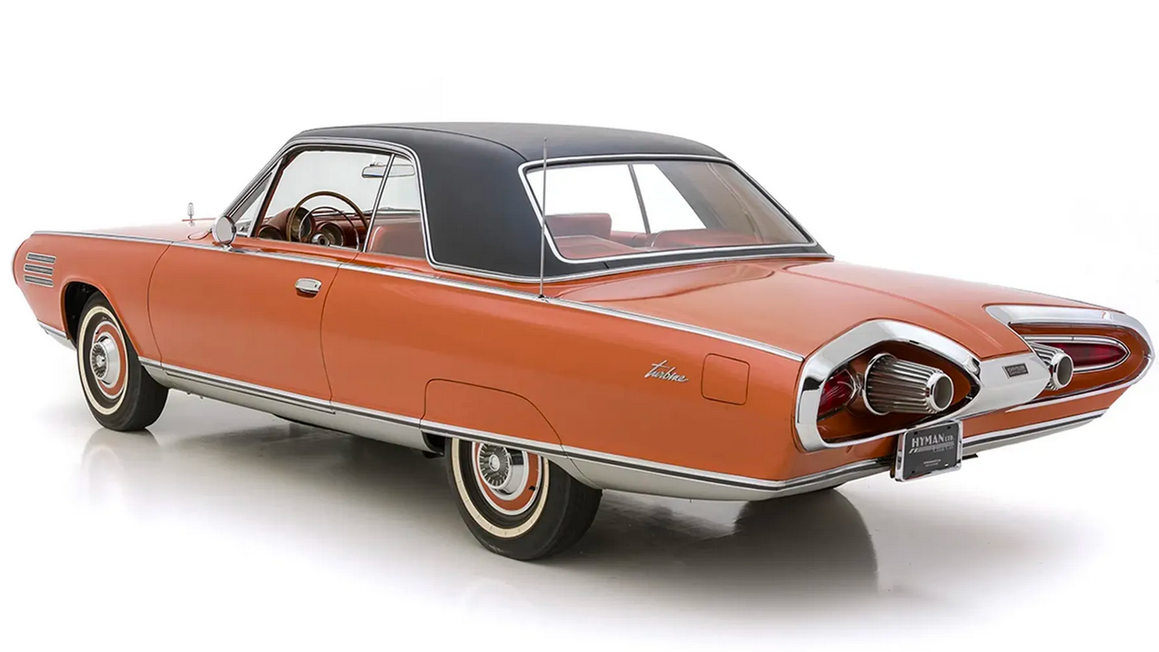
The generation that followed the CR2A was first tested in a Plymouth Fury, but ultimately ended up powering the most famous of Chrysler’s turbine vehicles, the Chrysler Turbine Car. Rather than installing the engine in an existing model used as a testing mule, as had been done with previous generations, this time Chrysler opted to create a new design from the ground up, in collaboration with legendary Italian firm Ghia.
With no pistons, crankshafts or connecting rods, as well as no need for a radiator or cooling system, the A-831 was radically different from a standard combustion engine; it idled between 18,000 and 22,000 rpm, and at 36,000 rpm it produced its peak power output of 130 hp. The turbine’s maximum safe speed was 44,500 rpm, according to the “Driver’s Guide” Chrysler published to illustrate the new engine’s characteristics.

Related
The Italian-Built American Car That Idled At 18,000 rpm
The history of Chrysler’s one-of-a-kind Turbine Car, and why it didn’t work out.
The A-831 was also highly versatile when it comes to fuel. In Chrysler’s own words, it could run on anything “from peanut oil to Chanel No. 5”: any substance with combustible properties could be used, except for leaded fuel which left deposits that damaged the engine. The Driver’s Guide recommended kerosene and diesel as the best options, although the president of Mexico at the time successfully ran a Turbine Car on tequila.
5
A-875
Power Output: N/A
The A-831 was followed by the short-lived A-875, introduced only a year after its predecessor in 1964. There was a slight overlap between the two engines: when the A-875 was introduced, the A-831 Turbine Cars were still being put through their paces by the public, as part of an innovative testing program that lasted nearly three years. The A-875 was mechanically very similar to the A-831, but had larger regenerators. This engine was only tested for a short period of time in two 1964 Plymouth Furys; still, the turbine project carried on, leading to the creation of the sixth-gen engine by 1966.
6
Sixth generation
Power Output: 150 hp
The sixth-gen engine brought further improvements on the engine braking front, as well as the ability for components like the power steering pump to be driven directly by the power turbine. This engine was installed in two Dodge models: a Charger and a Coronet 500. The latter even came close to getting a small production run of its own: Chrysler briefly contemplated the possibility of building and selling 500 turbine-powered Coronets, but ultimately decided against it due to increasing emissions standards. The Coronet remained in service as a testing prototype for the next few years, until the seventh-generation engine was completed in the early 70s.
7
Seventh generation
Power Output: 104 hp
In the early ’70s, Chrysler received a grant from the Environmental Protection Agency (EPA) aimed at funding further research on turbine engines. The result was the seventh-generation engine, which was both smaller and lighter than the company’s previous efforts. This engine was first installed in two 1976 Dodge Aspens, then in a 1977 Chrysler LeBaron, with a view towards starting a production run later in the decade. However, this ultimately did not come to pass, as the turbine engine fell out of favor as a concept and the automotive world rapidly moved on.
1:18

Related
Video: Two-Thirds Of Americans Want The EPA To Be Tougher On Emissions
According to a new study, the vast majority of Americans want more efficiency.
Emissions regulations were beginning to get more strict, meaning the turbine engine’s poor fuel economy was more and more of a problem; the other issues that had been plaguing the engine for years, such as poor acceleration and erratic performance, were insurmountable obstacles that made a successful production run impossible. The seventh generation of the Chrysler turbine engine turned out to be the last; it was also installed in the very last turbine-powered Chrysler ever built, a 1980 Dodge Mirada.
Sources: Chrysler, HowStuffWorks, AllPar, MotorCities National Heritage Area.