Did Switching to VC-Turbo Engine Hurt Performance?
Though it has fallen far from its heyday, Infiniti is bouncing back with strong new products like the QX80. However, each step forward seems to be accompanied by a baby step backward, something we noticed while testing the updated 2026 Infiniti QX60. The QX60 was introduced in 2012 as the JX35, and for its entire life, it was powered by a 3.5-liter V6 from Nissan’s VQ engine series (not including the forgotten QX60 Hybrid). Last year, however, the longstanding VQ was finally put to rest for the Infiniti brand.

- Base Trim Engine
-
2.0-liter turbo inline-4
- Base Trim Transmission
-
9-speed automatic
- Base Trim Drivetrain
-
Front-Wheel Drive
The 2025 QX60 introduced a new engine, a 2.0-liter turbocharged four-cylinder with variable compression technology. This is the same engine found under the hood of the QX50 and QX55, but unlike those models, the QX60 uses a nine-speed automatic, not a continuously variable transmission. Infiniti says the VC-Turbo engine is more fuel efficient, and produces similar power as the old V6. But after testing the 2026 QX60 for a week, we aren’t sure the new engine is much of an improvement.
The Outstanding VQ35 V6

To understand what we don’t love about the new engine, we must first talk about why we loved the outgoing one. Nissan’s VQ Series V6 engine was found under the hood of some excellent cars, ranging from the Pathfinder SUV to the G35 sports coupe. The first-generation QX60 uses this engine, but it was paired with a CVT that muddled the experience. Then the second-generation QX60 came along for the 2022 model year, introducing a far superior nine-speed automatic.
At the end of its lifecycle in the QX60, the VQ35DD engine produced 295 horsepower and 270 lb-ft of torque, going out to front- or all-wheel-drive. That’s a bit more power and torque than Honda’s V6 in the Acura MDX, and more hp (but less torque) than the turbo-four in the Lexus TX. European rivals with turbocharged six-cylinder engines outclassed it, but for its age and price point, the VQ punched above its weight, and it sounded great.
Swapping In The VC-Turbo

Nissan’s VC-Turbo engine, also known as the KR20DDET, should be pretty familiar by now, after being used in the QX50, QX55, Altima, Murano, and Pathfinder (China-only). A 1.5-liter three-cylinder version called the KR15DDT also exists in the Rogue. The “VC” portion of the name refers to the engine’s ability to vary its compression ratio. It can run a low compression ratio (8.0:1) to achieve more power, then switch to high compression (14.0:1) for greater thermal efficiency. An actuator arm rotates the control shaft, adjusting the vertical position of the piston within the cylinder, altering the compression ratio.
Put more simply, this engine is supposed to deliver the best of both worlds between power and fuel efficiency. We’ve always had a problem with this claim, however, because the QX60 is neither the most powerful nor the most fuel-efficient vehicle in its segment. It produces 268 hp, which is less than the old V6 (a 27-hp drop), and the torque only seems a modest bump to 286 lb-ft (a 16 lb-ft increase). Was it really worth the added complexity to achieve more torque, but less power?
It Is Actually Slower

If you only care about the performance side of the equation, the easy answer to our question is a resounding “no”. Infiniti does not quote a 0-60 mph for the QX60, but we recorded the sprint in our 2026 QX60 Sport tester at a lackluster 7.82 seconds. That’s slower than the following three-row crossovers: Lexus TX 550h+ (5.37 seconds), Ford Explorer (5.64 seconds), Hyundai Palisade (6.97 seconds), Chevrolet Traverse (7.41 seconds), and Buick Enclave (7.79 seconds).
|
Infiniti QX60 VC-Turbo Vs VQ V6 Performance |
||||
|---|---|---|---|---|
|
Models |
Engine |
Power |
Torque |
0-60 mph |
|
2024 Infiniti QX60 |
3.5-liter V6 |
295 hp |
270 lb-ft |
6.6 seconds |
|
2026 Infiniti QX60 |
2.0-liter Turbo-Four |
268 hp |
286 lb-ft |
7.82 seconds |
More importantly, the four-cylinder QX60 is slower than the model it replaces. CarBuzz never did a 0-60 test on the outgoing model, but our friends at Redline Reviews recorded a 6.6-second time in a 2024 QX60 with the V6 engine. Redline also tested a 2024 Nissan Pathfinder Rock Creek with the same engine, at it hit 60 mph in 6.4 seconds.
Is It More Fuel Efficient?

In terms of performance, the VC-Turbo is actually a downgrade from the outgoing VQ engine, but is it more fuel efficient? Looking at the numbers from the Environmental Protection Agency, the surface-level answer would be “yes”. With FWD, the QX60 gains one mile per gallon overall, and that number doubles to a two-MPG gain with AWD. These numbers are calculated with a 2025 QX60, since the EPA has not yet published official data for the 2026 model. Since the 2025 QX60 also had the VC-Turbo engine, we expect similar fuel efficiency. In our real-world testing, we averaged 21.4 MPG in the 2026 QX60 AWD compared to 19.9 MPG in a 2022 model.
|
Infiniti QX60 VC-Turbo Vs VQ Efficiency |
|||
|---|---|---|---|
|
Miles Per Gallon |
City |
Highway |
Combined |
|
2024 Infiniti QX60 FWD |
21 MPG |
26 MPG |
23 MPG |
|
2025 Infiniti QX60 FWD |
22 MPG |
28 MPG |
24 MPG |
|
2024 Infiniti QX60 AWD |
20 MPG |
25 MPG |
22 MPG |
|
2025 Infiniti QX60 AWD |
22 MPG |
27 MPG |
24 MPG |
One or two MPG doesn’t sound like that much, so how much does that actually save you in terms of fuel cost? According to the EPA, you could save as much as $203 per year switching from a QX60 AWD with the V6 to the VC-Turbo. That adds up to $2,030 over 10 years. For the FWD model, those savings are lower; you will save about $152 per year or $1,530 over 10 years. The VC-Turbo technically does its job here, but it’s still less impressive than other options in this segment. Here’s how the QX60 stacks up against its rivals in yearly fuel costs (according to the EPA):
- Infiniti QX60 (FWD): $2,544 per year
- Infiniti QX60 (AWD): $2,622 per year
- Lexus TX 500h (AWD): $2,266 per year
- Acura MDX (AWD): $2,944 per year
- BMW X5 xDrive40i (AWD): $2,486 per year
- Volvo XC90 B5 (AWD): $2,387 per year
The QX60 Is Better In Other Ways

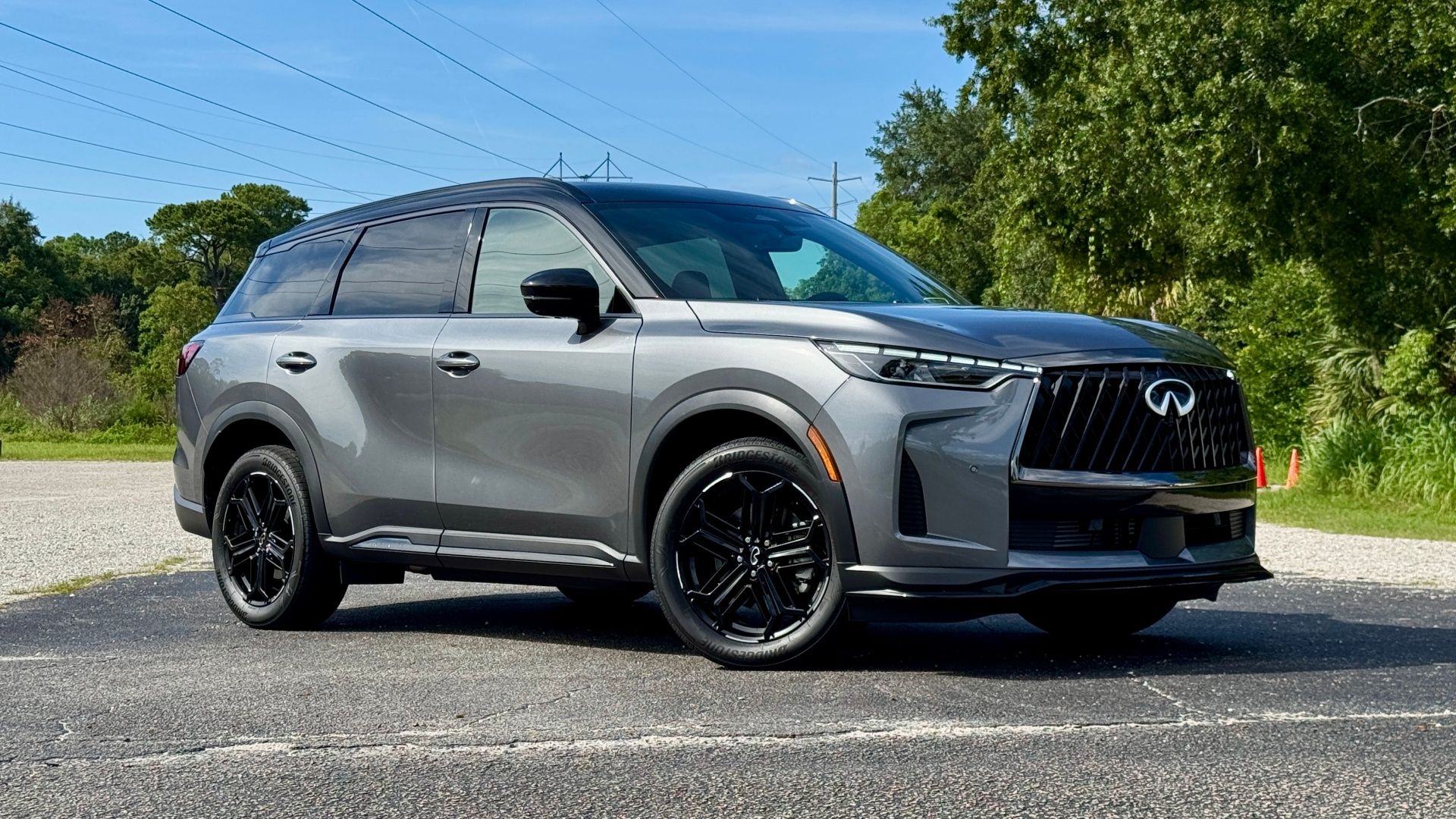
While the switch from the V6 to the VC-Turbo hasn’t been the most positive change for the QX60, this model is improved in other ways for the 2026 model year. For starters, it gets a new Sport trim level that looks more stealthy with a black grille, black wheels, and other black accents. There are some minor changes to the bumper and grille, and details on other trims. ProPilot 2.1 with hands-free highway driving has also been added, but only on the top Autograph trim.

There are more significant differences inside, where the 12.3-inch infotainment system now has a Google-based operating system. It’s quicker, cleaner, and more functional than before, and it’s now paired with a 16-speaker Klipsch audio system or a 20-speaker system on the Autograph trim.

We tested the 16-speaker version in our Sport trim tester, and it sounded far superior to the outgoing Bose system. Infiniti has also kept the price increase minimal for 2026, only raising it by about $1,000. So if you don’t care about performance, the 2026 QX60 is nicer than past versions.