
Best Modern Interpretations Of Classic Cars
Key Takeaways
- Retro styling in modern cars evokes nostalgia and connects younger generations to automotive heritage.
- Iconic cars like the Fiat 500 and Mini Hardtop blend old and new design elements seamlessly.
- Despite modern advancements, the appeal of retro styling works by adding warmth and individuality to the car market.
The EV revolution is in full swing, and a new generation of cars looks sleeker, smoother, glossier, and more futuristic. Yet, retro styling remains a great source of warmth in the face of increasingly high-tech automotive design.
Cars like the Fiat 500, relaunched in 2007 with a new body design looking like a slightly smoothed-out and much bigger 1972 model, or the Mini Hardtop, bearing the charming silhouette and circular headlights of its predecessor, remind us not to forget where we’ve been along the journey to where we’re going.
2024 Fiat 500e
- Base MSRP
- $32,500
- Base Trim Horsepower
- 117 hp
- Base Trim Torque
- 162 lb-ft
- Transmission
- Single Speed Automatic
- Drivetrain
- Front-Wheel Drive
- 0-60 MPH
- 8.5 seconds
- Top Speed
- 94 mph
Why Retro Styling Works
The appeal of retro design isn’t just nostalgia. That’s part of it, sure. If you have fond memories of long road trips in the back seat of a Ford Bronco, the fact that the new model looks so familiar is a big part of the appeal. But for younger drivers, a retro-styled car is a connection to their automotive heritage. Maybe their grandpa drove a Camaro that looked a lot like the 2023 model.

Related
9 Awesome Retro Style Cars In 2022
The future won’t go well if you don’t also look back.
Or maybe it’s a way to stand out. The muscular lines of a Dodge Challenger certainly make the car pop in a parking lot full of generic crossovers, SUVs, sedans, and hatches. And sometimes, the retro styling becomes a signature, inseparable from the car itself. At this point, the rugged corners and open-air design of a Jeep Wrangler don’t so much remind us of the original WWII-era trucks as they remind us of dirt roads and camping trips.
Whatever the reason, here are some iconic cars where the retro styling just plain works. As an interesting side note, we also included the size and weight of the old compared to the new, just to show how much cars have grown over the years.
Hyundai Pony And The Hyundai Ioniq 5 And Hyundai N Vision 74
|
Model |
Hyundai Pony |
Hyundai Ioniq 5 N |
|---|---|---|
|
Wheelbase |
92.1 Inches |
118.1 Inches |
|
Length |
156.3-157.4 Inches |
185.6 Inches |
|
Width |
61.3 Inches |
76.4 Inches |
|
Curb Weight |
1,918-2,061 Pounds |
4,861 Pounds |
Neither the production model Hyundai Pony, the Hyundai Ioniq 5 N, nor the Hyundai N Vision 74 look exactly like the original Hyundai Pony Coupe concept car designed by Giorgetto Giugiaro, but they are clearly its offspring. The Ioniq 5 N leans into smoother, more aerodynamic, modern lines, while the N Vision 74 looks like it flew right out of a sci-fi action film. Between the various models, you get a good illustration of how far you can take a design in every direction before it becomes unrecognizable.

Related
9 Coolest Features Of The 2025 Hyundai Ioniq 5 N
Hyundai doesn’t care about what rivals do; it just wants EVs to be fun.
Being a compact crossover and an EV, the Ioniq 5 N is naturally much larger and heavier than the original Hyundai Pony, weighing more than twice as much as the Pony estate model. But thanks to smart engineering features, Hyundai ensured that its first electric hot hatch feels more nimble than the car that inspired its design.
Nissan Z Fairlady And The Nissan Z
|
Model |
Nissan Z Fairlady |
Nissan Z |
|---|---|---|
|
Wheelbase |
90.7 Inches |
100.4 Inches |
|
Length |
162 Inches |
172.4-173.2 Inches |
|
Width |
64 Inches |
72.6-73.6 Inches |
|
Curb Weight |
2,150-2,657 Pounds |
2,292 Pounds |
While the Nissan Z is a bit larger in every dimension, with a slightly more muscular front end, it’s incredible just how closely it matches the general profile of a classic Nissan Z Fairlady. The newer car has been modernized, but without losing what made the Fairlady recognizable at a glance. Mount the mirrors up front and swap the headlights, and you could almost mistake one for the other.

Related
The Future Of Nissan’s Combustion Engines Has Been Decided
Nissan will not invest another cent in new ICE powertrains, so where does that leave the next GT-R?
The original Fairlady packed a 128 hp 2.6-liter inline-six engine, while the new model’s twin-turbocharged V6 produced 400 horses. If you love gas-powered Z models, now is the time to get one. Nissan has officially stated that its future is electric, and that it will not be spending any money developing new combustion engines. Apart from the Z, what does that mean for the next-generation GT-R?
Renault 5 Turbo And The Renault 5 EV
|
Model |
Renault 5 Turbo |
Renault 5 EV |
|---|---|---|
|
Wheelbase |
95.7 Inches |
100 Inches |
|
Length |
144.1 Inches |
154.3 Inches |
|
Width |
68.9 Inches |
69.7 Inches |
|
Curb Weight |
2,138 Pounds |
3,307 Pounds |
The Renault 5 Turbo and the Renault 5 EV are good examples of how far you can bend a basic design concept while keeping it recognizable. The newer model almost looks like the original model, wearing a thick, cozy winter coat. The high headlights, compact size, and generally boxy shape remain, but the car has been given an aerodynamic polish and a more modern vibe overall, befitting an electric car.

Related
Renault 5 EV Debuts As A Funky $27,000 Mini Cooper Rival
Known as Le Car in the US before its retirement, the nameplate returns with battery power.
Being an EV, the new Renault 5 weighs a little over a thousand extra pounds compared to the original Renault 5 Turbo. That’s just how it is with EVs, but it’s worth pointing out that the new model is extremely light compared to most electric vehicles. The original Turbo packed a mid-mounted turbocharged engine taking up 85.3 cubic inches of space, not that it mattered because it was nothing more than a Group B WRC homologation car. The new car is built around a standard EV skateboard, so you can actually take passengers along for the ride.

Add CarBuzz to your Google News feed.
Second-Generation Dodge Charger And The Dodge Charger Daytona
|
Model |
Second-Gen Dodge Charger |
Dodge Charger Daytona EV |
|---|---|---|
|
Wheelbase |
115 Inches |
121 Inches |
|
Length |
206 Inches |
206.6 Inches |
|
Width |
79.1 Inches |
79.8 Inches |
|
Curb Weight |
3,220 Pounds |
5,838 Pounds |
Some will argue that a Dodge Charger should never be electric, but it has the perfect name for it. This thing weighs almost twice as much as the original, owing to the hefty battery pack, but it matches the general dimensions of a 1971 Dodge Charger remarkably well and captures the spirit of that iconic, muscular front end. Other than the futuristic sheen, the biggest difference may be the wheelbase, with the Daytona EV standing six inches longer from wheel to wheel than the classic Charger.

Related
The People Have Spoken, And Electric Vehicles Can’t Be Muscle Cars
According to a study, 56% of Americans don’t think the Dodge Charger Daytona is a “real” muscle car.
If you really can’t stand the idea of a Dodge Charger that doesn’t pack a V8 under the hood, the 2024 edition will also be available with a twin-turbocharged inline-six that’s more powerful than both naturally aspirated V8 engines available in the previous model. But it’s nice to know that, whichever Charger you go with, you’re getting the same classic profile that we all know and love.
Fifth-Generation Ford Bronco And The Sixth-Generation Ford Bronco
|
Model |
Fifth-Gen Ford Bronco |
Sixth-Gen Ford Bronco |
|---|---|---|
|
Wheelbase |
104.7 Inches |
100.4-116.1 Inches |
|
Length |
183.6 Inches |
173.7-198.9 Inches |
|
Width |
79.1 Inches |
75.9-85.7 Inches |
|
Curb Weight |
4,430 Pounds |
4,297-4,945 Pounds |
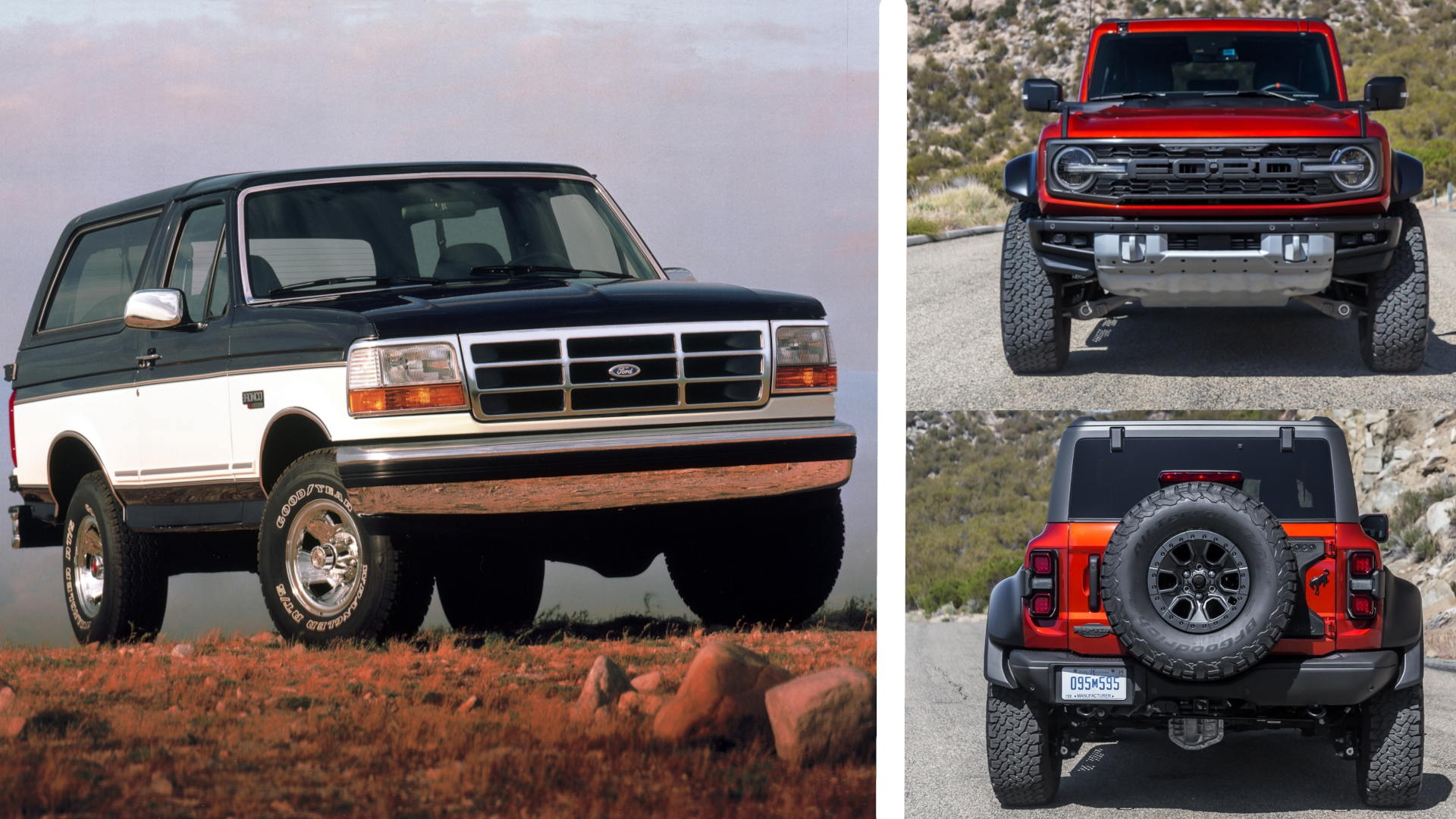
The exciting thing about the announcement of the sixth-generation Ford Bronco was how little it changed. The truck is even roughly the same size and weight. If anything, the new Bronco looks even more retro than the classics, with more pronounced circular headlights and squared-off rear. The biggest difference in terms of dimensions may be that the fifth-gen Bronco stood an extra inch or so above the new model in terms of ground clearance, but new AWD tech more than makes up the difference if you’re looking for an off-road beast.

Related
Ranking Every Ford Bronco Generation From Worst To Best
Even the lowest-ranked Bronco generation was a great SUV.
The smaller Bronco Sport carries the same bulky attitude as its bigger brother but smooths the lines down a bit for an appearance somewhere between a classic Bronco and a 1990s Ford Explorer. Both vehicles capture the feel of Ford SUVs from that era when we were still calling them trucks.
Willys Jeep And The Jeep Wrangler
|
Model |
Willys Jeep |
Jeep Wrangler |
|---|---|---|
|
Wheelbase |
80 Inches |
96.8-118.4 Inches |
|
Length |
131 Inches |
166.8-188.4 Inches |
|
Width |
62 Inches |
73.9 Inches |
|
Curb Weight |
2,453 Pounds |
4,012-5,268 Pounds |
The Jeep Wrangler has grown to be much larger than the “Army Truck” that spawned it. Even the smallest two-door variant stands about a foot wider and three feet longer than the original Willys Jeep. But you can still pull the doors and the roof off. They haven’t smoothed the angles out by much, and it’s still a rugged, uncompromising off-road utility vehicle. The Wrangler’s design has evolved over the years, but it hasn’t changed its basic philosophy.
2:18

Related
Jeep Death Wobble: 30 Years Later, Still The Wrangler’s Achilles Heel
Here’s everything you need to know about the dreaded Jeep death wobble.
Jeep has done an excellent job over the years of expanding its brand with models like the Renegade and the Gladiator retaining the sharp, angular corners and leaning into smoother lines and more concessions to conventional, modern design in family SUV models like the Cherokee, the Grand Cherokee, and the Compass. This has allowed the automaker to retain strong branding on their core off-roader without having to stake their entire end-of-year report on a single model or water the Wrangler down any.
1963-1977 Alpine A110 And The 2017 Alpine A110
|
Model |
1963-1977 Alpine A110 |
2017 Alpine A110 |
|---|---|---|
|
Wheelbase |
82.6-85.8 Inches |
95.2 Inches |
|
Length |
152 Inches |
164.5 Inches |
|
Width |
57.9-61.0 Inches |
70.8 Inches |
|
Curb Weight |
1,556 Pounds |
2,432-2,456 Pounds |
While the Alpine A110 was certainly modernized in its late-2010s redesign by Deyan Denkov, it maintained the same general vibe as Giovanni Michelotti’s original vision for a two-door Berlinette. Besides the smoother lines and sleek, modernized headlights, the new A110 boasts all-aluminum construction. Even so, it weighs in at nearly a half-ton heavier than the original and stretches about ten inches longer from wheel to wheel.

Related
Alpine Reveals Plans For US-Bound Sports Cars
The French automaker will offer the A110 coupe and roadster in the USA, along with a larger A310 four-seater and two SUVs.
The new Alpine A110 is a rear mid-engine, rear-wheel drive car packing a turbocharged 1.8-liter four-cylinder Renault engine. The original A110 was also a rear-engine, rear-wheel drive, but available with several naturally aspirated four-cylinder Renault engines. So the new car looks the part, and, more importantly, it feels the part. In other words, Alpine is not just using the retro styling as a cheap marketing gimmick; they’re delivering a true modern A110.
Volkswagen Rabbit And The Honda e
|
Model |
Volkswagen Rabbit |
Honda e |
|---|---|---|
|
Wheelbase |
94.4 Inches |
99.6 Inches |
|
Length |
155 Inches |
153.3 Inches |
|
Width |
63 Inches |
69 Inches |
|
Curb Weight |
1,830 Pounds |
3,336-3,402 Pounds |
The Volkswagen Rabbit and the Honda e share forward-slanting rear windows, round headlights, a small stature, and a wheel at every corner. Besides that, there is a general design philosophy at work here; both of these cars are simply adorable. The e was designed by Yuki Terai as the “Urban EV Concept,” drawing inspiration in equal parts from the VW Golf/Rabbit and early Hondas with the intention of creating a friendly, comforting car.
Besides the more bubbly aerodynamic lines of the newer car, the Honda e also weighs in at an extra sixteen hundred pounds or so, owing to the hefty battery pack. Overall, when you compare the Honda e to the Volkswagen Rabbit, you could say that it’s a good example of a new car capturing the general spirit of the original, while not necessarily following its exact lines or dimensions in any concrete, literal way. Sadly, the world did not respond well to the tiny Honda, and it was axed after only three years on sale.
The Original 1964-1969 Porsche 911 And The 992 Series Porsche 911
|
Model |
1964-1969 Porsche 911 |
992 Series Porsche 911 |
|---|---|---|
|
Wheelbase |
89.3 Inches |
96.5 Inches |
|
Length |
163.9 Inches |
177.9-178.5 Inches |
|
Width |
63.4 Inches |
72.9-74.8 Inches |
|
Curb Weight |
2,249 Pounds |
3,263-3,770 Pounds |
Porsche has remained true to the 911’s original design from the very start. The new 992 Series is a bit bigger in every dimension, weighing more than a thousand extra pounds and stretching an extra foot or so in the wheelbase. But the bulging headlights and sleek silhouette with the sloping back end are design hallmarks. There is a very clear lineage of design throughout 911’s entire history; there is no “missing link.”

Related
Porsche 911 Carrera Generations: Everything You Need To Know In One Place
Porsche’s immortal everyday sports car might be the best all-rounder in its class; unmatched practicality, comfort, and handling make it the king.
The visual design of a Porsche is only part of the package, of course. The sound is just as important, and the base 992 Carrera model packs a 3.0-liter flat-six engine with twin turbos and gorgeous engine notes. So if you’re a longtime fan of the brand, you can rest assured that they’ve covered all their bases in creating an aesthetically pleasing sports car.
1979-1992 G-Class And The Current Mercedes G-Class
|
Model |
1979-1992 Mercedes G-Class |
2022 Mercedes G-Class |
|---|---|---|
|
Wheelbase |
94.5-112.2 Inches |
113.1-113.8 Inches |
|
Length |
165.8 Inches |
191.5 Inches |
|
Width |
69.3 Inches |
86.1 Inches |
|
Curb Weight |
3,913 Pounds |
5,842-6,315 Pounds |
The 2022 G-Class lands within a couple of inches of the original wheelbase at its longest while stretching a couple of extra feet in body length and another foot and a half across in width, and it weighs an extra ton or so. But at a glance, it just looks like a slightly bigger version of the original G-Wagon. Mercedes has essentially made only the changes that they absolutely needed to make in order to turn their iconic all-terrain sports utility vehicle into a modern SUV.

Related
5 Coolest Features Of The 2025 Mercedes-Benz Electric G-Class
The iconic G-Class has gone electric with some next-generation technology. If you know nothing else about it, then learn these 5 facts.
The latest model has the same squared-off edges, big grille, round headlights, and angular flares. Maybe the most disappointing difference between the two is that the newer G-Class is not available as a Cabriolet. Other than that, the new G-Class is pretty much everything you ever loved about the old one, just bigger, roomier, and more comfortable. Pretty soon, it will also be available as an EV.
Jaguar E-Type And The Jaguar F-Type
|
Model |
Jaguar E-Type |
Jaguar F-Type |
|---|---|---|
|
Wheelbase |
96 Inches |
103.2 Inches |
|
Length |
175.3 Inches |
176 Inches |
|
Width |
65.2 Inches |
74.2 Inches |
|
Curb Weight |
2,900 Pounds |
3,760-3,945 Pounds |
The Jaguar F-Type isn’t exactly a throwback, but you can look at it and identify the E-Type’s DNA right away. The power bulge, the sloping headlights, and the aggressive nose. The F-Type stands within an inch of the E-Type’s wheelbase and has earned praise for recapturing the magic of the classic sports car. The F-Type takes up considerably more room on the road, has a much lower ground clearance, and boasts a bulkier design overall, as is standard with newer sports cars, but it’s still unmistakable where it draws its inspiration.
The F-Type is a strong example of how a brand can retain its identity from a visual perspective even as design standards change over the years. While the F-Type is more retro-inspired than overtly retro, there’s no mistaking it for anything but a descendant of the Jaguar E-Type, and there’s no mistaking it for anything but a Jaguar.
Land Rover Series III And The Current Land Rover Defender
|
Model |
Land Rover Series III |
Land Rover Defender |
|---|---|---|
|
Wheelbase |
109 Inches |
101.9-119 Inches |
|
Length |
175 Inches |
180.5-211.7 Inches |
|
Width |
66 Inches |
79.1 Inches |
|
Curb Weight |
3,752 Pounds |
3,870-5,800 Pounds |
Comparing the new Land Rover Defender to the largest of the original Land Rover Series models, the Land Rover Series III, the Defender is noticeably larger. The eight-seat 130 model, the biggest of the bunch, stretches a full three feet longer than the Series III, making it nearly a stretch limo version of the original SUV. In terms of styling, the Defender draws on the original model for inspiration, but is not necessarily beholden to it, smoothing the original’s Jeep-like design out with subtle flares, aerodynamic lines, and a single hardtop roof option.
Newer SUVs are more versatile in terms of design, performance, and onboard creature comforts. Where the early Land Rovers were built specifically for African deserts and Outback adventuring, new Land Rovers are intended to handle rough roads, carpool lanes, and road trips with the kids. The Defender’s meet-me-halfway design speaks to the needs of today’s SUV market.

