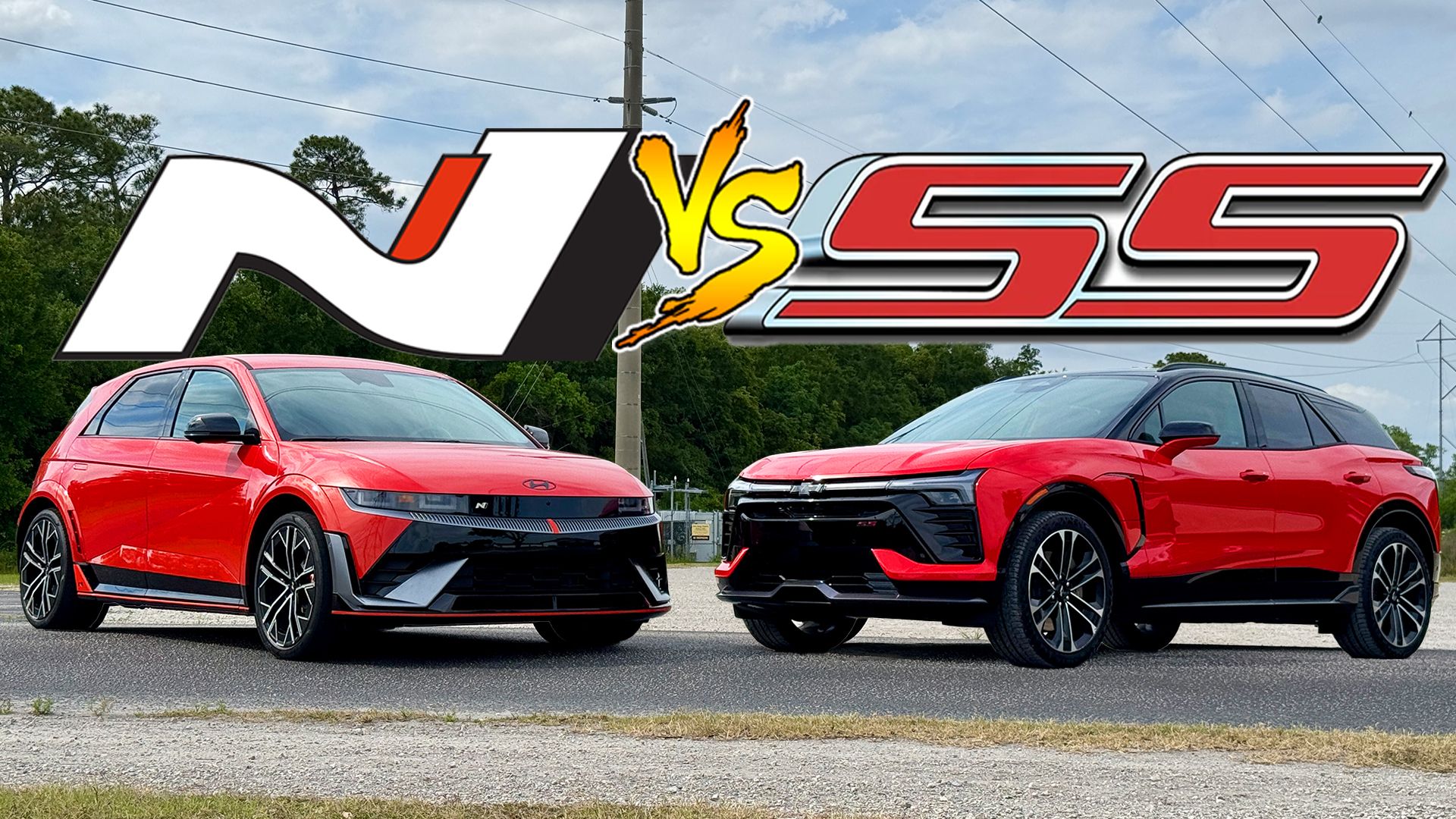
An All-Rounder Faces An All-Star
If you had told us 20 years ago there would come a day when family crossovers would match the performance of a hypercar, we’d have laughed in your face. Well, as we prepare to compare two electric crossovers from Chevrolet and Hyundai, it appears that day has come. Both of these vehicles can keep up in a straight line with a Porsche Carrera GT, a car that not-so long ago was a member of the Hypercar Holy Trinity. Oh, and they can keep pace with the V10 exotic without burning a drop of gasoline…and all for around $65,000. What a world, huh?
-
2025 Hyundai Ioniq 5 N AWD
- MSRP
-
$66,100
- Drivetrain
-
All-Wheel Drive
- Horsepower
-
601 HP
- Torque
-
545 lb.-ft.
-
2025 Chevrolet Blazer EV SS AWD
- MSRP
-
$60,600
- Drivetrain
-
All-Wheel Drive
- Horsepower
-
615 HP
- Torque
-
648 lb.-ft.
The 2025 Chevrolet Blazer EV SS and 2025 Hyundai Ioniq 5 N are our chosen gladiators for this battle, both of which produce over 600 horsepower, sprint to 60 mph in the low three-second range, and are both glaringly orange (although these images appear much more red!). Though these models are competitive in terms of price, size, and performance, Chevy and Hyundai have taken drastically different approaches to building a performance EV, yielding two cars that seem similar on paper, but provide their own advantages and disadvantages. After reviewing the Blazer SS and Ioniq 5 N back-to-back, we emerged with a clear favorite, but the final verdict is far more nuanced. Thus, we’ll compare these two vehicles in seven categories, and whichever one performs better in four of them will be declared our overall winner.
This comparison is based on a back-to-back test drive experience, as well as manufacturer-provided facts and figures which we tested for proof.
Styling: Crossover Vs. Hot Hatch
Styling is one of the more subjective lenses by which we will compare the Blazer SS and Ioniq 5 N, but rather than judging these cars by which one we prefer visually, we will decide a winner based on which takes the bigger swing in terms of design.
It may not share anything apart from its name with the gas-powered Blazer, but it’s clear that Chevy wanted to show some styling connection between the two models. Dimensionally, the Blazer EV is nearly two inches lower, nearly an inch longer, and over an inch wider than its gas-powered counterpart with a wheelbase that’s about nine inches longer. Chevy jazzes up the SS model with standard 22-inch wheels, which can be replaced by optional black wheels for a hefty $2,950. There’s also a unique grille and some SS badges, but most onlookers may not immediately guess this is a “special” Blazer. We love Chevy’s color palette, which includes four standard colors (like our tester’s Habanero Orange) and two optional hues, as well as the Blazer’s LED light bar that plays a cool animation when you walk up to it or when the vehicle is charging. We just wish it stood out more from lesser Blazers.
|
2025 Chevy Blazer SS Vs 2025 Hyundai Ioniq 5 N Exterior Dimensions |
||||
|---|---|---|---|---|
|
Dimensions |
Length |
Wheelbase |
Height |
Width |
|
Blazer SS |
192.6 inches |
121.8 inches |
65 inches |
78 inches |
|
Ioniq 5 N |
185.6 inches |
118.1 inches |
62.4 inches |
76.4 inches |
If we are judging these two performance vehicles by bold styling, the Ioniq 5 N has a clear advantage. The standard Ioniq 5 breaks the mold with its retro-futuristic boxy shape and pixel lights, and the N model distinguishes itself more than the SS. It’s nearly an inch lower, two inches wider, and over three inches longer due to the front and rear diffusers. The Hyundai is smaller than the Chevy in all dimensions – seven inches shorter, 2.65 inches lower, 1.6 inches narrower, and 3.7 inches less in wheelbase. We also love the N’s 21-inch forged wheels, orange-painted brake calipers, and aggressive body kit with orange accents. It looks more like a hot hatchback than a conventional crossover. The Ioniq 5 has one fewer paint color available, only two of which are no-cost, but our tester’s Soultronic Orange ($500) pops just as much as the Blazer’s Habanero Orange.
Result: In a pure competition of which car would attract more attention, the Ioniq 5 is the winner in this section.
Practicality: Splitting Hairs
The Blazer and Ioniq 5 might boast drastically different dimensions, but they are similar in terms of practicality. Despite being significantly longer, the Blazer has slightly less cargo space behind its second row, though the gap is less than one cubic foot. This gap shrinks further with the seats folded; the Ioniq 5 holds just a 0.2 cube advantage over the Blazer. Neither automaker cites storage under the floor, but the Blazer’s larger area might make up for the slightly smaller trunk. In terms of legroom, the Chevy boasts more in the front but less in the rear, though the combined number leans in the Blazer’s favor. The same is true for headroom, where the Blazer has more combined vertical space, and it also has about an inch more shoulder room than the Ioniq 5.
|
2025 Chevy Blazer SS Vs 2025 Hyundai Ioniq 5 N Interior Dimensions |
||||
|---|---|---|---|---|
|
Dimensions |
Legroom Front | Rear |
Headroom Front | Rear |
Shoulder Room Front | Rear |
Cargo Space |
|
Blazer SS |
44.2 | 38.9 inches |
40.9 | 38.1 inches |
58.7 | 58.3 inches |
25.5 | 59.1 cubic feet |
|
Ioniq 5 N |
41.7 | 39.9 inches |
39.8 | 38.7 inches |
57.7 | 57.9 inches |
26.1 | 59.3 cubic feet |
This section is possibly the closest between these two vehicles, so we need to look beyond the specs to crown a winner. Both vehicles have rear air vents and USB ports, but the Blazer has heated rear seats. The Blazer also makes it easier to fold the rear seat with more accessible latches. We like the Ioniq 5’s back seat because it can slide and recline, a rear feature in this segment, making it more comfortable for adults. However, the Blazer has more easily accessible lower LATCH anchors for a car seat, making it the more practical choice for a family.
Result: Based on its slight advantage in passenger space and better car seat setup, the Blazer squeaks by with a win.
Interior Appointments: Elevated Vs. Overhauled
Both of these vehicles are based on crossovers that start in the mid-$40,000 range, but the N and SS versions each cost over $60,000, respectively. For that price, we will judge each model by how premium its interior feels, and by how much it elevates over the base model. The SS clearly offers minor differentiation from a regular Blazer EV. It gets an SS badge on the steering wheel, SS logos on the front headrests, and that’s about it. Chevy gives the SS a unique interior color scheme – Black, Ash Gray, and Argon Orange – which stands out but may be too “youthful” for some buyers. An optional Adrenaline Red interior is possibly even bolder, and replaces some of the suede parts with Evotex synthetic leather. These seats, while comfortable, are the same ones found in a base Blazer, not the kind of seats you’d want for a track day.
Hyundai gives the Ioniq 5 the proper N treatment, replacing the base model’s cushy seats with a set of sport buckets with light-up N logos. These seats are far more supportive for track driving, but are still comfortable for daily use and retain their heating and ventilation. To save weight, Hyundai deletes the power seats, while Chevy retains them in the Blazer SS. The Ioniq 5 N also loses its sunroof, while the Blazer SS keeps its panoramic unit (optional for $1,495). Hyundai changed the Ioniq 5’s open cabin for the N model, swapping the sliding center console for a fixed one with multiple storage tiers that are super useful. We also prefer the fit and finish of items like the switchgear in the Ioniq, which feels more impressive than the Blazer.
Result: The Ioniq 5 N feels like it gets a proper upgrade inside, not just a different color scheme. It also has a nicer fit and finish, resulting in a clear win.
Technology & Safety: Excusing A Mistake
We have a love/hate relationship with the Blazer EV’s infotainment system. The standard 17.7-inch touchscreen is massive, and features an excellent Google-powered operating system that features some of the best voice commands you can find in any car. It also uses built-in Google Maps, which offer amazing route planning with charging stops and a calculation of how much range you will have upon arrival. The 11-inch gauge cluster is easily customizable, and can show multiple setups, including a map view. Chevy even added a few buttons and knobs, giving quicker access to climate controls when you don’t want to use the touchscreen. There’s only one issue; GM refuses to put Apple CarPlay or Android Auto in its EVs. The infotainment system can replace most key CarPlay and Android Auto functions, but the text message reading, one of the best phone mirroring features, is slow and cumbersome. Chevy earns back some points with its excellent safety suite, which includes standard hands-free Super Cruise, the best hands-free system on the market.
The Ioniq comes with two 12.3-inch displays, as well as buttons and knobs positioned below it. We love the shortcut buttons for several key functions, but wish the heated and ventilated seats weren’t only accessible via the touchscreen. The climate controls are quickly accessible, but live on a separate touch panel that’s hard to see during the day with polarized sunglasses. Hyundai prioritized vehicle data on the gauge cluster, which can be configured in several themes, including a special N mode that shows a tachometer, but it can not display a full-color map. Unlike the Chevy, Hyundai does include CarPlay and Android Auto. Both cars have a Bose audio system with eight speakers, but the Ioniq 5 N adds two exterior speakers that play simulated acceleration sounds.
Result: Overall, we prefer the larger screen and Google interface in the Blazer EV, but the exclusion of CarPlay and Android Auto was almost enough to make us prefer the Ioniq 5. Since this category also includes safety technology, which factors in Chevy’s Super Cruise, the Blazer barely pulls ahead.
Performance & Range: Lap Times Vs Road Trips
The Blazer SS produces 515 hp and 450 lb-ft of torque normally, but can develop 615 hp and 650 lb-ft in a performance mode called Wide Open Watts (WOW). Unlike Hyundai’s launch and NGB modes, WOW stays on until you power cycle the vehicle, meaning it’s arguably more usable. The Blazer’s performance specs are less impressive than its rival’s, with a claimed 3.4-second 0-60 time, and our real-world test clocked it in 3.47 seconds. That’s nothing to scoff at, besting our real-world 0-60 times for the manual and automatic Cadillac CT5-V Blackwing; the Blazer EV SS is just slightly behind the bonkers Hyundai. In the quarter-mile, the SS would clock in at an impressive 11.8 seconds at 115 mph, tying the Audi RS6 Avant.
Hyundai comes out swinging in terms of performance, shelling out 601 horsepower and 545 lb-ft of torque from the Ioniq 5 N’s dual-motor setup. Those outputs increase to 641 hp and 568 lb-ft using launch control or the N Grin Boost button on the steering wheel. Hyundai claims a 0-60 mph time of 3.25 seconds, but we recorded an even quicker run in just 3.1 seconds. If you took it to a drag strip, the Ioniq 5 N could reach the quarter-mile mark in 11.1 seconds at 123 mph, which is quicker than a Chevrolet Corvette Stingray. There is a price to pay for this supercar-level performance; the N’s wide and sticky tires drop the range down to just 221 miles per the EPA. On a positive note, the Ioniq 5’s 800-volt charging architecture enables a 228 kW peak speed, meaning you can replenish the 84 kWh battery from 10% to 80% in as little as 18 minutes.
Related
9 Coolest Features Of The 2025 Hyundai Ioniq 5 N
Hyundai doesn’t care about what rivals do; it just wants EVs to be fun.
Chevy scores back some points thanks to its larger 102 kWh battery, which gives the Blazer SS an impressive 303-mile driving range. It’s worth noting the Chevy’s battery will take much longer to refill on account of its size, and the Blazer’s lower 190 kW peak charging speed, which can add 78 miles of range in 10 minutes. Most charging is done at home, and the Blazer can be paired with an optional GM Energy PowerShift Charger ($1,699) that provides up to 19.2 kW on a Level 2 outlet and can be used for bidirectional charging. This option is pricey, but can greatly reduce charging times compared to the standard 11.5 kW peak, which is just above the Ioniq 5’s charging speed.
Result: The Ioniq 5 N would win in a drag race or any track session, but we think this level of performance may be lost on the majority of customers. The Blazer SS is far from “slow” and its superior range is a huge selling point against not just the Hyundai, but the entire segment. A big battery helps the Blazer eke out this win.
Driving Experience: Drastically Different Approaches
Chevy’s Super Sport badge has meant many things over the years, being applied to vehicles from the Camaro to the Malibu and the Silverado. In the modern interpretation, SS is supposed to encompass the following attributes: Fun, Electric, Exhilarating, Style, and Functional. In our opinion, Chevy met these targets. The Blazer SS is fun to drive (for a crossover). It has nicely weighted steering that’s quicker than a standard Blazer, and a playful chassis that doesn’t cower when it reaches a corner. The SS gets a 30% stiffer suspension, though it’s not an adaptive unit that can firm up during spirited driving. It also benefits from upgraded six-piston Brembo front brakes (15.3-inch rotor), which do an admirable job bringing over 5,600 pounds to a halt. Drivers can opt for the Performance Package ($395), which adds Continental Summer tires, performance brake lines, and reduced fade rotors, but doesn’t suddenly turn the Blazer into a track monster. A Z drive mode with a Competitive Mode dials back traction and stability control for maximum enjoyment. These are decent upgrades over a Blazer RS, but it’s clear that Hyundai went further in its performance mission.
It may lack the legacy of SS, but Hyundai built its N performance brand on three pillars: Corner Rascal, Everday Sports Car, Race Track Capability. The Ioniq 5 N is built not only to be a fun daily driver, but also to tear up a racetrack. It has more serious hardware, including 15.75-inch front rotors, Pirelli P Zero tires, and electronically controlled suspension, as well as a lengthy list of software features that enhance the driving experience. There’s N Torque Distribution (an e-LSD with 11 settings for sending the power front-to-back), N Drift Optimizer (a rear-biased drift mode), Torque Kick Drift (a function to make the rear end lose traction like a clutch kick), and multiple battery/motor settings to preserve energy during extended track sessions or provide maximum power on a drag strip or hot lap. Chevy built the SS for a family to enjoy spiritedly on a back road; Hyundai developed the N for enthusiasts who want to maximize every ounce of performance at the limit.

Related
2025 Hyundai Ioniq 5 N First Drive Review: Setting The Bar For Electric Performance
Taking on Laguna Seca Raceway in an electric crossover? Hell yeah.
Not only is the Ioniq 5 N more driver-focused, but it also pushes electric performance vehicles in a new direction with its N Active Sound and N e-Shift features. The former plays one of three acceleration noises: Ignition (simulating a four-cylinder turbocharged Elantra N), Evolution (inspired by the RN22e prototype), and Supersonic (sounds like a jet plane). These sounds can be used on their own or in combination with N e-Shift, which simulates an eight-speed dual-clutch transmission. The feeling of shifting gears completely changes how the Ioniq 5 feels to drive, giving drivers an audible reference point of when to hit the brakes and what speed to approach corners. It’s nothing short of game-changing. Even without these features, the Ioniq 5 thrills with incredibly sharp steering, a perfectly balanced chassis, and a lower curb weight of just over 4,800 pounds. The Blazer SS feels like an SUV made sporty, the Ioniq 5 N feels like a supercar wearing SUV clothing.
Result: If you gave us the keys to both cars to drive on the track or a fun road, we would choose the Ioniq 5 N 10 out of 10 times. It’s the clear victor.
Value: Winning Without A Government Boost
The Blazer SS starts at $60,600, which is considerably less than the Ioniq 5 N, even factoring in the $1,495 destination fee. That $5,480 price gap widens to $12,980, accounting for the federal tax credit, which the Blazer qualifies for because it’s built in Mexico. The Blazer does have additional options, such as a Dual Level Charge Cord ($295) or PowerShift Charger ($1,699), dual pane sunroof ($1,495), Cargo Convenience Package ($550), Performance Package ($395), Graphics Package ($625), gloss black wheels ($2,950), and two optional colors ($495-$995). However, even if you check every option box, including the more expensive charger and Iridescent Pearl Tintcoat paint, the Blazer would still be $4,271 cheaper (after the tax credit).
Price-conscious buyers who can only afford one vehicle will want to pay attention here, as one vehicle clearly emerges as the superior value. The Ioniq 5 N comes in a single trim starting at $66,200 (plus $1,375 for destination), and the only add-ons are limited to optional colors and dealer accessories. It does not qualify for the $7,500 federal tax credit if you purchase it since assembly takes place in South Korea, but is eligible if you lease since it falls under the $80,000 cap for SUVs.
Result: The Blazer SS is a far superior value, even without the tax credit factored in. It decisively walks away with this category.
Verdict: Niche Vs All-Rounder
There you have it: the 2025 Blazer EV SS takes home the win after beating the Ioniq 5 N in practicality, technology, performance & range, and value. Hyundai put up a strong fight, winning in exterior styling, interior design, and driving experience. So, Chevy is the one we’d buy, right? No.
If it was our money, the Ioniq 5 N is still the most special performance EV money can buy, hence why it won our Best EV of the Year award in 2024. We still believe that the Hyundai’s N e-shift feature makes it the ideal EV for car enthusiasts, even more so than pricier models like the Porsche Taycan or Lucid Air, and we’d learn to live with the limited range. However, we are well aware that car enthusiasts make up a vanishingly small percentage of overall car buyers, and the Blazer EV SS makes sense for more potential shoppers.

We could easily criticize Chevy for not making the SS feel sporty enough, especially compared to the N, but we are willing to cut the company some slack because this is a family SUV, not a dedicated sports car. Though our irrational enthusiast brains prefer the Ioniq 5 N, it’s hard to argue with the Blazer’s superior range and drastically lower price, two selling points that are major motivators for EV buyers. The Ioniq 5 N’s gear and sound features, while novel, may go unused by the general car-buying public. The Blazer SS is all the fun most families will really want with almost zero drawbacks, and that’s why we think it deserves the win.

Expert Opinion
“If you will never turn on the simulated gears or augmented sounds in the Hyundai Ioniq 5 N, the Chevrolet Blazer SS is the better option for you. But if you are a bit silly like me, there’s still no EV that can touch the Ioniq 5 N.”