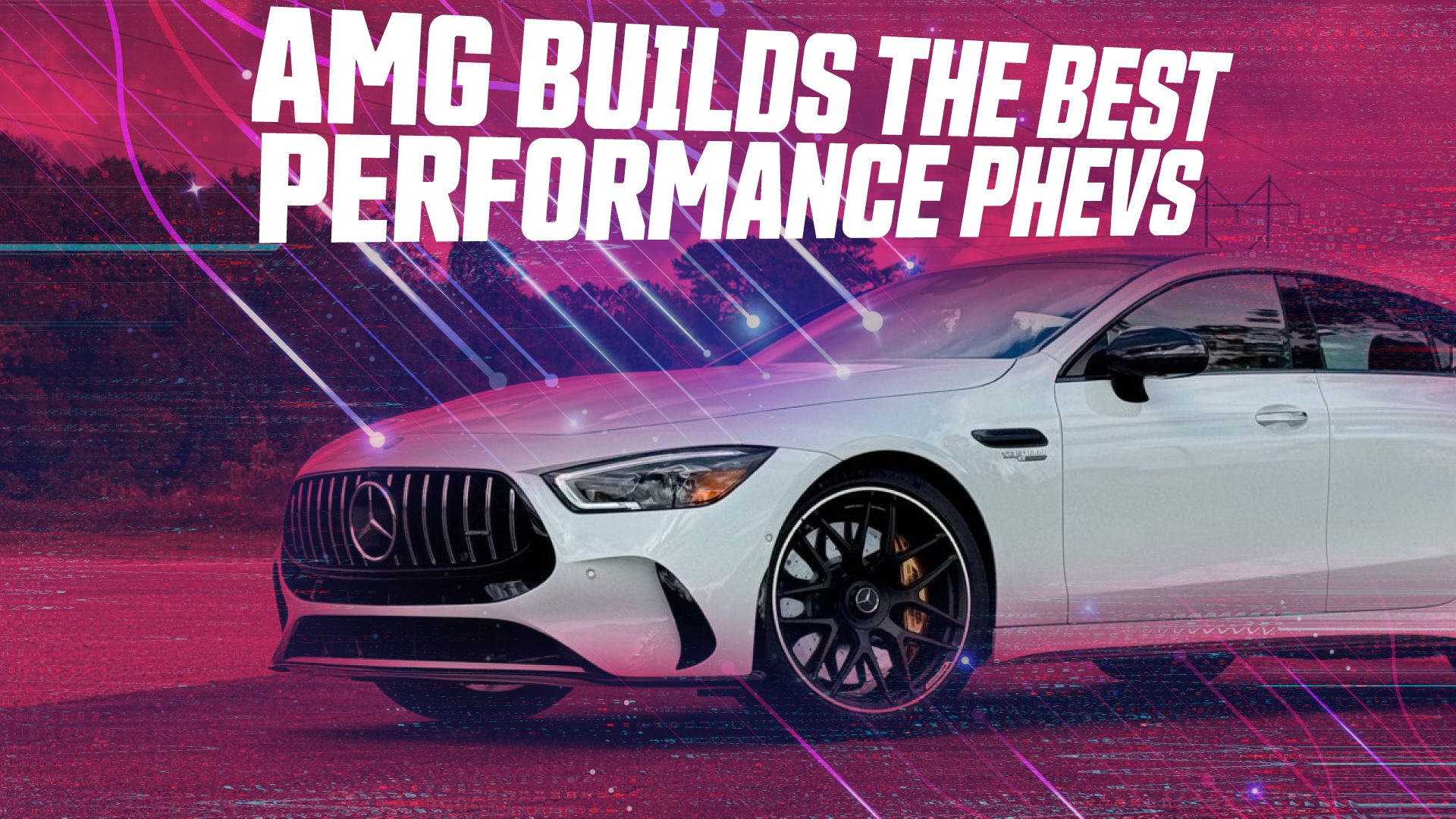
AMG Currently Makes The Coolest PHEV System On The Market
It’s been more than a decade since a trio of cars called the hypercar Holy Trinity – the Ferrari LaFerrari, McLaren P1, and Porsche 918 Spyder – proved that hybrid powertrains could deliver world-class performance. Aside from the Porsche, these cars all sold for seven-figure price tags (the 918 was $845,000), but thanks to the advancement of technology, this type of performance is now available for a fraction of the price.
Mercedes-AMG Enters The Chat
The 2024 Mercedes-AMG GT 63 S E Performance 4-Door Coupe might be the ultimate representation of what a plug-in hybrid can be in the modern age, apart from new-age supercars like the Lamborghini Revuelto, and the successor to the P1, the Mclaren W1.
It combines a twin-turbo V8 with a small battery and electric motor, generating 831 horsepower and 1,032 lb-ft of torque. In fact, the AMG is quick enough to outsprint more expensive cars to 60 mph, all while delivering a more comfortable experience. Here’s how the AMG GT E Performance stacks up against other fast PHEVs.
All 0-60 mph times on the charts are manufacturer estimates and ranges are EPA ratings.
|
2024 Mercedes-AMG GT 63 S E Performance 4-Door Coupe Performance Vs Competitors |
||||
|
Model |
Engine |
Horsepower |
Torque |
0-60 |
|
AMG GT 63 S E Performance 4-Door Coupe |
4.0-liter V8 |
831 hp |
1,032 lb-ft |
2.8 seconds |
|
BMW M5 Sedan |
4.4-liter V8 |
717 hp |
738 lb-ft |
3.4 seconds |
|
Porsche Panamera Turbo S E-Hybrid |
4.0-liter V8 |
771 hp |
738 lb-ft |
2.8 seconds |
Audi And BMW Aren’t Even Close
AMG’s main competition comes from Audi Sport (which builds RS models) and BMW M, neither of which had an answer to the GT 63 S E Performance. The 2025 BMW M5 is closest, producing 717 hp and 738 lb-ft of torque from its 4.4-liter twin-turbo V8 and PHEV system. Audi doesn’t currently build a performance PHEV, so the RS7 Performance falls far short with only 621 hp and 627 lb-ft. In fact, the GT E Performance’s engine alone has a higher output (630 hp and 664 lb-ft) without any electric assist.

Related
RANKED: The Quickest Cars We Tested In 2024 From 0-60
Can you guess which was the quickest and which was the slowest?
With over a 100 hp advantage over the BMW and an over 200 hp edge on the Audi, the AMG GT exists in a higher realm of performance. Mercedes claims the car will hit 60 mph in 2.8 seconds, but it was even quicker than that in our testing. The car sprinted to 60 mph in just 2.68 seconds, the quickest of any car we tested in 2024. We didn’t have a chance to test the RS7, but the M5 took 3.25 seconds to hit 60 mph, besting BMW’s 3.4-second estimate. According to Mercedes estimates, the non-hybrid AMG GT 63 4-Door hits 60 mph in 3.3 seconds, so it may be quicker (in the real world) than the more powerful M5.
Other Performance PHEVs
Mercedes’ direct German competitors may not compete with the GT E Performance, but there is a more direct competitor within the Volkswagen Group: the Porsche Panamera Turbo S E-Hybrid. This car is the AMG GT’s closest rival. It’s marketed as a four-door coupe, costs more than the average mid-size German luxury sedan, and comes with a V8 PHEV system.
The Turbo S E-Hybrid generates 771 hp and 738 lb-ft from its 4.0-liter twin-turbo V8 and electric motor, matching the AMG with a 2.8-second manufacturer 0-60 sprint. Porsche often understates its 0-60 times, so the Panamera should be pretty close to the GT in terms of acceleration. This exact same powertrain is also available in the Bentley Continental GT Speed and Bentley Flying Spur, as well as the Cayenne Turbo S E-Hybrid and Lamborghini Urus SE, but those cars are heavier than the Panamera.

Add CarBuzz to your Google News feed.
If you want a PHEV that’s quicker than the AMG GT, it will cost significantly more. The McLaren Artura gets a smaller 3.0-liter twin-turbo V6, but produces 690 hp with its electric motor. That’s way less than the Mercedes, but the Artura is far lighter, 3,303 pounds versus 5,247 lbs. McLaren’s estimated 0-60 time of 3.0 seconds is slower, but some outlets have recorded it as low as 2.6 seconds. Ferrari builds three PHEV supercars: the 296 GTB, SF90 Stradale, and the all-new F80, which use a 4.0-liter twin-turbo V8 and 3.0-liter twin-turbo V6, respectively. The 296 delivers 816 hp, the SF90 produces 986 hp, while the halo Ferrari takes it up to 1,184 hp. These cars can hit 60 mph in under 2.5 seconds, albeit at a much higher cost than the Mercedes.
|
2024 Mercedes-AMG GT 63 S E Performance 4-Door Coupe Performance Vs Supercars |
||||
|
Model |
Engine |
Horsepower |
Torque |
0-60 |
|
AMG GT 63 S E Performance 4-Door Coupe |
4.0-liter V8 |
831 hp |
1,032 lb-ft |
2.8 seconds |
|
McLaren Artura |
3.0-liter V6 |
690 hp |
531 lb-ft |
3.4 seconds |
|
Ferrari 296 GTB |
3.0-liter V6 |
819 hp |
546 lb-ft |
2.9 seconds |
|
Ferrari SF90 Stradale |
4.0-liter V8 |
986 hp |
590 lb-ft |
2.5 seconds |
|
Lamborghini Revuelto |
6.5-liter V12 |
1,001 hp |
739 lb-ft |
2.5 seconds |
Lastly, there’s the Lamborghini Revuelto, which is more than triple the price of the AMG GT. So, it should be quicker. Thanks to a 6.5-liter naturally aspirated V12 and three electric motors, the Revuelto is the most powerful car here with 1,001 hp, with the ability to launch to 60 mph in about 2.3 seconds. The Lamborghini Temerario with its 4.0-liter twin-turbo V8, three electric motors and 907-hp output is also expected to be fairly quick with an estimated 2.7-second 0-60 mph time.
Mercedes Isn’t Done Yet
For any PHEV to come close to the AMG GT E Performane 4-Door’s acceleration, you need to leave the realm of sedans and sprint into supercar territory. That’s pretty hard to believe. But to be fair to Mercedes, the company has an even quicker hybrid car that will soon arrive in the United States: the 2025 AMG GT 63 S E Performance.
The two-door version of the car will be much smaller and lighter, but still deliver 805 hp and 1,047 lb-ft of torque from its P3 Hybrid System. This car is estimated to hit 60 mph in 2.7 seconds, which, if it beats the projections like its four-door counterpart, should do the sprint in about 2.58 seconds. In other words, the AMG GT might be able to match or even exceed supercars.
Not All PHEVs Are Created Equal
Up to this point, we’ve only discussed these PHEVs in terms of their straight-line performance. While other metrics such as lap times are also important for a performance car, we can’t ignore how these vehicles function in the “electric” portion of their PHEV systems.
|
2024 Mercedes-AMG GT 63 S E Performance 4-Door Coupe Range Vs Competitors |
|||||
|
Model |
Battery Size |
Electric Horsepower |
Electric Torque |
Range |
Price |
|
AMG GT 63 S E Performance 4-Door Coupe |
6.1 kWh |
201 hp |
238 lb-ft |
1 mile |
$194,900 |
|
BMW M5 Sedan |
14.8 kWh |
194 hp |
207 lb-ft |
27 miles |
$119,500 |
|
Porsche Panamera Turbo S E-Hybrid |
21.8 kWh |
187 hp |
331 lb-ft |
30 miles |
$226,500 |
|
McLaren Artura |
7.4 kWh |
95 hp |
166 lb-ft |
21 miles |
$249,100 |
|
Ferrari 296 GTB |
7.45 kWh |
165 hp |
232 lb-ft |
7 miles |
$342,250 |
|
Ferrari SF90 Stradale |
7.9 kWh |
217 hp |
N/A |
16 miles |
$593,950 |
|
Lamborghini Revuelto |
3.8 kWh |
148 hp |
258 lb-ft |
5 miles |
$608,358 |
The AMG uses a highly unique P3 Hybrid System with a 400-volt battery designed to charge and discharge more quickly. You can plug it in and recharge at around 3.7 kW for around an hour or two, but you will only get one mile of EPA-rated range (around 5-6 real-world miles). If we owned one, it would almost certainly never get plugged into a wall because you can fully recharge the battery by driving fast and braking hard in Race Mode in about 10–15 minutes. AMG designed this system purely for performance, while some of the other PHEVs we’ve mentioned here can do both.
Stacking Up To EVs
Cars like the AMG GT E Performance and other hybrids like it prove electrification has a major role to play in the future of performance vehicles. However, they also demonstrate the antiquated nature of igniting gasoline in a cylindrical chamber. The AMG might have its gas-powered rivals from German outclassed in a drag race, but it still stands no chance against some of the quickest electric vehicles on the market.

Related
Rimac Nevera 0-60 And Every Other Performance Record Broken By The Electric Hypercar… So Far
The same man who holds the key to the Bugatti kingdom is also responsible for the world’s most exciting electric hypercar.
Not even counting seven-figure hypercars like the Rimac Nevera, which broke the 0-60 mph record in just 1.74 seconds, there are several other performance EV that would out-accelerate the Mercedes. The Lucid Air Sapphire is quicker (0-60 in 1.89 seconds), as is the Tesla Model S Plaid (1.99 seconds). There’s also the Porsche Taycan Turbo GT, which can hit 60 mph in 1.9 seconds. While PHEVs will continue to improve performance metrics, EVs should remain the drag race kings for the foreseeable future.