
5 Sports Cars That Provided A Peak Analog Experience
There’s nothing like the feeling of a truly exceptional sports car. Roadster or coupe, front-engined, mid-engined, or rear-engined, rowing through the gears on a twisty back road can be an almost spiritual experience as you fly through the turns with the roar of the exhaust filling your ears dotted by the occasional chirp of the tires. Some cars will feel like an extension of you in moments like these, but sadly, many sports cars have been neutered in recent years by electronic nannies and an overabundance of technology. We prefer the analog experience, which is why we wanted to take a look at five sports cars that made no compromises when it came to performance.
Each sports car has its own story to tell, and indeed, each of these models differs quite significantly from one another as their respective companies found different ways of approaching the same problems. At their core, however, was a desire to create vehicles that were light, nimble, well-balanced, and unbelievably fun; and all of them could be had with a manual transmission which exemplifies the analog driving experience. Nearly all of them have become icons thanks to their success as true sports cars, but be careful you don’t underestimate them, as some are much less forgiving than others.
1 Mazda MX-5 Miata (NA)
|
Specification |
Detail |
|---|---|
|
Years |
1989-1997 |
|
Engine |
1.6-liter / 1.8-liter Inline-4 |
|
Power |
114-133 hp |
|
Torque |
100-114 lb-ft |
|
Transmission |
5-speed manual / 4-speed auto |
|
Curb Weight |
2,116 lbs |
|
0-60 mph |
8.5-9.0 seconds |
|
Top Speed |
120 mph |
The first-generation Mazda MX-5 Miata, introduced in 1989, is often credited with reviving the lightweight roadster segment. Created with the help of automotive journalist Bob Hall, its design was inspired by classic British sports cars like the Lotus Elan and MG MGB, but with a great focus on reliability. Hall and others felt the car should be fun, accessible, and engaging, which is why Mazda was keenly focused on ensuring there was no added complexity or weight where not needed.
The car featured a front-engine, rear-wheel drive layout and weighed just 2,116 pounds in its base, stock form. Coupled with an excellent 5-speed manual, its handling and balance, thanks to the car’s 50:50 weight distribution, received universal praise from the press and public alike. Early models came with a 1.6-liter inline-four engine, producing 114 horsepower, later upgraded to a 1.8-liter in 1993 with up to 133 horsepower. By no means blistering numbers, but given the car’s low weight, it was just enough to make things exciting when in the power band.
The base model was unbelievably bare, featuring no power brakes or power steering, no power windows, no radio, and no air conditioning to keep the weight and price down. The 5-speed manual transmission was lauded for its short, precise throws, though an automatic was available in the US. The interior was simple, meant to keep the driver’s focus on driving more than anything else. There’s a reason these cars have shot up in price in recent years. It was a product of its time, and unfortunately, they’ll never build them like it again.
2 Dodge Viper RT/10 SR1
|
Specification |
Detail |
|---|---|
|
Years |
1992-1995 |
|
Engine |
8.0-liter V10 |
|
Power |
400 hp |
|
Torque |
465 lb-ft |
|
Transmission |
6-speed manual |
|
Curb Weight |
3,399 lbs |
|
0-60 mph |
4.6 seconds |
|
Top Speed |
165 mph |
The first-generation Dodge Viper, launched in 1992, was a beast of a car that took its no-compromise performance to the extreme. It was developed under the suggestion of Chrysler’s then-president, Bob Lutz, with design coming from Tom Gale, and there’s even a legend of Carroll Shelby having had some input.
At the heart of the Viper was a massive 8.0-liter V10 engine, originally derived from a truck engine but heavily modified by Lamborghini (then a Chrysler subsidiary) to produce 400 horsepower and 465 lb-ft of torque. These were big numbers in the early 90s, and coupled with the six-speed manual it proved to be a winning combination. This was meant to be an unrelenting vehicle, however, and its real character was defined by the lack of modern driver aids, of which there weren’t any.
There was no traction control, no ABS, and no airbags – just you, the car, and the road. The cabin was spartan though it offered leather seats, and the windows were made of vinyl, while the soft top was made of canvas to save weight. The side exit exhausts were an incredible design addition that would burn you if you weren’t careful, and the car even featured honest-to-god blinker fluid (fortunately it never needed to be changed).
The car’s massive power and lack of electronic aids meant that it could be unforgiving if mishandled, so forget about driving it in the wet. However, for those who could master it, the Viper offered a driving experience unlike any other – a visceral connection to a car that demanded respect and changed Dodge’s image forever.
3 Toyota MR2 (1st Generation)
|
Specification |
Detail |
|---|---|
|
Years |
1984-1989 |
|
Engine |
1.6-liter Inline-4 |
|
Power |
112-145 hp |
|
Torque |
97-140 lb-ft |
|
Transmission |
5-speed manual / 4-speed auto |
|
Curb Weight |
2,350 lbs |
|
0-60 mph |
8.5 seconds |
|
Top Speed |
120 mph |
The first-generation Toyota MR2, introduced in 1984, marked Toyota’s entry into the mid-engine sports car market. Known internally by its chassis code, AW11, the MR2 was initially conceived to create a fun-to-drive car that also offered good fuel economy, but its success altered its initial goal in future generations.
The MR2’s design was heavily influenced by the principles of lightness and balance. It featured a 1.6-liter inline-four engine, either naturally aspirated or supercharged in later versions, that delivered between 112 and 145 horsepower. These numbers may seem modest, but the MR2’s lightweight design meant that it didn’t need much power, and its mid-engined design meant it offered incredible handling.
The mid-engine layout gave the car a low center of gravity and excellent weight distribution, making it incredibly responsive. The steering was direct and communicative. However, the MR2’s mid-engine design also made it prone to snap oversteer, especially in wet conditions, which only got worse when the power was increased with the subsequent generation. No driver aids like ABS were there to save you in case things went sideways, meaning it came down to the driver’s skill and confidence. Keep in mind that the MR2 was the first time many people got to experience a mid-engine car. They hold on for dear life, but when they let go, they let go in a way that will stay with you for a long time.
The interior of the MR2 was simple and functional, with a focus on the essentials, but in most models, all you had were crank windows and no power steering to keep costs and weight down. It was just you and the car, and if you learned to control it at the limit, you were rewarded immensely.
4 Lotus Elise (Series 1)
|
Specification |
Detail |
|---|---|
|
Years |
1996-2000 |
|
Engine |
1.8-liter Inline-4 |
|
Power |
118-143 hp |
|
Torque |
122 lb-ft |
|
Transmission |
5-speed manual |
|
Curb Weight |
1,598 lbs |
|
0-60 mph |
5.8 seconds |
|
Top Speed |
126 mph |
The Lotus Elise, introduced in 1996, represented a return to Lotus’s roots of creating the ultimate, lightweight driver’s cars. The Series 1 Elise was a masterpiece of minimalist engineering, weighing in at just around 1,600 pounds, which was the key to its outstanding performance and handling characteristics.
It was powered by a 1.8-liter inline-four engine sourced from Rover (later sourced from Toyota), producing between 118 and 143 horsepower depending on the variant. Again, less than most economy cars today, but the car’s ultra-low weight meant it could accelerate from 0 to 60 mph in under six seconds, putting it on par with many higher-powered sports cars.
The 5-speed manual transmission always received praise too, but the real appeal was in the handling. With no power steering, the steering was incredibly direct and communicative, and it barely had doors or a roof, and the company even considered doing without them in its initial testing to make it even more extreme. Fortunately for its buyers, that didn’t happen, but still, this first model was never sold in the US due to not meeting our regulations.
Take a look at the interior, and you see Lotus stripped out anything that wasn’t essential, including creature comforts like air conditioning and sound insulation. The seats were little more than thinly padded shells, and the dashboard was a simple, functional affair. But this minimalism was all part of the Elise’s charm – every ounce of the car was designed with performance in mind and it succeeded. While we received later generations here, there’s still something about the rawness of this first model that has people importing them to this day.
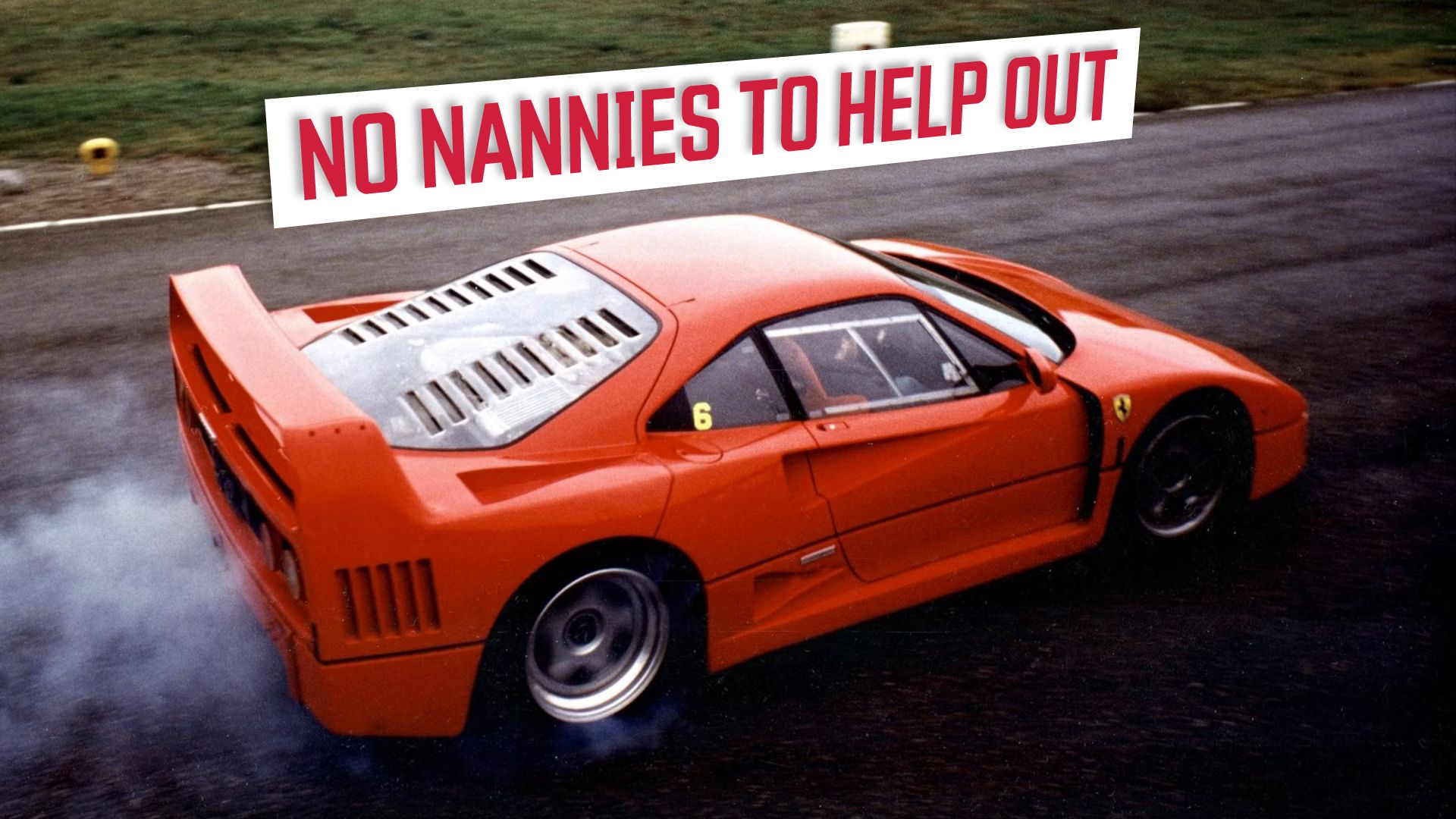
5 Ferrari F40
|
Specification |
Detail |
|---|---|
|
Years |
1987-1992 |
|
Engine |
2.9-liter Twin-Turbo V8 |
|
Power |
471 hp |
|
Torque |
426 lb-ft |
|
Transmission |
5-speed manual |
|
Curb Weight |
3,018 lbs (US) |
|
0-60 mph |
3.8 seconds |
|
Top Speed |
201 mph |
Produced between 1987 and 1992, the F40 was the last car to be personally approved by Enzo Ferrari and was built to celebrate Ferrari’s 40th anniversary. It was a car that captured the essence of what a Ferrari should be – fast, beautiful, and exhilarating to drive – and it’s slowly become one of the most iconic vehicles ever produced due to this success. F40s are worth far more than a million bucks these days.
While it didn’t have a V12 under the hood, the 2.9-liter twin-turbocharged V8 engine was incredible, and produced 478 horsepower and 425 lb-ft of torque. Combined with its famously lightweight carbon fiber and Kevlar construction, it allowed the F40 to accelerate from 0 to 60 mph in just 3.8 seconds and reach a top speed of over 200 mph, making it the fastest production car of its time.
The car had no power steering, no ABS, no traction control – nothing to dilute the connection between the driver and the machine, meaning it could be a handful if you weren’t careful. This was also back in the day before automakers learned how to control or mitigate turbo lag. You’d be mid-corner, feeling like a driving god, and suddenly the turbos would kick in, sending 425 angry Italian torques to the rear wheels. Pretty soon after, you felt like a driving dog.
The F40 was a car that rewarded you handsomely when pushed hard, but in day-to-day traffic, you were made immediately aware of its hyper-focused nature. The interior was stripped to the essentials, with exposed carbon fiber, minimal padding, and no unnecessary luxuries (though, later models did offer AC). The result was a car that was as close to a race car as one could get while still being street-legal, offering an exotic supercar experience unlike anything on the road today. There’s a reason these cars are highly coveted. Just make sure you don’t do anything to them that’s going to make Ferrari angry.

