
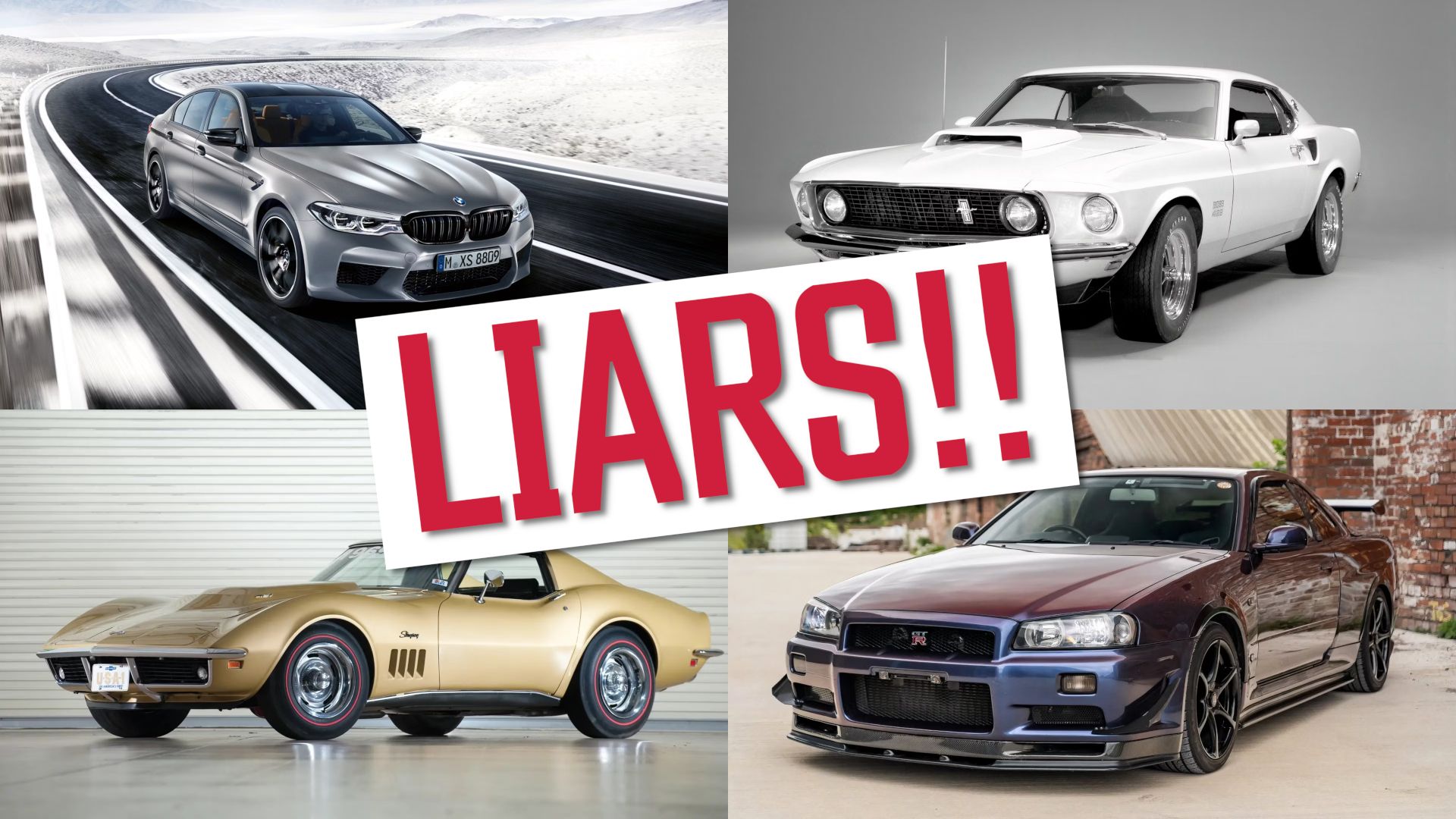
10 Times Automakers Lied About How Much Power Their Cars Made
Car manufacturers lie; no matter how much we want to believe everything we’re told is true, it’s not always the case. But a car manufacturer’s lying isn’t always a bad thing, and sometimes, we benefit from this. It recently emerged that BMW has been “lying” about the power outputs of the M4 CS, prompting us to investigate the various reasons why automakers might do this. It also sent us down a rabbit hole of times when cars made more power than advertised, which is where this list comes from.
We’re not going to rehash the same ones you’ve heard about over and over again, like the B7 Audi RS4 or the Porsche 959, although some of the cars and stories on this list may be familiar to some of you.
The vehicles on this list all produce more horsepower than claimed, as confirmed by various dyno tests, etc. Vehicles are arranged in order of claimed power output from lowest to highest. Real power outputs may differ based on altitude, dyno configuration, engine oil, fuel, and many other variables.
1 R34 Nissan Skyline GT-R
Claimed Horsepower: 276 hp (crankshaft) | Real Horsepower: 305-350 hp (crank)
- Engine: Nissan RB26DETT 2.6-liter twin-turbo inline-6
- Reason For Lying: Japanese Gentleman’s Agreement
- Years Produced: 1999-2002
Remember that Japanese Gentleman’s Agreement we just mentioned? Well, Japanese automakers all agreed to limit their cars’ power to 276 hp in a bid to avoid a power war and the potential dangers it might incur. It sounds noble, but they all lied, disclosing 276 hp for everything from the Mitsubishi Lancer Evo and Subaru Impreza WRX STI to the Toyota Supra and the Nissan Skyline GT-R.
Add CarBuzz to your Google News feed.
The R34-generation Skyline GT-R was better in every way than the R32 and R33, as was proven by its remarkable performance. But still, the official power output was claimed at 276 hp. Dyno tests suggested way more than that, with real-world estimates ranging from, 305 to 350 hp, depending on the spec. The RB26DETT inline-6 was legendary for sounding brilliant and producing mega power, and it made the R34 iteration of Godzilla something remarkable.
2 Chevrolet “Catfish” Camaro
Claimed Horsepower: 310 hp | Real Horsepower: 350 hp
- Engine: GM 5.7-liter LS1 V8
- Reason For Lying: Didn’t want to undermine the Corvette
- Years Produced: 1998-2002 (with LS1 V8)
The Catfish Camaro has carved itself a unique niche in American car lore, partially for its oddball looks. But the fourth-gen Camaro also had something else going for it. From 1998, the Catfish was equipped with a 5.7-liter LS1 V8 that had previously been deployed in the Corvette, but in a bid not to step on the Corvette’s toes, Chevrolet downplayed the performance of the Camaro, claiming a paltry 310 hp on tap 340 lb-ft of torque (or 325 hp/350 lb-ft in the Super Sport/SS). But those in the know alleged there was no difference in power and that the Corvette cranked out the full 350 hp as the Corvette did.
3 Honda Civic Type R
Claimed Horsepower: 315 hp (crankshaft) | Real Horsepower: 316 hp (wheels)
- Engine: Honda 2.0-liter turbo inline-four
- Reason For Lying: Honda likes to under-promise and over-deliver
- Years Produced: 2022-Present
When the new Civic Type R came along with 315 hp from an uprated version of the old 2.0-liter turbo-four, Hondata stuck it on the dyno to test those figures. The results were pleasantly surprising for fans of the hot hatch, with an extra horsepower found at the wheels, suggesting closer to 340 hp at the crank. As we know, this same motor has also been used in the Acura Integra Type S, which holds the honor of having the most powerful Honda four-cylinder engine ever produced. But one has to wonder, is its 320 hp genuine, or is the figure merely made up to justify the increase in price over the Civic Type R?
4 1999-2000 Ford Mustang SVT Cobra
Claimed Horsepower: 320-385 hp (crankshaft) | Real Horsepower: 285-400+ hp (crank)
- Engine: 4.6-liter modular V8 (SVT Cobra) / 5.4-liter V8 (Cobra R)
- Reason For Lying: Ford needed to save face
- Years Produced: 1999-2000
This entry comprises two cars, and only one of them was the subject of a ‘pleasant’ lie. The facelifted 1999 Mustang SVT Cobra had a new design and was supposed to have more power than its predecessor at 320 hp from a revised 4.6-liter V8 – an increase of 15 hp. But owners quickly realized something wasn’t right and that their cars were underpowered, with dynos suggesting it actually only made 285 hp at the crank, and acceleration runs proving slower than 1998 models. Not good. On August 6, 1999, Ford halted the sales of all unsold 1999 Cobras and issued a recall for those it had sold, replacing the intake manifold, certain computer components, and the exhaust system from the catalytic converters to achieve a genuine 320 hp. It was a massive failure, which is why Ford overcompensated the following year…
There was no normal SVT Cobra for the year 2000 because of the faux pas above, but there was a Cobra R, powered by a 5.4-liter V8 claimed to produce 385 hp and 385 lb-ft. But after the previous debacle, owners stuck their cars on the dyno, quickly revealing the Cobra R did make those figures, but at the wheels, suggesting an overcompensation by Ford and closer to 400 hp at the crank.
5 Ford Mustang Boss 429
Claimed Horsepower: 375 hp | Real Horsepower: 475-500 hp
- Engine: Ford 429ci V8
- Reason For Lying: Cheaper insurance rates
- Years Produced: 1969-1970
Built to homologate the 429ci V8 engine for Ford to battle Chrysler’s dominant Hemi V8 in NASCAR, these new V8s somehow ended up in the Mustang Boss 429 instead of the Torino. Ford was one of the guiltiest parties when it came to underquoting power. The adverts all said 375 hp, but reports from the era suggested the motor produced as much as 125 hp more than that. The Boss package cost $1,200 which, at the time, was nearly the price of a brand-new VW Beetle, but it gave you a 735 CFM Holley four-barrel carb on a high-rise intake manifold, and it used hydraulic cams.
The reason Ford lied about the power output was the same reason almost every other automaker of the era did – to cheapen insurance rates. But insurance companies grew wise to this tactic, and the Boss 429 only stuck around until 1970 before disappearing, along with its overpowered semi-hemi V8.
6 A90 Toyota GR Supra
Claimed Horsepower: 382 hp (crankshaft) | Real Horsepower: 388 hp (wheels)
- Engine: BMW B58 3.0-liter turbocharged inline-6
- Reason For Lying: Typical BMW engineering
- Years Produced: 2019-Present
We all know the Mk4 Supra made more power than advertised – that had to do with a certain ‘Japanese Gentleman’s Agreement’ which we’ll come back to in a moment. But we’re not talking about the Mk4 Supra here, we’re talking about the Mk5, or as it’s officially titled, the A90. Since it was revived in 2019, the GR Supra has been contentious. It uses a BMW platform, and worse, BMW engines, but with the latter comes a certain benefit – a tendency to underpromise and overdeliver, and boy does the GR Supra overdeliver.
Right from the early models, the lower horsepower rating of the 3.0-liter inline-6 was called into question, since the Supra matched the more powerful Z4 for acceleration. But in 2021, Car and Driver stuck the updated and uprated 382-hp GR Supra on the dyno, alongside its predecessor, to find out how much power it was really making. Toyota claimed 382 hp and 368 lb-ft of torque at the crank, but the dyno revealed more than that: 388 hp and 422 lb-ft… at the wheels! That means te GR Supra was likely producing over 400 hp at the crank, giving it way more bite than claimed.
7 Chevrolet L88 Corvette
Claimed Horsepower: 435 hp | Real Horsepower: 540-580 hp
- Engine: Highly modified Chevrolet 427-cubic-inch V8
- Reason For Lying: To dissuade casual buyers from buying one
- Years Produced: 1967-1969
These days, Chevrolet markets the heck out of every single Corvette variant it can, with poor marketing often being criticized as the reason the Camaro never sold as well as it should have in recent times. But in the 1960s, the wildest version of the Corvette wasn’t just not advertised, it was almost not spoken of at all by Chevrolet.
The L88 Corvette was a monster created by the father of the Corvette and the director of GM’s performance division, Zora Arkus-Duntov. It features a highly modified version of GM’s 427-cubic-inch V8, and while it allegedly produced 435 hp, realistically, you had between 540 and 580 ponies under your right foot. Arkus-Duntov wanted these cars to end up on racetracks, with the demure power rating allegedly used as a tactic to turn off casual buyers. The target audience was racing teams, and of the 218 cars built before 1969, many of them were used as intended.
8 Ferrari F40
Claimed Horsepower: 478 hp | Real Horsepower: 500+ hp
- Engine: 3.9-liter twin-turbo V8
- Reason For Lying: It made sub-500-hp seem wild
- Years Produced: 1987-1992
Described by Ferrari as “a very fast berlinetta designed by Pininfarina,” the F40 was a carbon fiber supercar/hypercar that pioneered high-performance turbocharging in a big way. Ferrari may have claimed 478 hp, 425 lb-ft, and a curb weight of 2,425 lbs, but it’s generally assumed that Ferrari was underquoting by at least 20 horsepower and the real figure was over 500. Combined with the vicious way the turbo motor delivered its torque, the F40 felt utterly rapid, which is one of the reasons the F50 that replaced it felt so underwhelming.
9 C8 Corvette Stingray
Claimed Horsepower: 495 hp (crankshaft) | Real Horsepower: 562 hp (crankshaft)
- Engine: 6.2-liter LT2 V8
- Reason For Lying: Chevy claims SAE testing is stricter than most dynos
- Years Produced: 2019-Present
The mid-engined Chevrolet Corvette punches way above the claimed 495 hp and 470 lb-ft it allegedly puts out from its 6.2-liter naturally aspirated V8, and that’s not just because of the extra reaction the mid-engine layout affords it. The reality is that the LT2 pushes out more than GM claims, with MotorTrend dyno testing putting outputs at 478 hp and 544 lb-ft at the wheels, translating to 562 hp and 640 lb-ft after correcting for drivetrain losses. At the time, Chevrolet blamed the testing standards set by the Society for Automotive Engineers (SAE) which required a slow build-up on the engine dyno resulting in more heat and greater losses. Whatever the case, we’re not complaining about the extra power.
10 2019 BMW M5 Competition
Claimed Horsepower: 617 hp (crankshaft) | Real Horsepower: 617 hp (wheels)
- Engine: BMW B58 4.4-liter twin-turbocharged V8
- Reason For Lying: Typical BMW engineering
- Years Produced: 2019-2022
BMW is a regular culprit when it comes to underquoting power, and multiple generations of M5 have punched well above their claimed figures. In 2019, Car and Driver stuck an F90 M5 Competition on the dyno to see whether its power figures were accurate or not, and the results didn’t come as much of a surprise. Whereas BMW claimed 617 hp and 553 lb-ft at the crank, the dyno revealed 617 hp and 606 lb-ft… at the wheels. That’s a huge increase, especially on the torque front, and the result was acceleration that was consistently quicker than BMW claimed, too.
We outright asked BMW why its figures always seemed so far below what the cars actually produced. Then Project Manager of Drivetrain at BMW M, Axel Theiling, told us “[BMW does] a static measurement of the engine power. We put the engine to the point with the maximum power, and we leave it there for at least 30 seconds,” unlike a single-point peak from a dyno run. Another point he highlighted was that any BMW customer should be able to achieve claimed power and acceleration times, regardless of weather conditions, altitude, and any other variable.
“In our opinion, every customer has to have the possibility to reach the power we say that we promise. It’s similar to the 0-60 and 0-100 mph times. We think that every customer has to be able to reach these numbers. It’s the whole package that’s important to our customers. Not only one number. We have to have the best package.”
Sources:
Car and Driver
,
Hemmings
,
MotorTrend

