10 Strangest V12 Production Cars
The V12 has long been regarded as the pinnacle of luxury and refinement. However, due to its large size and high costs for production and maintenance, the engine is somewhat of a rarity. The usual haunts have been the engine bays of pricey Italian exotics or flagship sedans from the German automakers (think the Mercedes-Benz S-Class). However, V12 engines have appeared in a variety of unexpected applications over the years, some of which might surprise you, as you’ll discover in the list below.
Mercedes-Benz
While its roots trace back to the creation of the Benz Patent Motorwagen in 1885, Mercedes-Benz was officially founded in June 1926 when Daimler Motoren Gesellschaft and Benz & Cie. (the world’s oldest car company) merged to create Daimler-Benz. This German manufacturer of premium cars is historically known for its motorsport pedigree in early Grand Prix racing, its off-road prowess in the creation of military vehicles like the Genadewagen (now G-Class), and its focus on utmost luxury and technological innovation in models like the S-Class and SL. Today, it is one of the world’s largest automakers.
- Founded
-
June 1926
- Founder
-
Karl Benz, Gottlieb Daimler, Wilhelm Maybach, and Emil Jellinek
- Headquarters
-
Stuttgart, Germany
- Owned By
-
Daimler AG
- Current CEO
-
Ola Källenius
All the cars on this list were in production at one point or still are, with one exception. They are listed in alphabetical order by model name.
1
Toyota Century (Second Generation)
Built From 1997 To 2017
|
Engine |
5.0-liter V12 |
|---|---|
|
Transmission |
4-speed automatic (later 6-speed) |
|
Horsepower |
276 hp (295 hp For Export Markets) |
|
Torque |
355 lb-ft |
The Century is Toyota’s flagship car, but many readers – including fans of the brand – may not know the big luxury sedan. That’s because the Century, which is only into its third generation after almost six decades of sales, is limited to Japan and a handful of other Asian markets, where the car is typically used to cart around dignitaries, including Japan’s emperor. While the original Century was powered by a V8 engine, Toyota, the company that makes Corollas and Camrys, pulled out all the stops for the second-generation model launched in 1997 by dropping a V12 under the hood.
The Century was the only model at Toyota to use the engine, with not even the most high-end Lexus models deemed worthy. Toyota picked the V12 over a V8 for the second-generation Century, due to the smoothness and effortless performance which ensures ultimate comfort for occupants. Sadly, Toyota reverted to using a V8 in the current third-generation Century, which was unveiled in 2017. The first Century SUV was also added to the lineup only two years ago.

Only One Toyota Was Worthy Of A V12 Engine
This engine came and went without many knowing it ever existed.
2
Mercedes-Benz CLK GTR Straßenversion
Built From 1998 To 1999
|
Engine |
6.9-liter V12 |
|---|---|
|
Transmission |
6-speed sequential manual |
|
Horsepower |
622 hp |
|
Torque |
539 lb-ft |
Mercedes-Benz has offered a lot of V12 engines over the years, but among the rarest was the unit that powered the CLK GTR Straßenversion, a homologation special from the late 1990s built in a run of just 28 cars. Don’t be fooled by the humble CLK designation in the name, as the CLK GTR was an extreme machine sharing many of its components with the CLK GTR race car that dominated the premier GT1 class of the FIA GT Championship in 1997 and the following year.
Mercedes racked up 17 wins in 22 races, earning it the Drivers’ and Constructors’ titles in both years. Incredibly, the Straßenversion – German for “Street version” – came with even more power than the race car. The original coupe version came with 592 hp, and this was later lifted to 622 hp when the open-top CLK GTR Roadster body style was added. Today, CLK GTRs, both road and race cars, can be found at the top vehicle auctions, where they typically command bids of eight figures.
3
Isdera Commendatore 112i
Built From 1999 To 1999
|
Engine |
6.0-liter V12 |
|---|---|
|
Transmission |
6-speed manual |
|
Horsepower |
402 hp |
|
Torque |
428 lb-ft |
Horacio Pagani in the 1990s started a successful business, dropping a Mercedes-Benz V12 into a mid-engine chassis and then wrapping it in a lightweight body with seriously sexy lines. However, he wasn’t the first to come up with the idea, as Germany’s Isdera had already treaded down that path with its Commendatore 112i supercar unveiled in 1993.
Unlike Pagani, Isdera didn’t find much success with its car, as poor economic conditions at the time pushed the company into bankruptcy after just a single example was built. Isdera was sold, and the new owners had the Commendatore 112i upgraded in 1999, renaming it the Silver Arrow C112i in the process. Among the upgrades was the fitting of a 6.9-liter V-12 shared with the Mercedes-Benz CLK GTR Straßenversion, though the Silver Arrow C112i was eventually returned to its Commendatore 112i specification around 2016.
4
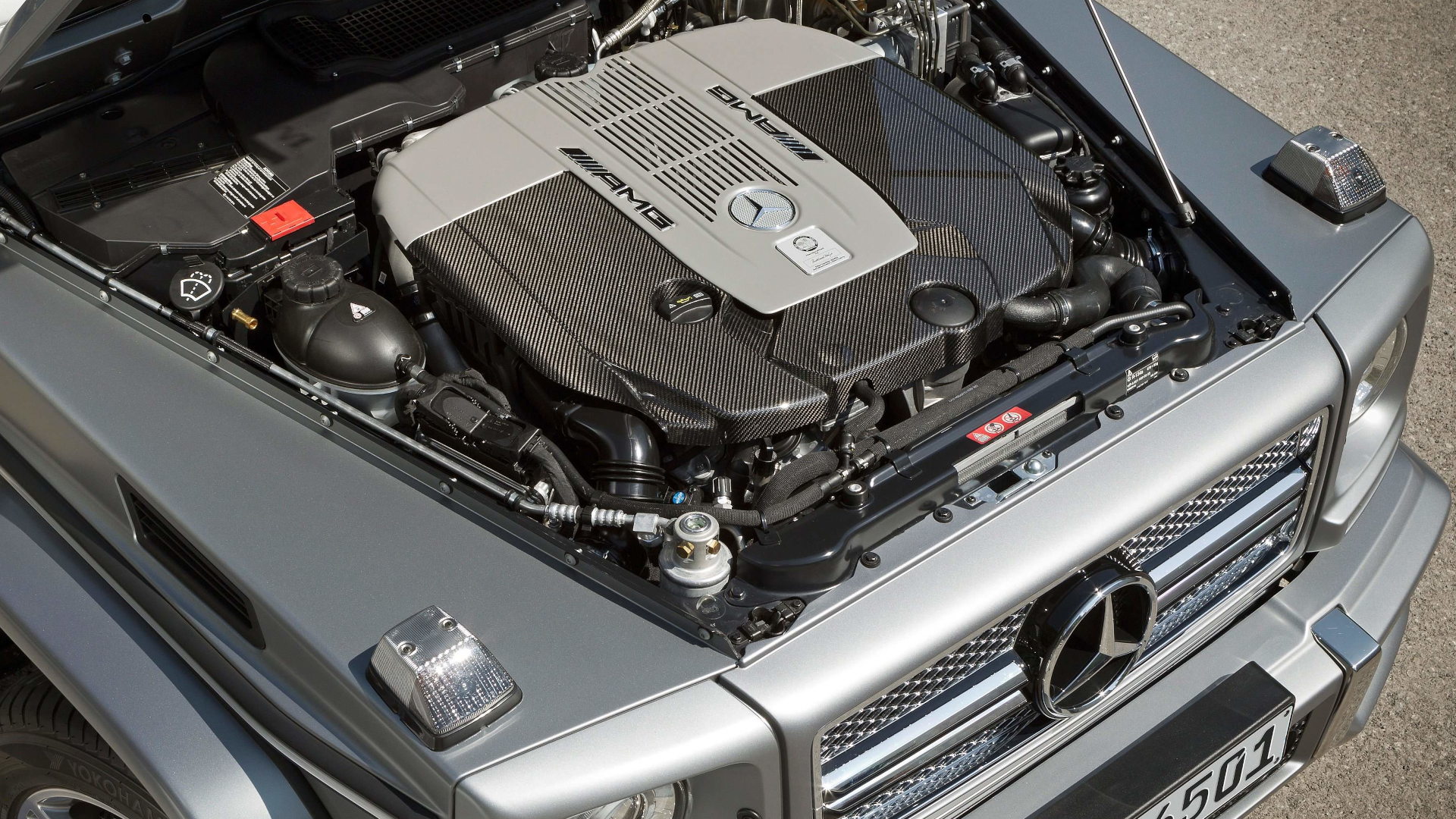
Mercedes-AMG G65
Built From 2012 To 2018
|
Engine |
Twin-turbo 6.0-liter V12 |
|---|---|
|
Transmission |
7-speed automatic |
|
Horsepower |
621 |
|
Torque |
738 lb-ft |
No one needs a V12 in an SUV, especially when there are smaller, more-efficient V8 engines that deliver the same or similar performance. However, there’s a certain smoothness only a V12 can deliver, not to mention the prestige and feeling one gets knowing there are 12 cylinders of fire and fury working away under the hood, ready to roar with just a press of the gas pedal.
It’s something owners of the Mercedes-AMG G65 are likely onto, as they paid extra for the privilege of a V12, even though, oddly enough, the V8-powered G63 of the same vintage is actually the quicker option. The G65 bowed out after the 2018 model year, but when it was available, the 577-hp G63 with its V8 engine and 9-speed automatic could hit 60 mph from rest in 4.4 seconds, versus the heavier G65 with its two fewer gears, which needed 5.3 seconds to achieve the same feat.

Related
Say Goodbye To The G-Class With The Mercedes-AMG G65 Final Edition
A swanky send-off for an extraordinary off-roader.
5
Vector M12
Built From 1995 To 1999
|
Engine |
5.7-liter V12 |
|---|---|
|
Transmission |
5-speed manual |
|
Horsepower |
492 hp |
|
Torque |
425 lb-ft |
There was a time when both Vector and Lamborghini were under the control of the same company, an Indonesian outfit called MegaTech, and which had links to the son of Suharto, Indonesia’s longest-serving president. It was through this link that Vector was able to launch a V12-powered supercar in the mid-1990s, the M12. Lamborghini supplied the engine, which was shared with the Diablo, but the partnership soon came to an end after Vector ran out of funds. Just 17 M12s were completed, and only 14 of those were drivable on public roads. The performance was promising, with the 0-60 time registering at just 4.8 seconds and the top speed approaching 190 mph. However, most of the reviews at the time were negative, making the M12 a hard sell, especially with the highly praised Diablo was available.
6
Ferrari Purosangue
Built From 2022 To Present
|
Engine |
6.5-liter V12 |
|---|---|
|
Transmission |
8-speed automatic |
|
Horsepower |
715 hp |
|
Torque |
528 lb-ft |
Ferrari, known for its fiery sports cars and supercars, stunned the world in 2022 when it unveiled its first SUV, the Purosangue. But in typical Ferrari fashion, instead of launching its SUV with one of its smaller V8 or V6 hybrid powertrains, the automaker went all out and dropped a V12 under the hood. It was a bold move, considering all the automakers getting rid of their gas-guzzling engines to meet ever-stricter emissions rules, but Ferrari also positioned the engine low to help lower the center of gravity, and used a front-midship layout to deliver a near-ideal 49:51 weight distribution to boost the Purosangue’s handling credentials. Currently, there’s only one other SUV with a V12 on the market, the Rolls-Royce Cullinan, and Rolls-Royce has indicated that it wants to be an EV-only brand by the end of the decade.

Related
Ferrari Purosangue’s Wild Off-Road Transformation Will Anger Ferrari Bosses
This is certainly NOT what Ferrari had in mind when making the Purosangue.
7
Audi Q7 V12 TDI
Built From 2008 To 2012
|
Engine |
Twin-Turbo 6.0-liter diesel V-12 |
|---|---|
|
Transmission |
6-speed automatic |
|
Horsepower |
500 hp |
|
Torque |
738 lb-ft |
Before its Dieselgate scandal of the previous decade, the Volkswagen Group went a little crazy with high-performance diesel engines, dropping a 5.0-liter V10 TDI engine in the Volkswagen Touareg, for example, and even experimenting with a 6.0-liter V12 TDI in the first generation of the Audi R8 supercar. While the diesel R8 never happened, its V12 TDI engine would make it into production, under the hood of the Audi Q7 V12 TDI.
The mighty engine highlighted Audi’s success in the world of endurance racing throughout the 2000s under diesel power, with the engine featuring a design derived from the diesel V12 fitted to Audi’s R10 TDI sports prototype raced in the mid-2000s. However, due to diesel’s lack of popularity in the USA, the Q7 V12 TDI never made it to these shores. Production ended in 2012, and the ensuing diesel scandal made sure there would never be a repeat.
8
Aston Martin V12 Vantage
Built In 2022
|
Engine |
5.2-liter twin-turbocharged V12 |
|---|---|
|
Horsepower |
690 hp |
|
Torque |
542 lb-ft |
|
0-60 |
3.4 seconds |
The idea of shoehorning your biggest engine into your smallest car seems like it would always be a winner, but few automakers actually do it today. Meeting emissions rules is likely the main culprit, but there are some automakers that in recent years have taken on the challenge. One of them is Aston Martin, which over the years has offered its entry-level sports car, the Vantage, with its biggest engine, a V12.
Its last V12 Vantage was offered as a special edition in 2022, with just 333 coupes and 249 roadsters built. Aston Martin said at the time that it would be the last time a V12 Vantage would be launched. Currently, the V12 is limited to the Vanquish, where it spits out 825 hp.
The Vantage doesn’t need the V12 anymore because the 2025 model gets fairly close to the V12’s figures, using nothing more than a twin-turbocharged 4.0-liter V8. The latter engine produces 656 hp, which is a bit down compared to the V12, but it also produces 590 lb-ft, which is more.
9
BMW X5 Le Mans
Only A Single Prototype Was Shown In 2000
|
Engine |
6.1-liter V12 |
|---|---|
|
Transmission |
6-speed manual |
|
Horsepower |
700 hp |
|
Torque |
531 lb-ft |
High-performance SUVs are common today, but they were still somewhat of an oddity around the turn of the century, as SUVs were typically only seen as attractive for their practicality. BMW, however, was exploring ways to turn up the wick in its original X5, and engineers actually got around to shoehorning a V12 under the hood in the one-off X5 Le Mans prototype.
While not a production model, the vehicle is worth mentioning considering the V12 it used: a 6.1-liter V12 related to the unit that powered the McLaren F1 supercar, and also used in BMW’s V12 LMR, the sports prototype race car driven to overall victory in the 1999 24 Hours of Le Mans. Not to mention the fact that BMW actually produced a model that worked, and set a Nürburgring record.
While the engine’s output was restricted to about 580 hp in the race car, without any regulations limiting them, the unrestricted engine delivered its full 700 hp in the X5 Le Mans. Sadly, production was never given the green light, which was also the case with two other applications BMW explored for the engine: use in the E34-generation M5 as well as a stillborn M8 based on the first-generation 8-Series.
10
Jaguar XJ12
Built From 1972 To 1997

|
Engine |
5.3-liter V12 |
|---|---|
|
Transmission |
3-speed automatic (later 4-speed) |
|
Horsepower |
295 hp (Series III) |
|
Torque |
319 lb-ft (Series III) |
Although the German automakers are more famous for using V12s in their luxury sedans, Jaguar was well ahead of the game, having dropped one in its XJ sedan as early as 1972. It was an odd move, given the inflation pressures and oil crisis at the time, but Jaguar was committed to improving the smoothness and refinement of its flagship sedan. The engine had staying power and would remain in the XJ for more than three decades, including finding a home in the coupe model. Power was only about 250 hp when the first XJ12 was launched, but was upped to 295 by the time the final Series III version ceased production.
Sadly, the V12 engine is a dying breed. Advances in technology – such as electrification and forced induction – have allowed smaller V8s and even V6s to match V12s in performance. Still, a few automakers remain committed to the V12 for as long as regulations allow, drawn by the unmatched smoothness and sound these engines provide.
Sources: Aston Martin, Audi, BMW, Ferrari, Jaguar, Mercedes-Benz, Toyota