10 Of The Best Bronco Models From The Past 60 Years
When Ford launched the Bronco in 1966, it had no idea it was creating an icon. Over six generations, the off-roader has captured the hearts and minds of consumers and enthusiasts alike, who cherish its rugged design, open concept, and go-anywhere attitude. When the company decided to cancel the model with no successor in place in 1996, it seemed like it was the end of a great era in American motoring, but 25 years later, the company brought it back in a big way, paving the way for a new generation of fans to enjoy one of the best off-roaders ever made.

- Base Trim Engine
-
EcoBoost 2.3L ICE
- Base Trim Transmission
-
10-speed automatic
- Base Trim Drivetrain
-
Four-Wheel Drive
Ford is celebrating the 60th anniversary of the Bronco in 2026, and to celebrate, the company has created a concept that pays homage to the original with some of the coolest styling and features that we’ve seen in a long time. The 2026 Ford Bronco Roadster Concept is going to go down as one of the greatest Broncos ever made, joining a long list of production trims and one-off concepts that have made audiences fall in love with the model over and over again over the last half-century. Here are the 10 best Bronco models ever made.
In this article, we explore the 10 greatest Bronco models of all time, listed in chronological order. While there have been many incredible independent builds over the years, we’ve chosen to only include factory-built and factory-affiliated models on this list.
1966 Ford Bronco Dune Duster Concept
|
Engine |
Possibly the 289-cubic-inch V8 |
|---|---|
|
Horsepower |
200 hp |
|
Torque |
282 lb-ft |
|
Drivetrain |
4WD |
|
Years Produced |
1966 (concept only) |
When Ford conceived of the Bronco, it created three body styles for the new off-road model. The first, and most common, was the classic two-door wagon, the second was a pickup truck with a tiny bed, and the third, and rarest, was the roadster. The roadster, commonly referred to as the “U13” internal designation, was a Bronco with no roof, doors, or rollbar. It aimed to be the truest expression of the freedom offered by the Bronco, giving occupants the freedom to jump in or out without a care in the world (or any real assurance of safety).
This model became the basis for the Dune Duster Concept that debuted along with the rest of the lineup at the 1966 Detroit Auto Show. Designed at Ford’s Styling Center in Dearborn, Michigan, and then built by the famed George Barris of Parris Kustom in Hollywood, California, the model was an eye-catching display of the carefree nature of the 1960s. It was painted in Golden Saddle Pearl with Walnut accents over an interior of reddish/brown leather seats with russet suede bolsters and more walnut trim. It even featured jump seats in the bed that don’t look particularly safe, but don’t worry, because they had seatbelts that were sure to keep you safe in case of a crash or a rollover.
1969 Ford Boss Bronco Concept
|
Engine |
350-cubic-inch Windsor V8 |
|---|---|
|
Horsepower |
290 hp |
|
Torque |
290 lb-ft |
|
Drivetrain |
4WD |
|
Years Produced |
1969 (one-off concept) |
Just three years later, the Bronco was selling like hot cakes, and there were those at the company who believed it now deserved its own high-performance version similar to the special editions the Mustang was getting. Kar Kraft, the famed Ford Skunkworks crew responsible for cars like the GT40 and Boss 429 Mustang, quietly took delivery of a brand-new Bronco off the assembly line and then went to work outfitting it to be the baddest Bronco that the world had ever seen. The goal was dominance, so it was fitted with a special version of the Mustang Shelby GT 350’s 351 Windsor V8 and a Hi-Po C4 automatic, the first automatic ever fitted to the Bronco.
With help from Bill Stroppe, the suspension was overhauled, and it was fitted with 4.11 limited-slip differentials and 15×10-inch chrome wheels wrapped in chunky 10-15LT Gates Commando tires. A hood scoop was borrowed from the Mercury Cougar Eliminator, and stripes similar to the ones found on the Boss Mustang were plastered on the side, along with the vital “BOSS BRONCO” graphics. There are rumors that the goal was to impress Ford President Bunkie Knudsen enough for him to greenlight it for production, and the fact that it was painted in Empire Yellow, his favorite, definitely points to that, but a shakeup at the company meant it never happened. The concept was then lost to history, until 40 years later, when it was uncovered in nearly perfect condition.
1971 Ford “Baja Bronco” Stroppe Edition
|
Engine |
302-cubic-inch V8 |
|---|---|
|
Horsepower |
205 hp |
|
Torque |
300 lb-ft |
|
Drivetrain |
4WD |
|
Years Produced |
1971–1975 |
If the Boss Bronco was a fantasy, the Baja Bronco was very real, and it was all thanks to Bill Stroppe. Stroppe was an ace race car builder with something to prove, and in the late 1960s, he convinced his pal Parnelli Jones to switch to off-road racing behind the wheel of the new Ford Bronco along with him. Expertly kitting out the SUVs, the Broncos would go on to win consecutive Baja 1000s in 1971 and 1972, officially putting the Bronco on the racing map.
To celebrate, Ford commissioned a special run of Broncos after the first win, dubbing it the Baja Bronco. V8-powered Broncos were sent to Stroppe and his team, and they outfitted them like the Baja-winning race cars with a paint job consisting of Poppy Red, Wimbledon White, and Metallic Blue, plus a matte black hood. Performance-wise, it sat on Gates Commando tires and features a heavier-duty suspension, extra cooling, a swing-out tire carrier, extra cooling, a different exhaust, and a rear bench seat. Wearing wider fenders and a bold bull-bar, approximately 450 to 650 were produced from 1971 to 1975, and today, they’re some of the most sought-after Bronco models of all time.
1978 Ford Bronco Free Wheeling Edition
|
Engine |
351M or 400-cubic-inch V8 |
|---|---|
|
Horsepower |
152–160 hp |
|
Torque |
278–314 lb-ft |
|
Drivetrain |
4WD |
|
Years Produced |
1977–1981 |
By 1978, the Bronco had grown into a full-size SUV, sharing much of its DNA with the F-100 pickup. It exuded a much stronger, wider, and more macho appearance compared to the previous generation, but Ford wasn’t afraid to let its hair down. One of the most fun ways it did so was the introduction of the Free Wheeling package that arrived in 1978. It was available on Custom or Ranger XLT Broncos and gave the Bronco tri-color striping in either blue/white/green or orange/tan/cream, depending on the base color of the Bronco chosen.
The bumpers were blacked out, and so were the mirrors, and tying it all together was your choice of white wheels in two different sizes or yellow wheels. The package did change slightly by 1981, but the vibe so perfectly captures the feeling of the 1970s, we think it deserves a place with all the greats. Clean 1970s Free Wheeling Broncos now attract big money, but if you can’t afford one of the old ones, you can always pick up one of the new ones.
1981 Ford Bronco Montana Lobo Concept
|
Engine |
Unkown |
|---|---|
|
Horsepower |
Unkown |
|
Torque |
Unkown |
|
Drivetrain |
4WD |
|
Years Produced |
1981 (concept only) |
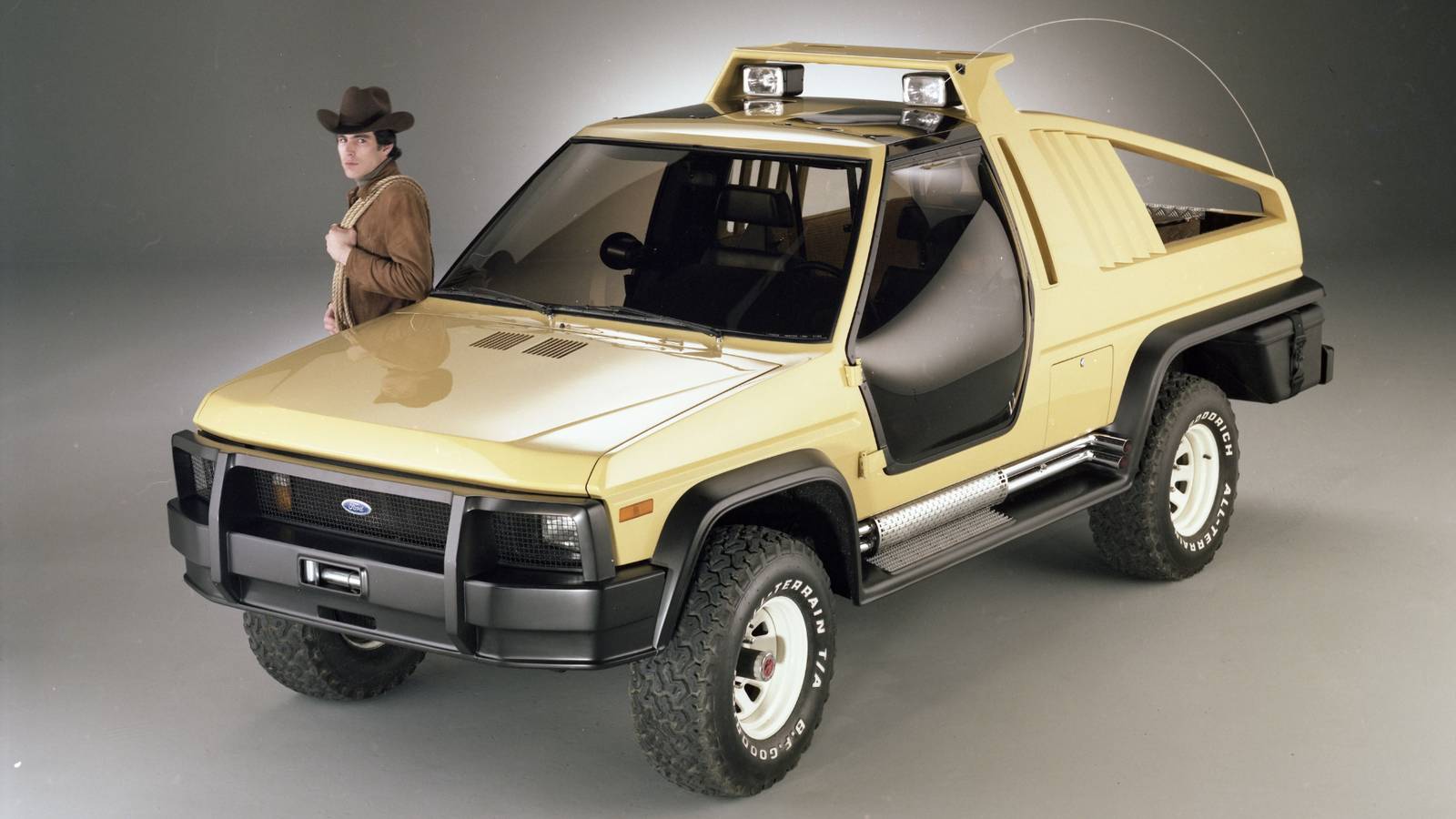
Today, the Lobo name means street performance, but back in 1981, it was a future cowboy’s dream. The Montana Lobo, a concept that debuted at the Chicago Auto Show as Ford’s “future of off-road vehicles.” Future is putting it lightly, because the concept really pushed the Bronco into genuine sci-fi territory. Despite arriving after the introduction of the third generation, it was based on a pre-1977 frame bathed in yellow and black with details like plexiglass doors that could be replaced with rope webbing, recessed bumpers and lighting, an integrated roll bar with louvered sides, and even a power winch.
On the inside, it featured black vinyl captain’s chairs, an electronic instrument panel that came from a 1980 Thunderbird, and overhead controls that had to make the spaceship vibe a little more accurate. The bed was even lined in hemp and featured two bench seats, but the coolest feature had to be the foldable loading ramp that was cleverly stowed in the truck’s tailgate. It was sweet 1980s excess, but the company was never going to put it into production.
1988 Ford Bronco DM-1 Concept
|
Engine |
N/A |
|---|---|
|
Horsepower |
N/A |
|
Torque |
N/A |
|
Drivetrain |
4WD |
|
Years Produced |
1988 (concept only) |
It seems like the 1980s were a wild time for the Bronco concepts, because the DM-1 that arrived in 1988 was downright insane. You’re not crazy, the insane jelly-bean-shaped car above is indeed a Bronco, and Ford created it for the “driving enthusiasts of the 1990s”. It was named after its designer, Derek Millsap, who had joined the Blue Oval and immediately impressed when his design was chosen from a group of 10 who were instructed to create their ideas for light trucks of the 1990s.
The car’s unique aerodynamic shape was achieved with a fiberglass and steel body, along with four-sided flush glass and an integrated roll bar. There was a focus on a roomy interior with seating for five, and it incorporated advanced technology for the time, like satellite navigation, six-way adjustable front seats, full electronic instrumentation, and an awesome steering wheel that should have made it into a production vehicle. It even featured a second display at the bottom of the windshield that displayed information like speed and time, and pretty much predicted some of the displays we’re seeing today.
1992 Ford Bronco Boss
|
Engine |
5.0-liter V8 |
|---|---|
|
Horsepower |
185 hp |
|
Torque |
270 lb-ft |
|
Drivetrain |
4WD |
|
Years Produced |
1992 |
Turns out the 1969 Boss Bronco wasn’t the only unique Bronco with “Boss” in the title. In 1992, the company unveiled another, the Ford Bronco Boss (how creative), which seems to us like a combination of the 1969 model and the Montana Lobo. It appears to be based on the then-new fourth-generation Bronco with an extreme makeover that saw it get a new silhouette with a sloped, retractable rear bed cover, complemented by roof rails and a light bar. The revised front and rear fascia perfectly integrated the bumper into the bodywork, and the power dome on the hood hints at the Bronco’s strong performance.
Sporting Lone Star Yellow paint and sitting on unique 17-inch chrome wheels, it certainly has the draw of a halo model, and we’re sure the blue/black leather interior complements it nicely, though we haven’t been able to find any images. At the time, Ford truck Design Director Andrew K. Jacobson hinted that the model could enter production if there was enough interest, especially because it was a real working concept with a 5.0-liter fuel-injected V8 under the hood connected to a four-speed auto with an electronic transfer case. But it never happened, and the Boss Bronco name died again.
1993 Ford Bronco Nite Edition
|
Engine |
5.0-liter or 5.8-liter V8 |
|---|---|
|
Horsepower |
185–210 hp |
|
Torque |
300–325 lb-ft |
|
Drivetrain |
4WD |
|
Years Produced |
1992–1993 |
When designing this sinister-looking Bronco, we have a feeling the immortal words of Henry Ford were ringing in the ears of the model’s designers: “Any color the customer wants, as long as it’s black.” Blacked-out special editions are a dime a dozen these days, but back in the early ’90s, they were still uncertain territory for automakers. Debuted on the fourth generation in 1991, and then carried over into the fifth generation in 1992.
As the name suggests, these Broncos utilize a Raven Black color scheme that extends from the bumpers to the roof, with splashes of either Aegean Blue or Azalea Pink accents, plus the requisite “Nite” name plastered in bold lettering all around. They sat on 15-inch aluminum wheels to help break up the look, and the exterior was finished with a blacked-out swing spare tire carrier. Depending on which exterior accents you chose, you received either a Crystal Blue, Dark Charcoal, or Scarlet Red interior with more Nite Edition accents. Available strictly with a V8, it was a force to be reckoned with, and it’s a highly sought-after edition today.
2022 Ford Bronco Raptor
|
Engine |
3.0-liter twin-turbo EcoBoost V6 |
|---|---|
|
Horsepower |
418 hp |
|
Torque |
440 lb-ft |
|
Drivetrain |
4WD |
|
Years Produced |
2022–present |
We then fast-forward to the long-awaited return of the Ford Bronco. The sixth generation debuted with the perfect blend of style, performance, and capability, but we always knew a more powerful Raptor version was in the cards, and the Ford Bronco Raptor arrived in 2022 as one of the most capable production off-roaders of all time. The SUV looks mean, as the company added a little over 9 inches to the width courtesy of some massive fender flares that now house 17-inch bead-lock-capable wheels wrapped in massive 37-inch KO2 all-terrain tires. Paired with modular bumpers front and rear, and plenty of underbody protection, it now sports 13.1 inches of ground clearance to take on nearly any obstacle.
Under the hood is a twin-turbo 3.0-liter V6 making 418 horsepower and 440 lb-ft of torque, controlled by a 10-speed automatic transmission with two-wheel-drive high, four-wheel-drive-high, and four-wheel-drive-low gearing. The seven G.O.A.T. (Goes Over Any Terrain) modes allow you to tailor the off-roader for any situation, including a Baja mode that would have made Bill Stroppe shed a tear. Combined with a more aggressive interior and the ability to tow up to 4,500 lbs, it’s the most capable Ford Bronco ever made (and certainly the most expensive).
2026 Ford Bronco Roadster Concept (60th Anniversary)
|
Engine |
2.3-liter EcoBoost I4 |
|---|---|
|
Horsepower |
300 hp |
|
Torque |
325 lb-ft |
|
Drivetrain |
4WD |
|
Years Produced |
2026 (concept only) |
Finally, the newest special edition gallops onto the scene as a celebration of the Bronco’s 60th anniversary, and it’s immediately become one of the coolest versions of all time. Remember that U13 roadster we mentioned at the beginning? Well, the company has decided to re-imagine it for the modern age with a restyled sixth-generation model that sports basically all the same changes that made the original such an incredible, and precarious, proposition.
Painted in Wimbledon White with burgundy accents, it’s ditched the doors, roof, and even its roll cage to capture the glory of the original, all the way down to the iconic Ford lettering. It’s as pure a recreation as they come, with modern bumpers that mimic the original chrome ones, and a bed that stores a spare heritage-styled steel wheel. The interior does still sport a touchscreen, but the seats don’t have headrests, and the seven-speed manual transmission has been restyled to take center stage. It’s pure, unadulterated open-top fun, one that will never make it to production, given the vast amount of safety equipment that is missing.
Sources: Ford.