10 Features The Ford Mustang GTD Shares With Real Supercars
The Mustang GTD shows that Ford is done playing games. For decades now, the Mustang has slowly redefined what a muscle car could be. Models like the Terminator Cobra, GT500, and GT350 have all proven a Mustang can turn just as well as it slingshots forward (with some help from Shelby American at least), but there was still a lack of respect from competitors. To them, you can throw the entire parts catalog at the Mustang, but at the end of the day, it’s still a Mustang. Until now.
Available Years
Mustang GTD
- Model
- Mustang
- Segment
- Coupe
- Base MSRP
- $300,000
The GTD redefines what a Mustang can be, and to prove that, we’ve highlighted 10 of its best features that put it on par with the world’s greatest supercars. It’s a Mustang in name and looks only, the rest is something cooked up by a Skunkworks team in secret and will now be built by the experts over at Multimatic. From advanced aerodynamics to carbon fiber construction and a track-ready suspension system, the Mustang GTD represents a quantum leap forward in Mustang performance, and we can’t wait to see what it does when fully unleashed.
1 Carbon Fiber Construction
If there’s one material associated with supercars, it’s carbon fiber, and the Mustang GTD uses a ton of it. This high-strength, low-weight material makes up the vehicle’s front and rear splitters, roof, fenders, trunk, hood, and many body panels. Only a few extra carbon fiber bits can be optioned, like the bumpers, and every carbon fiber option was shown off earlier this year when the company unveiled the 2025 GTD Carbon Series.
This means the car has shed hundreds of pounds compared with a regular Mustang, coming in at approximately 3,200 lbs. This should help the model achieve all those impressive lap times it’s gunning for, and there’s even a chance more intense customization could arrive in the future if Ford gets its way.

Add CarBuzz to your Google News feed.
2 Active Aerodynamics
Aerodynamics is always the area where supercars set themselves apart from normal vehicles, and the GTD is no different. Every opening or vent on the vehicle is functional. The Drag-Reduction System (DRS) sees the front splitter and rear wing working together to help gain speed in the straights and grip in the turns by changing the balance of the vehicle. We don’t know what the exact split is at any given time, but we know it’ll help with grip in the turns and speed in the straights.
Active aero is seen on supercars like the Gordan Murray T.50, not a Mustang, and this example is so intense that it isn’t even legal in racing. What’s better, is the suspension can drop the vehicle 40 mm to maximize the aerodynamic effects, and Ford says that at 150 mph it makes more downforce than the 911 GT3 RS. Given it makes more horsepower than the RS too, and we can’t wait to see a head-to-head.
3 Advanced Suspension System
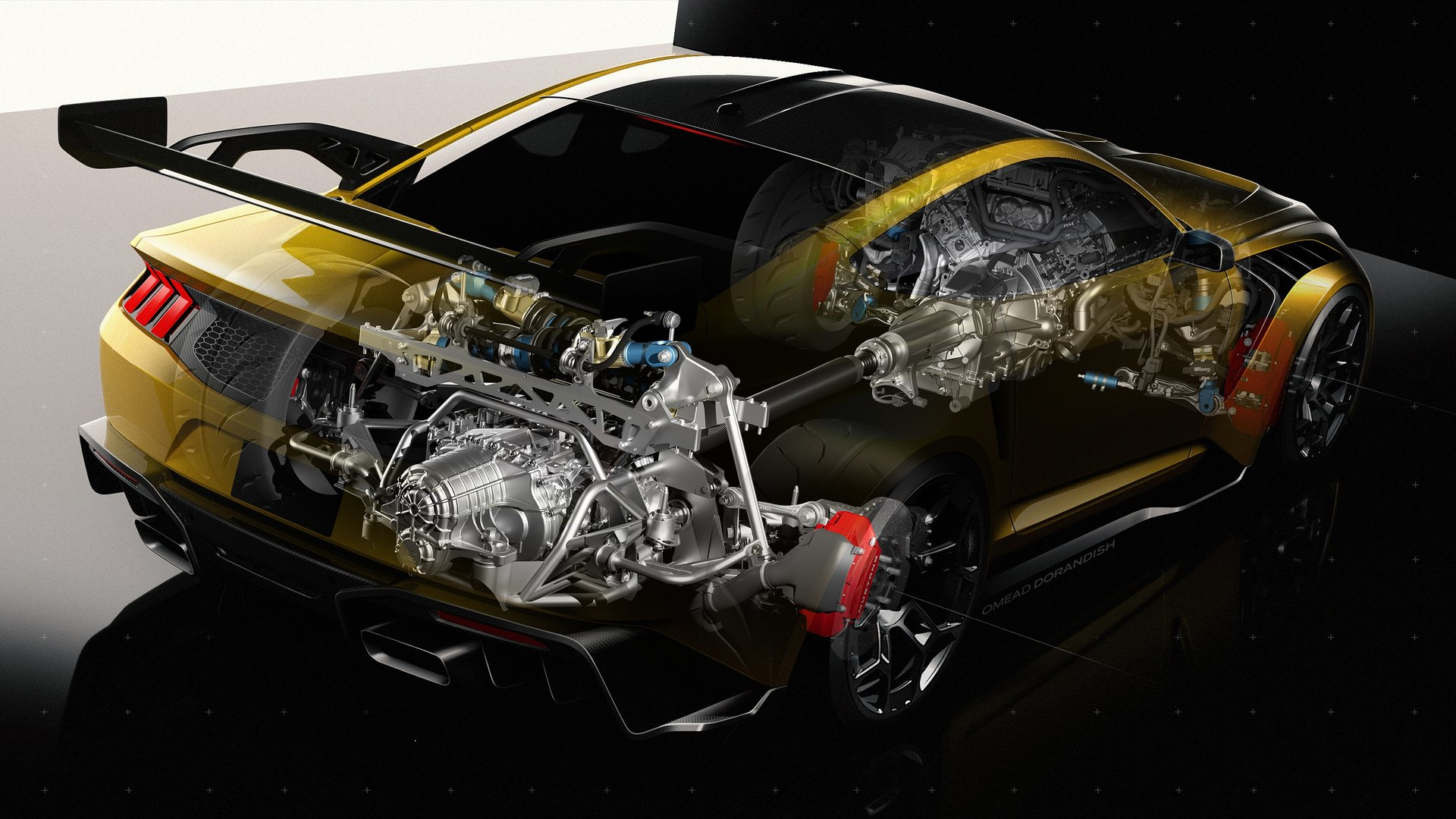
Another hallmark of supercar engineering is advanced suspension, and the setups can vary wildly from one to another. Here, you can see the suspension in all of its glory at the rear of the vehicle, and it truly does look like a work of art. It’s a semi-active setup that uses Multimatic’s adaptive spool valve damping system, adjusting spring rate and ride height hydraulically, with the ability to drop the car 40mm on the track.

Related
Why Is Unsprung Weight So Important?
Losing weight is always good, but it’s where that weight is lost that is arguably more important.
It uses unequal-length control arms in the front and an insane integral link pushrod and rocker arm suspension setup in the rear that has a 1:1 motion ratio between the pushrod and inboard damper. The benefit is its ability to automatically adjust to road conditions, improving the car’s handling whether you’re cruising on the highway or pushing its limits on a track, giving it a balance between everyday usability and race-ready performance. If you’re looking for a vehicle that can hold some luggage for a weekend getaway, this isn’t the one.
4 Unbelievable Paint Options
Customization is a hallmark of the supercar experience, because when you’re spending hundreds of thousands of dollars on a vehicle you best believe the customer will want a serious say in how it looks. The Mustang GTD follows this trend with near-unlimited paint options courtesy of the Extended Color service, which allows buyers to paint their vehicle in any color they want as long as Ford can keep the paint to the company’s standards. This last part is important because many of us were dreaming of a GTD in Ford’s iconic Mystichrome color, which the company says is never going to happen (until it’s given enough money at least).

Related
There’s Only One Color Ford Won’t Paint The Mustang GTD
The most advanced Mustang should get the most special paint, but Ford still gets flashbacks from the last time it allowed this finish to be applied.
Even better, let’s say you do approach the company with a unique color, and it can make it work. Do you really want to spend all that extra money on your very own color to see someone else with the same hue on their GTD at the annual gathering? No way, which is why Ford also offers an Extended Color Palette Lock-Out Option, which, for a hefty fee, doesn’t allow any other buyer to pick your chosen color.
5 High-Revving V8 Engine
The heart of the Ford Mustang GTD is a high-whining, supercharged V8 that can only be described as a monster. Based on the brand’s Predator series of engines, the company started with the same 5.2-liter supercharged V8 originally found in the GT500, but went through and completely overhauled it. The intake and exhaust systems have been overhauled, a smaller supercharger pulley has been used, and it now runs off of a dry-sump oil system that allows the engine to stay lubricated even during extreme cornering.
The best part about these changes is it now has a redline 150 RPM higher than the GT500, topping out at 7,650 RPM, and adding to its supercar pedigree. On the way there, the Mustang produces 815 horsepower and 664 lb-ft of torque, making it the most powerful factory Mustang ever produced and the fastest too, able to reach speeds of 202 mph.
6 Forged Wheels and Carbon Ceramic Brakes
To ensure that the GTD can handle its immense power, forged wheels and carbon ceramic brakes are standard. Forged wheels reduce unsprung weight, which helps improve handling and ride quality, and they’re also stronger to handle the rigors of racing. The standard units are made of aluminum, but you can upgrade to even lighter magnesium wheels if you want the most weight reduction. Regardless of whichever you pick, they’ll be wrapped in massive 325-millimeter front and 345-millimeter rear Michelin Pilot Sport Cup 2 tires.
But lightweight wheels and tires will only get you so far, and eventually, you’ll need to stop, so Ford partnered with Brembo once again to create a high-intensity braking system that can handle the rigors these cars are going to be put through. This means you get carbon ceramic rotors at every corner with six-piston calipers in the front and four-pistons in the rear, essential for cars that will see track time, as they don’t fade as quickly under heavy use compared to standard steel brakes. Supercars like the McLaren 720S and Porsche 911 GT3 RS also use carbon ceramic brakes for these exact reasons.
7 Dual-Clutch Transaxle

The issue with having such a massive engine setup in the front of the car is that it throws the balance of the vehicle completely out of whack. We all know that the golden 50/50 weight balance ratio is the one to aim for, and Ford was able to achieve it here through the use of a transaxle in the rear that’s connected to the engine through a carbon fiber driveshaft. Transaxles are extremely common in exotic supercars and race cars, so it only seemed fitting Ford’s supercar would use one too.
Unfortunately, there is no manual transmission option sending power to the rear wheels, strictly an 8-speed dual-clutch unit created by Tremec. This car is all about putting down the quickest laps possible, so a lightning-quick shifting DCT was the only option on Ford’s mind. To help keep it cool, a transaxle cooler is another piece taking up trunk space in the name of performance.

Related
Everything You Need To Know About The Lamborghini Revuelto’s Rear Transverse Gearbox
What other Lambos featured a similar configuration? And why does it even matter?
8 Active Performance Exhaust System
One of the defining characteristics of a supercar is its aggressive and finely tuned exhaust note. This is why many companies tune the timbre and tone of the headers and exhaust in the same way you would tune a fine instrument. Having a visceral reaction to a vehicle’s exhaust note is an important part of the ownership experience, and here those sounds are elevated thanks to a lightweight titanium Akrapovic exhaust. It makes the most of the vehicle’s immense power with a sound you need to hear to understand.

Related
Listen To The Sound Of The Mustang GTD’s Unhinged Supercharged V8
The Blue Oval is targeting 800 horsepower and a sub-7-minute Nurburgring time. But just listen to it.
With a sound like this, you’re going to hear this car coming long before you actually see it, which is why it’s important it’s also an active exhaust system. This system can modulate the exhaust flow to produce a more subdued tone during regular driving or open up fully for a loud, aggressive roar when in performance modes, ensuring your neighbors won’t hate you when you cold-start it on a Saturday.
9 Highly Limited Production Run
Much like exclusive supercars, the Mustang GTD will be produced in highly limited numbers. Ford hasn’t confirmed just how low the production run for the model will be, but if the Ford GT is anything to go off of, it should hover around 1,000. Only 1,350 units of the Ford GT were made from 2017 to 2022, so expect a similar production run here.
This exclusivity ensures that the GTD will be sought after by collectors and enthusiasts alike, much like limited-run models from Lamborghini or Bugatti. Also, you can be sure that there will be a few special editions that will be even more exclusive, like the Ford GT LM, of which only 20 were made. Prices on these models are going to be insane, that is, if you can afford a GTD at all in the first place.
10 Insane Price Tag
Finally, one of the biggest characteristics the GTD shares with supercars is its price, which is eye-wateringly expensive. How expensive? Well, we aren’t entirely sure yet, but we do know it will hover around $300,000 and is sure to go up immensely if extra boxes are checked. To put this in perspective, the most expensive street-legal Mustang you can currently buy is the Dark Horse Premium at $68,375, not even in the same league as the GTD.

Related
Ford Mustang GTD Will Be An American Legend Or A Global Embarrassment
Ford has made a movie about its Mustang GTD vs. The Green Hell.
This makes it more expensive than sports cars like the 911 Turbo S and Astin Martin Vantage; two vehicles that already blur the space between sports car and supercar. The GTD is in another realm, short and simple, and you know once the cars go on sale, their value is only going to increase with each successive year. Shame on all those who buy one just to flip, but with the returns they get, it’s hard to blame them.