10 Chevrolet Facts Every Chevy Fanboy Has To Know
Few companies have had the impact that Chevrolet has had, becoming a cornerstone of the American auto industry and as beloved as apple pie. From pioneering breakthroughs in automotive engineering to dominating the race track, Chevy’s legacy is etched into the fabric of millions of hardworking American lives through pickup trucks like the Silverado 1500, and we wanted to explore some of its most interesting contributions to the automotive landscape.
In this deep dive into Chevrolet, we uncover 10 intriguing facts that shed light on the brand’s storied past, from groundbreaking electric achievements to hot rod models that somehow slipped under the radar. The brand, and GM as a whole, has always prided itself on taking risks. This has often worked to Chevy’s advantage, allowing it to get the jump on its competitors, but other times, it meant the company swung and missed. Chevy’s an icon, short and sweet, just don’t go saying that around your Ford and Ram friends.
Related
Chevrolet’s Rarest And Most Forgotten Cars
The hits, the misses, and the unicorns.
1
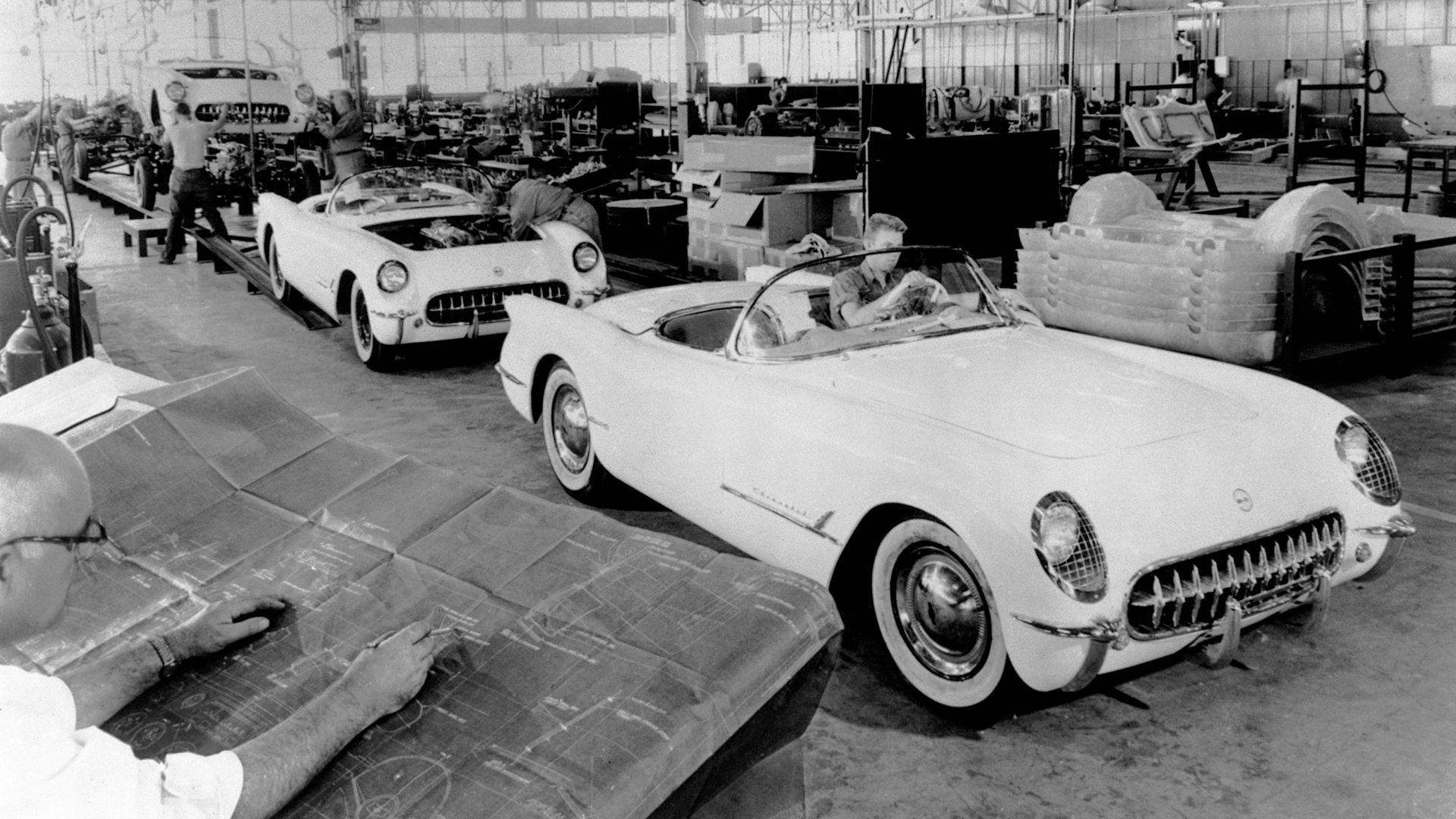
The C1 Corvette Was A Pioneer Of Fiberglass
The Chevrolet Corvette C1, introduced in 1953, revolutionized the automotive industry as the first mass-production car with a fiberglass body. The competing Kaiser Darrin was actually unveiled a year earlier, but supply issues meant the first model didn’t roll off of the production line until 1954. This innovative material, lighter and more durable than traditional steel bodywork of the era, allowed Chevrolet to craft sleek, futuristic designs that helped the automaker save money on tooling and emphasize its position as a cutting-edge sports car.
Fiberglass also offered greater flexibility, enabling Chevrolet to experiment with unique shapes and contours that defined the Corvette’s iconic silhouette. Of course, the lightness of the material added to the car’s performance, too, adding a quality to these early corvettes that was lost as the generations wore on.
2
The Brand Offered Four Wheel Steering On Early 2000s Silverados And Suburbans
In the early 2000s, Chevrolet introduced an innovative four-wheel steering system on select models of the Silverado and Suburban (along with the GMC Sierra and Yukon Xl). This technology, known as Quadrasteer, provided truck drivers with a capability previously only seen in cutting-edge sports cars and enhanced their maneuverability to extreme levels by allowing the rear wheels to turn in the same direction as the front wheels at low speeds and in the opposite direction at higher speeds.
Developed by Delphi Automotive, it was built around a Dana 60 axle that allowed the rear wheels to turn as much as 15 degrees at speeds up to 25 mph and up to 5 degrees at speeds above 45 mph. The system could be turned on and off at will and could get the 2002 Silverado 1500 to cut its turning radius down to a sedan rivaling 37 ft.
The wider track and beefier rear axle added almost 300 lbs in weight and allowed these trucks to tow and carry heavier things than normal trucks. Unfortunately, the complexity of the system and high price ($5,600 when it debuted) meant sales were slow, and it was discontinued in 2005.

3
Chevy Once Made A Hopped-Up Panel Van That’s Rarer Than Most Supercars
Back in the mid-2000s, Chevy, much like many of its competitors, decided it wanted to release more powerful, enthusiast versions of basically all of its models. Stretching from the Trailblazer to the Cobalt, everything was given an SS badge that signified various levels of hotness. But perhaps the most absurd out of all of them was the HHR SS panel van the company produced for just one year.
The HHR was a retro-styled crossover that was unveiled in the 2006 model year, offering quirky looks and uninspiring performance. Along with the four-door version, Chevy decided to release a panel version with plastic interior cladding perfect for a small business owner. When an SS version of the model was announced, we don’t think anyone expected the panel van to benefit, but Chevy thought its commercial buyers deserved to have some fun, too.
The SS version features sportier looks, bigger wheels, and SS badging throughout, but the biggest update was the addition of a 2.0-liter turbocharged four-cylinder that produced 260 hp and an optional five-speed manual transmission. Many other additions were made, but the van’s utilitarian nature was untouched. A combination of slow sales and serious money problems meant this model was doomed from the beginning, making the 216 produced some of the rarest Chevy models of the 21st century.
4
The S-10 Electric Was A Chevy Pickup EV Way Before Its Time
The Chevy S10 isn’t a pickup many people think about as “innovative,” but the fully electric version created by the brand in the late 90s was definitely ahead of its time. Taking from the revolutionary GM EV1, the S10 EV was introduced in 1997 in response to California’s laws demanding a small percentage of zero-emissions vehicles, similar to the Toyota RAV4 EV and Ford Ranger EV.
The S10 EV was powered by a single 114 hp motor that moved the front wheels only and could propel the pickup to 71 mph, which was less powerful than the motor out of the EV1 due to packaging constraints. A 16.2-kWh array of lead-acid batteries was standard but a 29-kWh nickel-metal-hydride pack could be optioned. The range was anywhere from 33-95 miles, and charging mainly came from a 240V Magne Charging system.
Despite its promising capabilities, production of the S-10 Electric was limited to 492 units, and all were leased, with a reported 60 being purchased when the program ended. You can still see them pop up for sale from time to time, and it really makes one wonder how things could have been different even if Chevy had more aggressively pursued the technology at the time.
5
The Suburban Is The Oldest Continuous Vehicle Nameplate In The World
Since its introduction in 1935, the Chevrolet Suburban has remained a steadfast symbol of utility, versatility, and the American spirit. Originally conceived as a rugged workhorse capable of carrying passengers and cargo, the Suburban has evolved over the decades to meet the changing needs of hard-working Americans. What many might not know is since its debut the model has never left us, making it the oldest continually sold nameplate in US history at almost 100 years old.
This includes WWII, as even though the company stopped consumer sales, it continued to make the trucks for the war effort. Of course, the model has changed substantially over the years, becoming much less of a durable workhorse and more of a comfortable, luxurious family hauler. Today, it’s a trusted companion for road trips, adventures, and everyday life and a constant reminder Americans really can’t get enough of big SUVs.
6
A Corvette Hit 254.76 MPH All The Way Back In 1988
The Corvettes today are true supercar killers; packaging exotic looks and performance at a (relatively) affordable price tag. They’re so good we don’t really appreciate how far they’ve come, or the fact a Chevy Corvette was the fastest street-legal car in the world in the late ’80s.
In 1988, a Chevrolet Corvette achieved a staggering speed of 254.76 mph during a high-speed run at the Transportation Research Center in Ohio thanks to severe modifications courtesy of legendary tuner Reeves Callaway. Dubbed “The Sledgehammer,” this relatively understated C4 Corvette features a fire-breathing twin-turbo 5.7-liter V8 with no restrictions whatsoever, allowing it to produce 898 hp and 772 lb-ft of torque. Those numbers are still very impressive today, meaning they were truly otherworldly at the time.
Everything else about the car was fine-tuned, and Goodyear even produced a special set of 300-mph tires specifically for this run. Driven by Callaway’s friend John Lingenfelter, the model rocketed to the 254 mph top speed and into the record books. This record lasted for 25 years before it was broken, and the car even came up for auction a few years ago, though it failed to sell.
7
No Manufacturer Has Dominated NASCAR Like Chevrolet
Chevrolet’s dominance in NASCAR racing is unparalleled, with the brand boasting a record-breaking number of victories and championships. In 2022, the brand featured 814 Cup Race wins, 40 manufacturers championships, and 33 driver titles; numbers that have only increased in the last two years.
No brands, including Ford and Toyota, come even close to the achievements of Chevrolet on the NASCAR track, nor can these brands boast as impressive a group of legendary drivers which includes the likes of Richard Petty, Dale Earnhardt, and Jeff Gordon.
From the legendary “Black Widow” to the Camaro ZL1, Chevrolet’s race cars have epitomized speed, power, and precision, earning the brand a reputation for success that seems untouchable. We’ll just have to see where things stand over the next 100 years of the sport.
8
The Volt Was The First Commercially Available PHEV In The US
Most people forget about the Chevrolet Volt and we can’t say we blame them. It made history as the first commercially available plug-in hybrid electric vehicle (PHEV) in the United States when it debuted in 2010, but what should have been another arm of GM’s EV dominance soon fizzled out due to poor sales and lack of innovation.
Blending electric propulsion with a gasoline-powered generator, the Volt offered drivers the flexibility of electric driving with the peace of mind of extended range capability thanks to a 1.4-liter gasoline engine paired with a 16-kWh lithium-ion battery pack. Power mainly came from the 111 kWh front-mounted electric motor producing 150 hp, but at speeds above 70 mph, the gas engine kicked in, providing extra grunt.
With an EPA-estimated electric range of up to 53 miles and a combined range of over 400 miles, the Volt provided drivers with an efficient and revolutionary alternative to the typical hybrids at the time. Unfortunately, despite its positive attributes, it never caught on the way Chevy wanted it to, lasting only two generations before being discontinued along with an entire slew of GM sedans in 2019.
9
The Camaro Was Unveiled Over The World’s Largest Conference Call
Although the Camaro was one of Chevrolet’s most iconic models of all time, not many know its debut was groundbreaking for more than one reason. Instead of debuting the model conventionally at an auto show or showcase of some kind, the company decided the best way to impress the industry would be to take the best telecommunication technology of the time and set up the world’s first large-scale teleconference.
Using all of the might of Bell Telephone with the near-unlimited resources of 1960’s GM, in June 1966, 100 technicians were strewn about 14 hotel rooms across the country to coordinate a massive conference call that comprised dozens, if not well over a hundred executives, journalists, and dealers. The innovative use of technology showcased Chevrolet’s commitment to generating excitement for its iconic muscle car and set the tone for its success moving forward.
10
Chevrolet’s Founder Didn’t Know How To Give Up
An automotive Steve Jobs in many senses, in 1910, William C. Durant was ousted from General Motors, the company he had founded, due to mounting debts and internal conflicts. Around this time, he almost set up a deal for GM to purchase Ford, but he was denied a loan from the banks and the board soon lost faith in him. Unwilling to give up so easily, he soon set about starting another automotive company.
In 1911, he joined forces with Buick race car driver Louis Chevrolet, soon forming the Chevrolet Motor Company. Where Louis was interested in upper-class luxury models, Durant knew money was in mass production, and within a couple of years, Louis left the company to focus once again on his racing.
Durant proved to be exceptionally talented at running a motor car company, and after the success of models like the Chevrolet Four-Ninety, found himself in a place to start buying stock in the company that had previously ousted him. By September of 1915, Durant, along with the help of others, started buying up immense amounts of GM stock until Chevrolet soon owned General Motors (you read that right), and his comeback was complete.
Of course, Durant would be ousted for the last time in 1920, but you must admire the man’s resilience in the face of adversity.