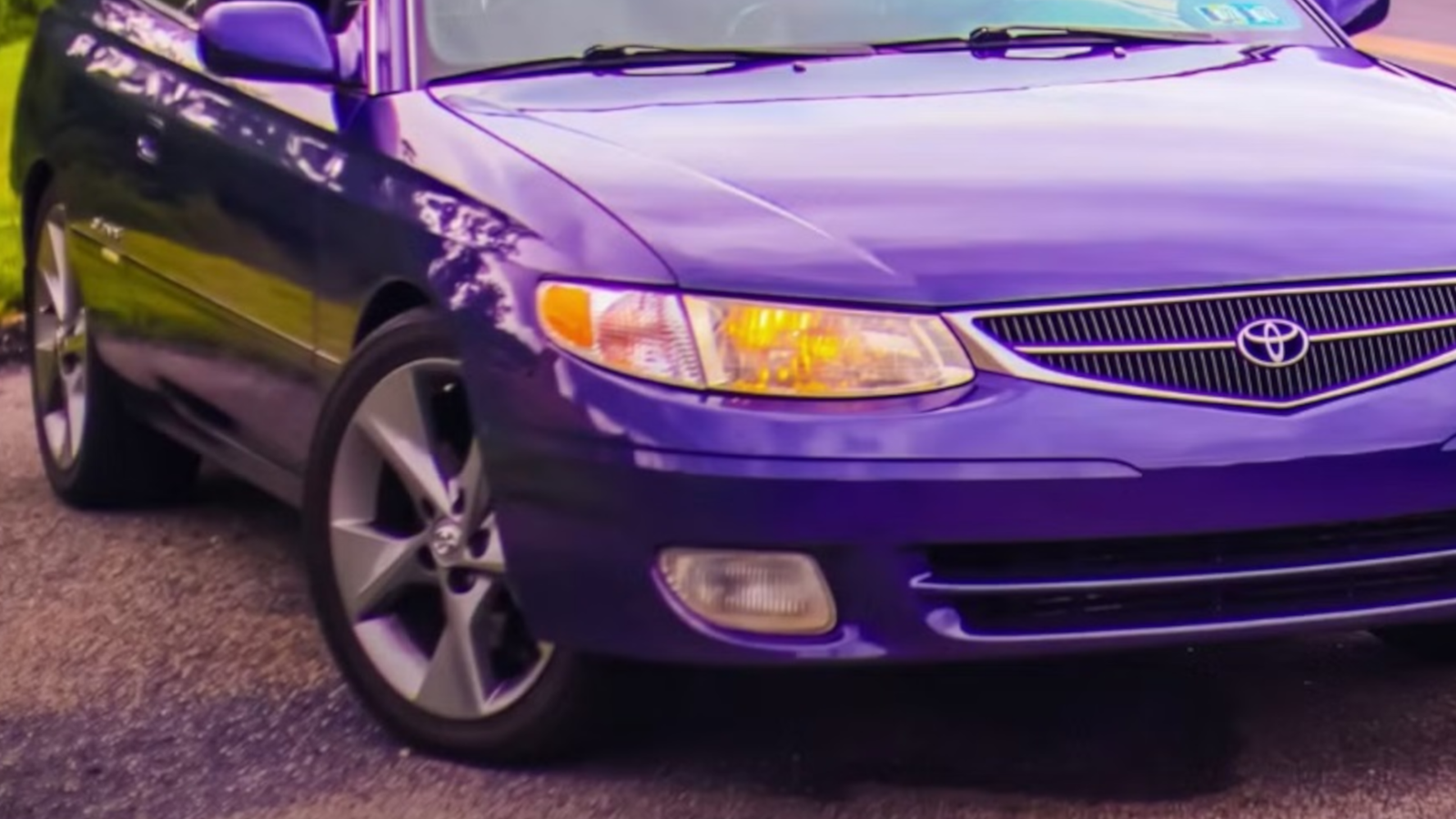
The Supercharged Toyota Solara Was A Powerful Luxury Sedan
In the late 1990s and early 2000s, a whole world of relatively affordable sports cars existed, and Toyota sought to establish a bigger name for itself in the performance sphere. The MKIV Supra was on another level and had a price point that pushed it out of the realm of affordability for most buyers. You could go for the Celica or MR2, which were both two-door options with unique character as well. However, Toyota thought a specific TRD car was missing from its lineup. The Camry Solara was a two-door version of the Camry with its own unique styling. In this article, we explore the history of the Solara, what made the Solara TRD so special, and why it’s virtually unheard of today.
Specifications and stats have been gathered from a variety of trusted sources listed at the bottom of the article. Where official times and speeds were not available, independent tests were used. Prices do not include destination charges, taxes, or other applicable fees.
The History of the Toyota Solara
Short-Lived, but Long Loved
The Toyota Camry Solara was built on the previous generation (XV10) Camry platform with the intention of replacing the Camry’s two-door coupe variant. It lived for just two generations. The first gen began in the 1999 model year and ended after the 2003 model year. The second-gen Solara was broken up into two parts. It started with the model years 2004 through 2006, and then the last two model years, 2007 and 2008, were a lightly facelifted version before the discontinuation. You could buy one as either a coupe or a convertible, with the convertible surprisingly selling more units when new.
The first-generation Solara had three main powertrain choices. You could either get a 2.2-liter four-cylinder, a 2.4-liter four-cylinder, or a 3.0-liter V6. The second-gen dropped the 2.2-liter and 3.0-liter powertrains in favor of the 2.4-liter and added the optional 3.3-liter V6. The first generation came with a standard five-speed manual transmission connected to the front wheels, and an optional four-speed automatic transmission was also available. The second-gen came with your choice of a five-speed manual, or four- or five-speed automatic transmissions.
The 1999 Toyota TRD Camry Solara

Here’s the thing about the Toyota Camry Solara TRD that might be somewhat confusing at first. There is no official trim called the Solara TRD. As we learned while spending too much time researching on Toyota’s newsroom and archives, there are no specific results for the Solara TRD, nor does the brand’s press site offer a single photo of the thing. However, it did indeed exist and could be purchased from dealerships across the country starting with the launch of the Solara’s first generation.
What Sets the TRD Solara Apart?
What made the Solara TRD different from the rest of the model’s lineup at the time was a host of dealer-installed TRD upgrades that could be purchased as an option when ordering a car from the dealer’s catalog. You had to start with the SLE trim, which was equipped with a 3.0-liter V6 engine and a five-speed manual transmission. At this stage, the car still had 200 horsepower and 214 lb-ft of torque, which was reasonable against rivals like the Honda Civic Coupe at the time. The TRD kit added more power to pit it against performance versions of typical rivals, like the Civic Si.
This is where the TRD parts come into play, making things more interesting. We’ll get into the pricing of it all later on, but to make your Camry Solara a TRD, you could choose to purchase a TRD supercharger, then the “Stage 3 TRD package,” which included a seven-piece polyurethane body kit for added flair and attention, lowering springs, new struts, and seventeen-inch TRD wheels to wrap it all together. Those two packages made the car a TRD, but you could also include a handful of other factory modifications, like a high-flow muffler, stainless steel brake lines, short-throw shifter, anti-roll bar, and performance brake pads for the full experience.
How Does the TRD Solara Variant Perform?
Since Toyota doesn’t offer any literature regarding the TRD package’s specifications, we’re relying on other trusted sources for performance specs and road testing. According to MotorTrend, TRD claims the supercharger kit adds an extra 62 horsepower and 54 lb-ft of torque to the base Solara’s V6, bringing the total to 262 horsepower and 286 lb-ft of torque. Car and Driver, on the other hand, tested the car on the road in 2000 while listing its output at 247 bhp and 242 lb-ft. On-paper specifications are rarely the exact metrics found in real life, though.
The same is true for the car’s road testing. MotorTrend lists the TRD’s on-paper sprints and quarter-mile times: the stock Solara could do 0-60 in 6.9 seconds, while the TRD variant dropped that time down to 5.6 seconds. The TRD could also theoretically reach 80 mph in 9.3 seconds and finish the quarter-mile in 14.3 seconds at 99.3 miles per hour. Actual road test figures are shown in the chart below.
|
1999 Toyota Camry Solara TRD Performance Test Results* |
|
|---|---|
|
0-60 MPH |
6.3 seconds |
|
0-100 MPH |
16.9 seconds |
|
5-60 MPH |
6.6 seconds |
|
Standing 1/4 Mile Time |
14.9 sec. @ 95 mph |
|
Top Speed |
135 MPH |
|
*As tested by Car and Driver, 1st Nov. 2000 |
|
Why is the 1999 TRD Solara so Rare?
It’s All About the Money

Why don’t we see any TRD Solaras on the road today? Well, it’s not that they were unreliable and couldn’t survive to see the light of 2025 – they were just too expensive, so very few people bought them. The base model Toyota Camry Solara SE started at $18,698 before options, destination, taxes, and other fees. Adding a V6 to the SE trim brought the price to $21,248. Upgrading to the SLE with a standard 3.0L V6 meant spending a minimum of $25,048 in 1999.
Adding on the TRD supercharger cost an extra $3,700, and the Stage 3 TRD Package added an extra $4,220 to the total. Combined, you were looking at $7,920 for the basic TRD add-ons, which brought the total to $33,388, and that doesn’t include the rest of the upgrades we listed earlier. All combined, the muffler, roll bar, brake pads, brake lines, and shifter added another $924, bringing the total price of a Toyota Camry Solara TRD (based on the SLE trim) to about $34,000. After accounting for twenty-six years of inflation, that’s more than $65,000 in today’s money.
Comparable Rivals to the TRD Solara
Toyota probably wouldn’t have made the TRD kit available for the Camry Solara if it didn’t think there was a place for it. The late 90s brought a host of affordable Japanese sports cars and performance variants of existing commuter cars, so Toyota wanted to join in on the fun. Here are a couple of direct competitors to the TRD-kitted Solara.
1999 Honda Civic Si

The Si badge had been around for a while by the time the Civic debuted with its “Sport Injected” variant. Conveniently making an appearance at the same time as the TRD Solara, the 1999 Honda Civic Si was the first iteration of a legend in the making. The 1999-2000 Civic Si was powered by a 1.6-liter B16A2 DOHC VTEC inline-four-cylinder engine that produced 160 horsepower and 111 lb-ft of torque. With a standard 5-speed manual transmission and front-wheel drive, the Si coupe was tested, completing the 0-60 mph sprint in 7.4 seconds.
1999 Honda Prelude Type SH

Another Solara TRD competitor from the Honda brand is the 1999 Prelude Type SH. Unlike the Civic Si from the same model year, the Prelude SH was powered by a 2.2-liter DOHC VTEC four-cylinder engine that made 200 horsepower and 156 lb-ft of torque. The standard transmission was another 5-speed manual, but a 4-speed automatic was available. It had double wishbone suspension and anti-roll bars as standard in the front and rear, which helped it corner even better. As tested, it could sprint from 0 to 60 mph in about seven seconds.
Summary: The TRD Camry Solara was Great in Theory
If Only It Was More Affordable

The TRD variant of the Toyota Camry Solara was certainly an interesting option to add on at the dealership. Still, we’re glad they offered it for an otherwise unremarkable two-door Camry. Its supercharger provided plenty of power in comparison to other performance-minded rivals, and the body kit looked better than the boring base model. If it weren’t for the high prices, we’re sure there would have been far more TRD kits equipped with Solara models on the road today.
Sources: MotorTrend, Car and Driver, The Autopian, The Doubtful Technician, Cars.com, Honda, Toyota