The Volvo Pedestrian Airbag Was A Near Idea That Failed
When innovations in automotive safety come up, Volvo is one of the major names in the industry. The company has distinguished itself for its contributions to safety over the decades, producing vehicles rich with features that have helped keep drivers and passengers as safe as possible. Most notably, the brand was the first to introduce the three-point seatbelt design in 1959, leaving the patent open so that other brands could use it.
One of Volvo’s recent creations, however, is not aimed at boosting the safety of people inside the car, but rather outside the vehicle. The “Pedestrian Airbag” is exactly what it sounds like. It’s a large airbag located outside the car, ready to inflate in the event of a pedestrian being struck. This feature, however, has not quite encountered the expected degree of success. Let’s take a closer look at the pedestrian airbag and the broader history that surrounds it.
Volvo
- Founded
-
1927
- Founder
-
Assar Gabrielsson, Gustaf Larsson
- Headquarters
-
Gothenburg, Sweden
- Current CEO
-
Jim Rowan
This feature focuses on the “pedestrian airbag” pioneered by Volvo, and why it did not catch on among other automakers.

Related
Volvo Takes The World’s Biggest Safety Technology Another Step Into The Future
The Swedish automaker has improved upon the technology it pioneered and gave away decades ago.
Volvo’s Pedestrian Airbag: An Ambitious Creation, But Not As Successful As Expected
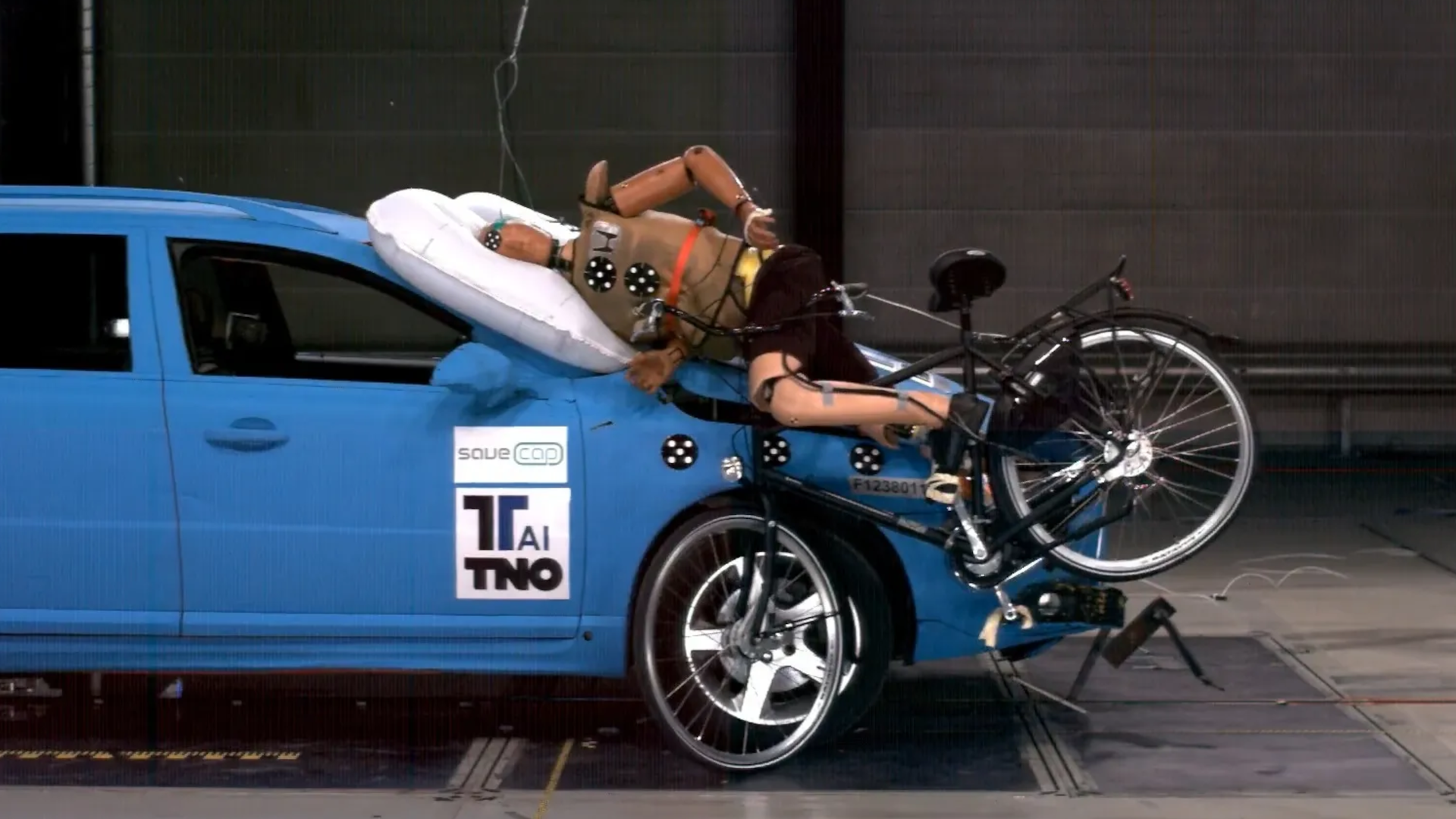
In 2012, Volvo introduced a new safety feature in its newly released V40 model. It was an airbag built to protect not the car’s occupants, but pedestrians. The system is triggered by seven sensors located in the front of the vehicle, which detect the presence of a human leg. If a collision with a pedestrian is detected, a large airbag is deployed that covers the bottom part of the windscreen. This helps protect the pedestrian from head injuries.
The airbag inflates in only a few hundredths of a second. At the same time, the hood lifts approximately four inches. The process creates a gap between the panel and the engine bay components, allowing the hood to deform during impact and thereby cushion the pedestrian. The system is active between speeds of 12.5 mph and 31 mph. Volvo programs the system this way as the majority of accidents involving pedestrians occur within this range.
While experts hailed the pedestrian airbag as the next frontier of automotive safety, it was not as successful as Volvo had hoped. The company didn’t include the feature on any further models by the brand aside from the V40. Other companies also attempted to implement similar technology, but also failed to make waves in the automotive world. The issue of pedestrian safety remains a thorny problem, with injuries and casualties on the rise, and automakers are struggling to mitigate it.
The Model That Introduced The Pedestrian Airbag: The Volvo V40
|
Volvo V40 Specs |
|
|
Engine |
1.6L-2.5L inline-four gas / 1.6L-2.0L inline-four diesel |
|
Horsepower |
120-251 hp |
|
Torque |
177-295 lb-ft |
|
0-60 |
~6.5-8.5 seconds |
|
Top Speed |
130 mph |
The first and only Volvo model to be equipped with the pedestrian airbag was the V40, sold between 2013 and 2019. This model was not the first to bear the V40 nameplate, as the moniker had previously been used for the wagon version of the S40 available between 1995 and 2012. The new V40 debuted at the 2012 Geneva Motor Show and went on sale shortly afterward for the 2013 model year. However, unlike its older namesake, the new V40 never reached the United States, as demand for hatchbacks in the country had fallen due to the rise of crossovers and SUVs.
Despite being on the market for only seven model years, the V40 was available with an extensive range of engines. The powerplants included multiple inline-four and inline-five gas-powered options, as well as three diesels – two inline-four units and one inline-five. Several transmissions were also available, including two six-speed manuals, a six-speed dual-clutch automatic, and three automatic transmissions from the Japanese company Aisin.

Related
New Volvo V40 Officially Revealed Ahead of Geneva
The five-door hatchback finally made its official online debut, just a week before its unveiling at the Geneva Motor Show.
On the design front, the V40 adopted the minimalist, sleek profile that characterized Volvos of this era. It featured a rounded, U-shaped grille with a large badge positioned in the center. The all-caps VOLVO lettering stretched across the back of the vehicle is another recurrent feature in the brand’s models. The V40 underwent a minor facelift in 2016, which included the addition of Volvo’s “Thor’s Hammer” headlights as well as some interior updates.
A slightly more rugged “Cross Country” version of the model was available in parallel with the standard variant. The V40 Cross Country featured a raised ride height, along with larger wheels and protective body panels. Volvo discontinued both versions after the 2019 model year.
Pedestrian Safety: A Difficult Journey Through The Years
While the safety of vehicle occupants is frequently seen as the predominant challenge for automakers, keeping pedestrians safe has been an equally major task over the decades. In the very early days of motoring, when the car was still an unfamiliar sight on most roads, some countries implemented laws that required a person to walk in front of a moving car waving a red flag, to alert pedestrians of the vehicle’s presence and the potential hazard.
Naturally, as cars became more popular and speeds increased, this was no longer feasible. However, car companies and lawmakers continued to implement measures to protect pedestrians. As new regulations were introduced, car design evolved. One notable example of automotive design adapting to improve pedestrian safety was the disappearance of pop-up headlights. As iconic as they were, when deployed, the lamps posed a potential danger to pedestrians.

Related
Here’s Why More People Are Getting Run Over By Cars Than 10 Years Ago
A new study shows that we’re still at a ten-year high for pedestrian fatalities, despite improvements in ADAS technology. What gives!?
In recent years, however, accidents involving pedestrians have become a more significant problem than in the past, mainly due to the rise of crossover and SUV body styles. Vehicles are getting, on average, heavier and bulkier, which means injuries and fatalities among pedestrians have been increasing over the past decade. Automakers have been trying to mitigate this problem through the use of technology, such as increasingly sophisticated pedestrian detection systems, to prevent collisions from happening in the first place.
The Pedestrian Airbag Beyond Volvo, And Why It Hasn’t Worked
The pedestrian airbag might seem like one of those innovations that should have become a commonplace automotive safety feature; however, that was not the case. Ironically, one of the biggest reasons came from Volvo itself. Two years before the launch of the V40, Volvo was the first automaker to pioneer pedestrian detection technology combined with automatic braking. This system used a combination of radar and camera input to detect the presence of a person or animal in front of the vehicle, initiating an emergency stop if the driver failed to react in time.
Prevention is always better than a cure, and pedestrian safety is no exception. Automakers quickly realized it was better to stop accidents from happening in the first place than to mitigate injuries and damage. As a result, they invested their resources in developing pedestrian detection and automatic braking, which are now commonplace safety features in the lineups of several major automakers around the world.
That being said, the concept of the external airbag hasn’t completely died out yet. Earlier this year, Subaru announced that the Japanese version of the 2026 Forester will be equipped with an external airbag designed specifically to protect cyclists. The company first started implementing external airbags in 2016, four years after Volvo.
However, Subaru quickly realized that its initial airbag design was not particularly effective at protecting cyclists and decided to update its offering with the new Forester. The airbag was expanded to inflate around the A-pillars, protecting both pedestrians and cyclists whose heads are typically positioned higher in the event of a crash. In 2022, Ford also filed a patent for an external airbag. However, this feature has not yet appeared on any of the Blue Oval’s production models.
Sources: Volvo