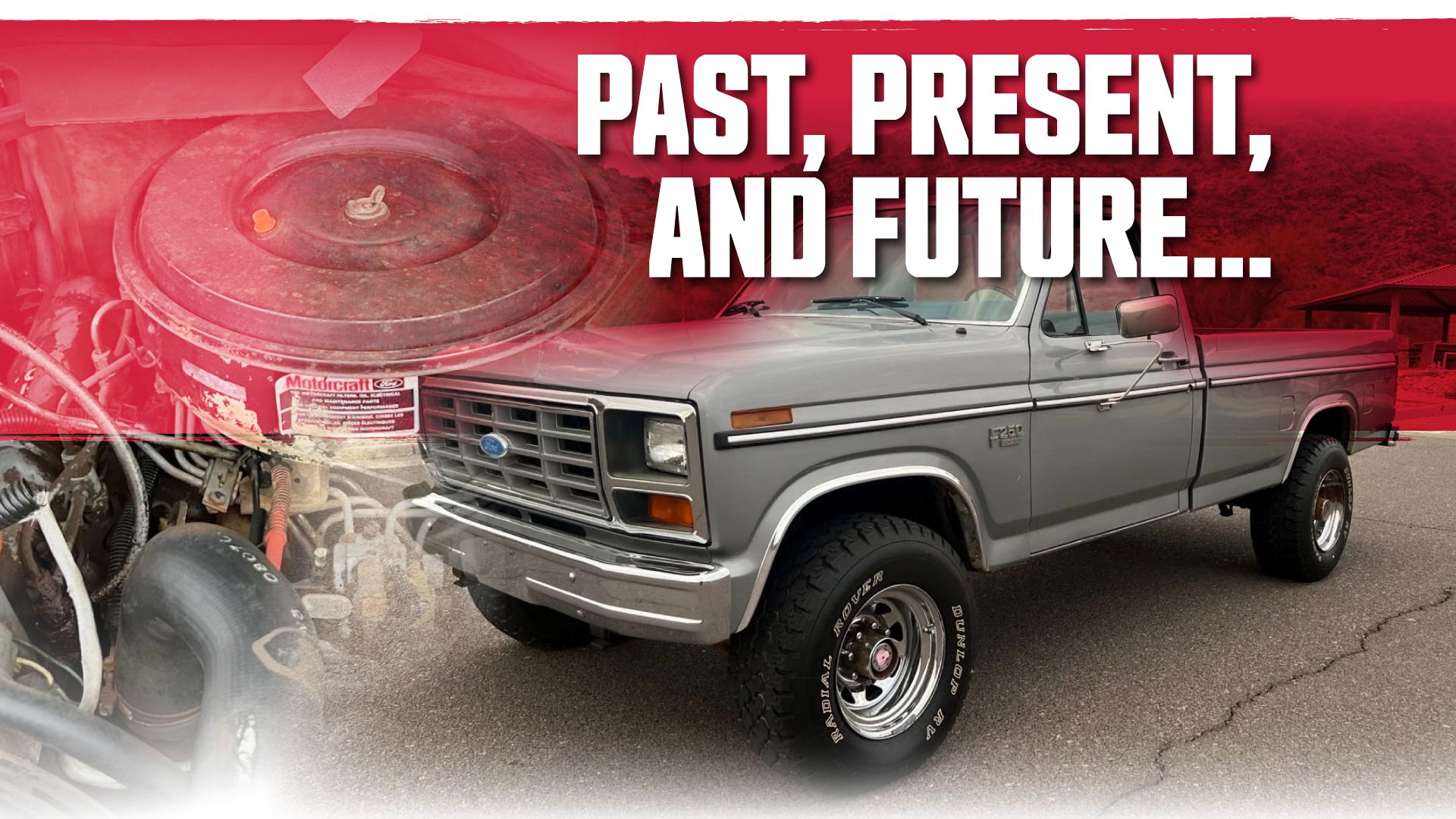
The Power Stroke Diesel Engine: Past, Present, And Future
These days, heavy-duty pickup trucks powered by diesel engines are a rather common sight. There are numerous reasons for heavy-duty trucks to use a diesel engine, many of which center around the diesel motor’s penchant for producing a high amount of torque with a displacement similar to large gasoline engines. Not to mention, when compared to gasoline engines of a similar size, diesel mills are typically a bit more fuel efficient.
Available Models
Ford
- Founded
-
June 16, 1903
- Founder
-
Henry Ford
- Headquarters
-
Dearborn, Michigan, USA
- Owned By
-
Publicly Traded
- Current CEO
-
Jim Farley
However, while diesel pickups are run-of-the-mill these days, they weren’t even around in the States with any mass-market capacity until the late 1950s. The first American automaker to feature a diesel-powered pickup was International. However, these trucks are few and far between, and they soon dropped them. General Motors and Dodge both offered diesel engine options starting in 1978, but the former utilized the problematic Oldsmobile diesel V8, and the latter used a 4.0-liter Mitsubishi unit that was rarely selected.
It wasn’t until Ford released their diesel pickup in 1982 that the craze kicked off. Not to mention, Ford’s first diesel pickups used an engine that would lead to the creation of the iconic Power Stroke diesel V8.

Related
Only 5 Automotive Brands Are Still Selling Diesel Cars In America
The number has dropped significantly in the past few years.
We’ve decided to dedicate this write-up to the Power Stroke diesel engine due to its extreme popularity among consumers and its responsibility for kickstarting the diesel-powered pickup truck craze as we know it today.
Humble Beginnings
As mentioned, Ford wasn’t the first American automaker to introduce a diesel engine for its pickup trucks, as General Motors beat them to the punch by four years. However, we can credit Ford with releasing the first successful diesel pickup truck option. In the early 1980s, Ford was looking for a way to inject some much-needed power along with a more fuel-efficient mill, some of which routinely got single-digit fuel economy ratings. It also indirectly replaced the Ford 400 CID V8.
A deal was struck with a company called International to supply their then-new 6.9-liter diesel V8, which featured a type of fueling called indirect injection, leading to the motor’s codename being “6.9L IDI”. Interestingly, the 6.9L diesel was first meant to act as a fuel-efficient alternative to Ford’s 351 CID Windsor V8, which was one of the most popular engine choices for the Ford F-Series at the time. As for power figures, the 1982 6.9L IDI diesel threw out 175 horsepower and 315 lb-ft of torque. In 1987, the 6.9 IDI’s displacement was increased to 7.3 liters, and a turbocharged option was added for the 1993 model year.
Enter The Power Stroke Diesel
Just 18 months after International began building turbocharged versions of the 7.3L IDI diesel, they released the first iteration of the Power Stroke diesel V8, also sporting a 7.3-liter displacement. The 7.3-liter Power Stroke came solely with turbocharging, as a non-turbo version was never produced. By the time the Power Stroke was brought in, International’s engine division had been renamed Navistar, and the new motor carried the internal codename “T444E”. Released halfway through 1994 for Ford F-Series trucks, the new mill produced 210 horsepower and 425 lb-ft of torque.
The 7.3-liter Power Stroke diesel is widely considered to be the most reliable version of the Power Stroke ever produced, especially those built between the mid-1990s and the very early 2000s, with particular focus being put on the 1999.5–2001 version, due to its use of forged internals. In 2002, PMR connecting rods were introduced, but were slightly prone to failure under heavy use. In total, the 7.3-liter Power Stroke was in production from 1994.5 through 2003, and was only discontinued due to tightening emissions regulations and new noise regulations coming into effect in California.
Problems Creep In
The time period spanning from the 7.3L Power Stroke’s discontinuation in the first half of 2003 and the introduction of the 6.7L Power Stroke in 2011 is fraught with issues for the iconic diesel mill.
6.0L Power Stroke
Following up the 7.3L Power Stroke can be likened to a first-time musician following a blow-out set by The Beatles, it’s not an easy spot to fill. Unfortunately for Navistar and Ford, the 6.0-L Power Stroke, released in 2003.5, ended up being an extremely problematic engine. From the start, the mill had issues with its head gaskets, which were found to fail under normal load with relatively low mileage. A process called “Bullet-proofing” was introduced, which consisted of removing the stock head bolts and replacing them with longer ones.
A couple of other issues facing the 6.0L mill were its oil cooler and EGR, or Exhaust Gas Recirculation valve. The oil coolers were prone to clogging, causing engine oil back pressure issues and blowby. The EGR valve would also clog, resulting in excessive blow-by and increased crankcase pressure. The 6.0L Power Stroke lasted just three and a half years, when it was replaced by the 6.4L Power Stroke.
6.4L Power Stroke
While the 6.0L had to follow one of the best diesel engines ever made, the bar was set quite low for the 6.4L. Introduced in 2008, the new mill featured twin-turbocharging, a first for any American series-production diesel engine featured in a pickup truck. While the 6.4L is considered to be a bit more reliable than the disastrous 6.0L, it still carries its share of issues, many of which have nothing to do with the 6.0L’s problems.
For one, the 6.4L utilized a Diesel Particulate Filter, or DPF, which was meant to clean its exhaust emissions. However, these were prone to clogging, causing back pressure. Its radiator was prone to leaking heavily and its intercooler up-pipes were prone to cracking under heavy load, causing a significant decrease in turbocharger pressure. On top of it all, the 6.4L also suffered from oil dilution from coolant seepage. Cracked pistons were also reported.
The Power Stroke At Present
The second disastrous Power Stroke diesel variation, the 6.4-liter, was axed after just two years. Ford couldn’t afford to have yet another Power Stroke iteration further tarnish its reputation, so the Detoit Giant took matters into its own hands for the 6.4-liter’s replacement. In 2011, Ford fully purchased the rights to the Power Stroke namesake and cut Navistar out completely. That same year, the 6.7-liter Power Stroke was released, which was nearly completely designed by Ford themselves.
While some issues were present throughout the 6.7L’s first few years, subsequent tweaks and alterations have kept the mill relatively trouble-free, so long as it’s properly maintained, of course. As of this writing, the 6.7L has been in continuous production for 14 years, with only upgrades and slight revamps to keep it relevant in modern times. Not to mention, the 6.7L is currently the torquiest (it’s a word) pickup truck diesel engine on the market, with 1,200 lb-ft at its disposal. A High-Output 6.7L-equipped Ford F-450 Super Duty can tow up to 40,000 lbs, meaning it can tow more than Ram’s and GM’s heavy-duty pickups.
Sources: Ford, International, The Autopian