The World’s First Twin-Turbocharged Car Was A Maserati
The first production car to use a turbocharger was the Oldsmobile Jetfire, which paired a turbocharger with a V8 engine. Since then, many turbocharged cars have been produced, and it is becoming more common for the average production car to feature one.
Maserati
- Founded
-
1 December, 1914
- Founder
-
Alfieri Maserati
- Headquarters
-
Modena, Italy
- Owned By
-
Stellantis
- Current CEO
-
Davide Grasso
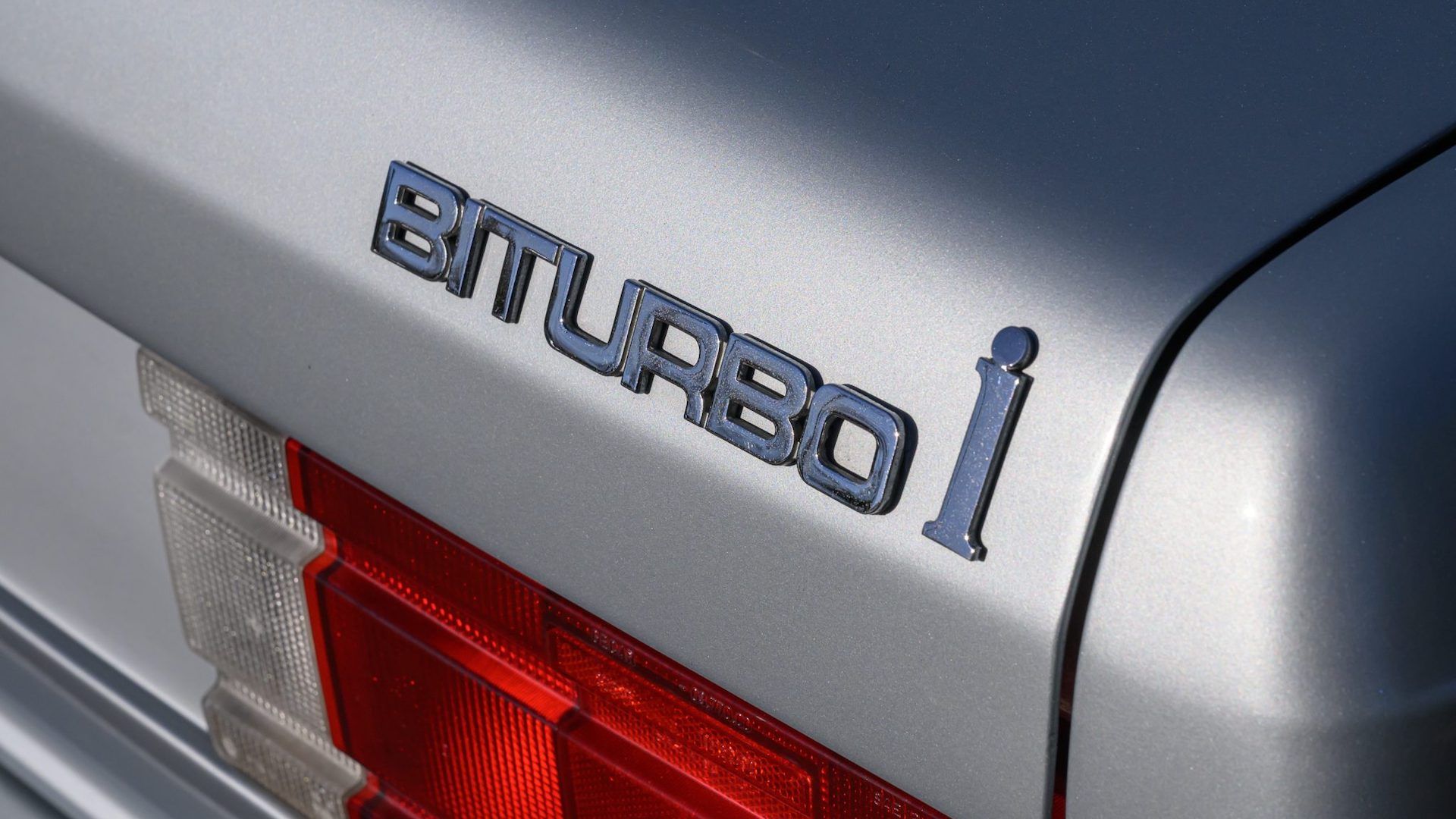
Following the Jetfire, it would be roughly two decades before we’d see the first production car with an engine coaxed by a pair of turbochargers instead of just one. That car was the aptly named Maserati Biturbo, which might not have been everyone’s cup of tea but Maserati might not have existed now if the Biturbo hadn’t come around when it did.
The Maserati Biturbo
The world’s first twin-turbocharged production car was an important model for the Italian automaker. It was the product of a distinctive era for Maserati, known as the era in the automaker’s history when Alejandro de Tomaso owned it. De Tomaso gained ownership of Maserati in August 1975, which was made possible by the tough times that the company faced under the ownership of Citroën, compounded by the 1973 oil crisis that hindered Maserati’s attempt at expansion. It’s a similar situation that we face today, even though Maserati’s CEO has tried to ease our nerves.
Alejandro de Tomaso is the same man who founded De Tomaso Automobili Spa and eventually created a car built around the idea of killing Carroll Shelby’s iconic Cobra. So, it should be no surprise then, that as soon as De Tomaso got control of Maserati, his immediate action was to fire the chief engineer and attempt to inject some performance into Maserati’s lineup. The goal was to do so at a lower cost than the high-end models that came before – like the Maserati Bora and the Maserati Khamsin – which were produced under Citroën’s ownership.
Enter the Maserati Biturbo
The Maserati Biturbo wasn’t conceived to claim the world’s first twin-turbocharged production car title, although it came just in time to beat Ferrari. Instead, it was seen as a means to an end, that end being an expansion of the brand’s reach by offering a sports car with impressive performance and a reasonable selling price. The first model was a coupe, followed by a sedan, and then finally a spyder variant. Pierangelo Andreani designed it, but the car was subject to multiple redesigns over the time it was produced.
Nowhere Near The F40, But Still Impressive
|
1981 Maserati Biturbo coupe |
1991 Maserati Biturbo 2.24v coupe |
1983 Maserati Biturbo 425 sedan |
1984 Maserati Biturbo Spyder |
|
|
Engine |
2.0-liter twin-turbocharged V6 |
2.8-liter twin-turbocharged V6 |
2.5-liter twin-turbocharged V6 |
2.0-liter twin-turbocharged V6 |
|
Power |
178 hp |
245 hp |
197 hp |
180 hp |
|
Torque |
187 lb-ft |
193 lb-ft |
223 lb-ft |
208 lb-ft |
|
0-60 mph |
6.1 seconds |
6 seconds (est) |
6.5 seconds |
7.1 seconds |
|
Top speed |
134 mph |
143 mph |
134 mph |
134 mph |
The world’s first twin-turbocharged production car was powered by a petite V6 engine displacing two liters in the debut model. It was also the first production engine to employ three valves per cylinder. Still, it would be expanded to four valves in later derivatives like the Maserati Biturbo 2.2 4v. While we’ve seen many twin-turbocharged V8s – one of which powered Ferrari’s 80s hardcore 650-hp monster – the Maserati Biturbo relied on a twin-turbocharged V6 engine derived from the automaker’s Formula One Maserati V8. Interestingly, because of the tax imposed on cars in Italy powered by engines with a displacement of over two liters, Maserati produced two powertrains for the Biturbo.
The variant of the Biturbo powered by the 2.0-liter V6 was earmarked as the model for Maserati’s domestic market, and a model earmarked for export that featured a 2.5-liter V6 engine, which would later be replaced by a slightly larger V6 engine. The coupe variant was the pioneering model and, in its meekest form, commanded an output of 178 hp. Still, in its most extreme configuration – the Maserati Biturbo Racing – it utilized a 2.0-liter twin-turbocharged V6 engine that mustered nearly 300 hp.

Related
Not Even The Maserati Name Could Save This Short-Lived Sports Car
We won’t blame you if you’ve never heard of this little Italian sports car.
The Maserati Biturbo sedan debuted two years after the coupe. Although there were derivatives designed as high-performance offshoots, the sedan’s V6 engines were as powerful as those used in the coupe configurations. Maserati debuted the convertible version of the Biturbo in 1982, which was mechanically similar to its stablemates. However, in terms of power output, it wasn’t as potent as the coupe or sedan.
The last incarnation of the Maserati Biturbo was a Maserati 228, a two-door, five-seater grand tourer based on the Biturbo chassis. It employed a 2.8-liter twin-turbocharged V6 that only managed to muster 250 hp, and ultimately, only 500 examples of this GT model were produced.
How Has Twin-Turbocharging Evolved Since
We’ve already established that the first twin-turbocharged production car was the Maserati Biturbo, which debuted in 1981. The twin-turbocharger system it relied on was a parallel turbocharger system. It used two similar-sized turbochargers that worked in tandem to improve power delivery and reduce turbo lag. The Ferrari F40 that would debut later in the 1980s featured a parallel twin-turbocharged system. It was an impressive feat, and just four years after the Maserati Biturbo debuted, another iteration of the twin-turbocharger system debuted on the only non-Ferrari to lap the Fiorano circuit: the Porsche 959.

Related
The World’s Newest Twin-Turbo V8 Comes From The Last Place You’d Expect
A twin-turbo V8 from a very unlikely source.
When the Porsche 959 debuted, it pioneered the sequential twin-turbocharger system. Instead of having both turbochargers work concurrently, the Porsche 959 featured two turbochargers of different sizes. The smaller turbocharger is used for the lower part of the rev range, passing some of the exhaust gases to a larger turbocharger that sustains the car at higher rpm. This benefits a vehicle by avoiding turbocharger lag, which plagues the Ferrari F40, causing a sudden increase in power midway through the rpm. This is why inexperienced drivers routinely send these cars into a wall. We’ve seen many cars utilize sequential turbocharging systems.
One of the coolest examples is the Bugatti Chiron, which features four turbochargers. Two of these are used for lower rpm and then pass the baton on to the larger turbochargers for higher rpm. The series twin-turbocharged systems are another major configuration for twin-turbocharged systems. Series turbocharging is distinguished by using the efforts of a turbocharger, then compounding that by passing on exhaust gases to a larger turbo, and so on.
Surprisingly Affordable
There is a fair amount of significance to the title “world’s first twin-turbocharged production car,” and you’d think that this might cause a spike in its average selling price on the used market. Surprisingly, the world’s first twin-turbocharged production car is surprisingly affordable on the used market. According to Classic.com’s resources, the average selling price of the Maserati Biturbo is $14,001, with many examples being sold in this year alone.

Related
One Of The Best Italian Sports Sedans Costs Less Than A Rental Spec Nissan Versa
Used bargains are one of the great wonders of the world, as evidenced by the fact you can have a Maserati for the same cost as a new Nissan Versa.
At the time of this article’s publication, an example of the 1984 Maserati Biturbo is listed for just $8,000, while an example of the 1986 Maserati Biturbo Spyder is listed for $16,500. Many examples have been sold for less than $20,000. It’s a bargain, considering that it was an important model for the Italian automaker and in automotive history, warranting full resto-mod treatment.
Sources: Maserati, Classic.com, BringATrailer