Best Hybrid SUVs | 2025 Hybrid Crossover Ratings
Automakers often hybridize their more popular models in a move to hit a larger market, and considering how in-vogue SUVs and crossovers are, it’s hardly surprising there are plenty of hybrid SUV options. Now, extra choices when it comes to buying a car are seldom a bad thing, but it can muddy the water and make reaching a decision that much harder. As many advantages as hybrids bring to the equation, they have drawbacks, too, whether this applies to luxury or mainstream models. Luckily, we have used our in-depth review system to weight each product and produce our rankings of the best hybrid SUVs of 2025.
Vehicles are assigned a BuzzScore in relation to their direct segment competitors, and as such, vehicles in this list, while similarly scored, do not necessarily compete directly against one another. Find out more about how the BuzzScore ratings work here. These lists are continuously updated with the latest BuzzScores and vehicles as they become available.
Only full hybrid and plug-in hybrid SUVs have been considered for this list; mild hybrids, which often see a negligible increase in performance and/or efficiency, are not included.
1
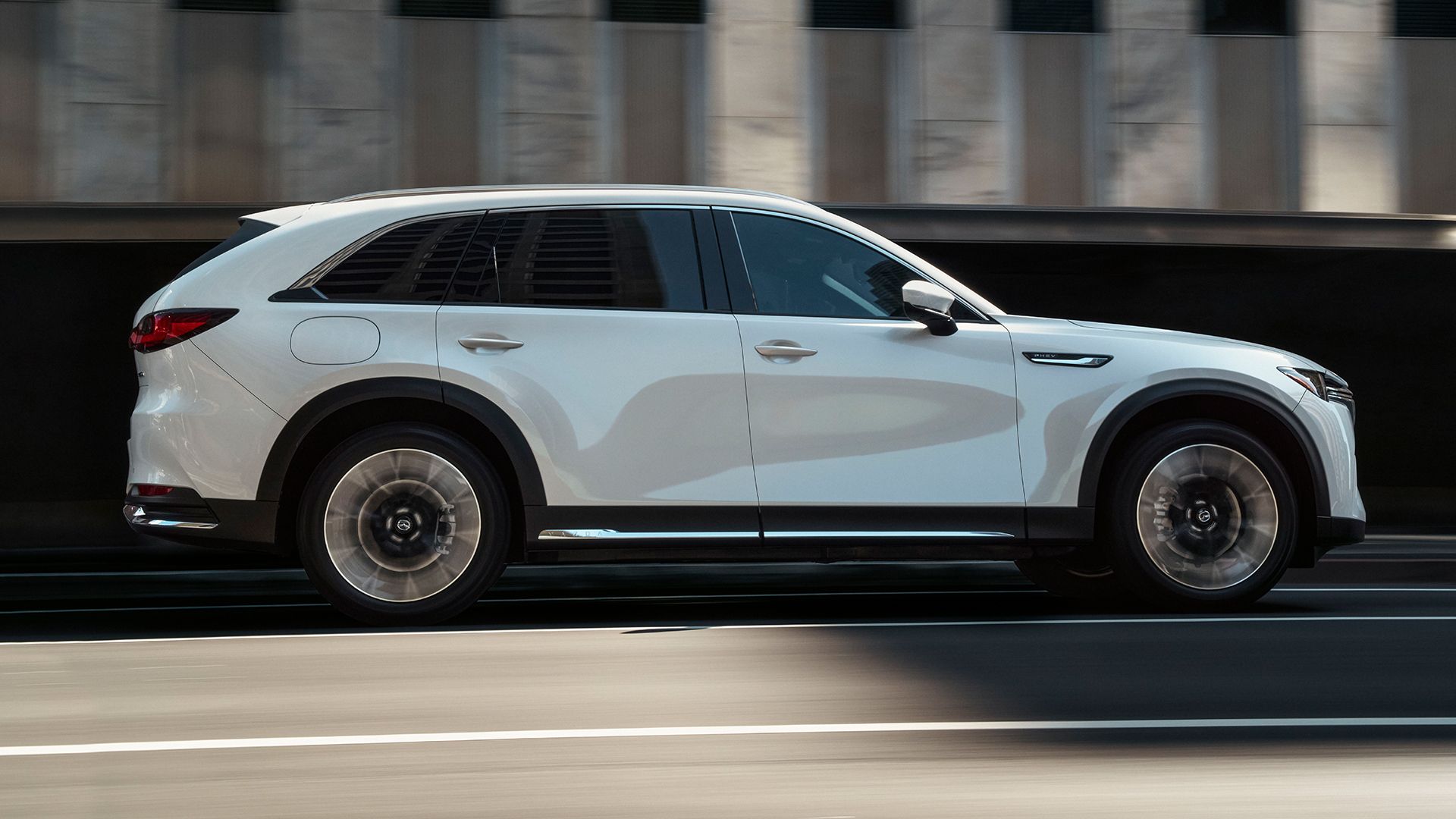
Mazda CX-90 PHEV
2025 Mazda CX-90 PHEV
- MSRP
-
$49,945
- Engine
-
2.5L I4 PHEV
- Horsepower
-
323 hp combined
The best hybrid SUV, according to our BuzzScore system, is the Mazda CX-90 PHEV with a great score of 8.8 out of 10. Like other modern Mazdas, the CX-90 PHEV offers a premium driving experience in a quality interior with luxurious styling and plenty of features. It starts at $49,945 for the base model Preferred trim, but gets expensive quickly at the top end of the range. All three trims are driven by the same 2.5-liter four-cylinder hybrid powertrain that makes a net combined 323 horsepower. They also all come with standard all-wheel drive and automatic transmissions, bringing fuel economy to 56 MPGe combined. Expect to cover around 25 miles on electric power alone.
“The outgoing CX-9 was among the most fun-to-drive SUVs in the mainstream segment, and the CX-90 only improves upon that formula: A rear-biased platform with all-wheel-drive delivers balanced handling that keeps drivers grinning on a windy backroad. The steering is on the heavy side for a family SUV, but justifies that weight with good responsiveness and connectivity to the road.”
– Jared Rosenholtz, Editor-at-Large, CarBuzz

Related
10 Best Luxury Cars You Can Buy Brand New For Less Than $70,000
These are our 10 best picks if you’re shopping for a premium vehicle on a budget.
2
Toyota RAV4 Hybrid

2025 Toyota RAV4 Hybrid
- MSRP
-
$32,300
- Engine
-
2.5L Dynamic Force I4 Hybrid
- Horsepower
-
219 hp combined
The Toyota RAV4 Hybrid is not only one of the best hybrid SUVs, but one of the best hybrid cars in general. We could spend all day explaining why the RAV4 outsold every car in America last year. With a starting price of $32,300, it’s comparable to rivals like the Honda CR-V Hybrid, and offers a lot for the money. The RAV4 Hybrid looks great with a mix of rugged angles, especially in the Woodland Edition. It feels solid and you can bet it’ll last the test of time. Under the hood is a 2.5-liter four-cylinder hybrid that makes 219 combined horsepower, and it gets 41/38/39 mpg city/highway/combined.

Related
10 Best Family Cars Across Multiple Segments
We’ve even thrown a wildcard in here.
3
Hyundai Santa Fe Hybrid

The next hybrid SUV with a good BuzzScore of 8.4 out of 10 is the Hyundai Santa Fe Hybrid. Some people still aren’t the biggest fans of the Santa Fe’s styling from the back, but that angular, boxy look contributes to some great storage space and headroom inside. Regardless of the styling, it’s still a nice family car. The 2025 model starts at $37,800, which is just under its direct rival, the Sorento Hybrid. Driving either the front or all wheels of the Santa Fe Hybrid is a 1.6-liter four-cylinder hybrid that makes a combined 231 horsepower and 271 lb-ft of torque. In FWD configuration, it gets 36/35/36 mpg.
“With little drama, we pulled out into traffic and found the hybrid system to be fine. Nothing special, just fine. It may have lower power figures than the gas-only model, but the electric motor smooths out power delivery from a standing start and relieves the load on the transmission, which makes for a smoother driving experience.”
– Ian Wright, Senior Road Tester, CarBuzz

Related
2025 Hyundai Santa Fe Hybrid First Drive Review: Fixing The 2024 Santa Fe
Does the gas-only Santa Fe even make sense now?
4
Kia Sorento Hybrid

Very similar to the Santa Fe Hybrid, but with distinct styling and slightly less power, is the Kia Sorento Hybrid. When you get down to it, the Sorento Hybrid has nearly identical mechanical specifications to the Santa Fe. It’s powered by the same 1.6-liter turbocharged four-cylinder, only this time it’s tuned for 227 combined horsepower and 258 lb-ft of torque. If you prefer the styling of the Sorento over the Santa Fe, you’ll have to pay slightly more, though. This model starts at $38,690. You can choose either front-wheel-drive or AWD; those with FWD get 36/36/36 mpg and AWD versions get 34 mpg across the board.
5
Toyota Corolla Cross Hybrid

2025 Toyota Corolla Cross Hybrid
- MSRP
-
$28,495
- Engine
-
2L Dynamic Force I4 Hybrid
- Horsepower
-
196 hp
Another one of Toyota’s best hybrid SUVs is the Corolla Cross Hybrid. Its practical size, reliable powertrain, and suite of standard features in a relatively affordable package earn it an 8.1 out of 10 rating. While the rest of the list is filled with larger SUVs, the Corolla Cross Hybrid slots into the subcompact segment. You can pick one up for a base price of $28,495, or spend a little more for the cool Nighshade trim. Under the hood is a 2.0-liter four-cylinder hybrid that makes a combined 196 horsepower. With standard AWD and an automatic transmission, this Toyota SUV gets 45/38/42 mpg city/highway/combined – not many cars can beat that.
And with its excellent fuel economy, Toyota build quality and longevity, ease of use, and small footprint, the Corolla Cross Hybrid is the sensible choice for those looking for a small crossover.
– Ian Wright, Senior Road Tester, CarBuzz
6
Mazda CX-70 PHEV

Mazda returns to the list with another one of its top hybrid SUVs: the CX-70 PHEV. This model is slightly smaller than the CX-90 PHEV, but still provides the same premium quality and elevated spirit as its sibling; it only loses a third seating row. The interior feels luxurious and refined while the exterior retains a modern and smooth style. There are only two trims to pick between, with the Premium being the least expensive at $54,400. It retains the same 2.5-liter four-cylinder hybrid that we found in the CX-90 PHEV, so it also has 323 horsepower and 369 lb-ft of torque. It also has the same AWD system and automatic transmission, so it gets 56 combined MPGe.

Related
Mazda CX-70 Vs. CX-90: The Obvious And Not-So-Obvious Differences Between Mazda’s Midsize SUVs
On the face of it, these two SUVs are remarkably similar – but are the differences hidden in the details?
7
Toyota Sequoia

The largest option for hybrid SUVs on this list is the Toyota Sequoia. With a BuzzScore of 8.0 out of 10, the Sequoia is a formidable option against other three-row SUVs. To get your hands on a base model SR5 with RWD, you’ll have to fork over $62,425 before destination and fees; after that, the lineup extends to over $80k for the 1794 Edition at the high end. Every trim is powered by the same 3.4-liter V6 i-Force Max hybrid that makes 437 hp and 538 lb-ft of torque. Depending on your choice of RWD or 4WD, you’ll get an estimated 21/24/22 mpg or 19/22/20 mpg.
8
BMW X5 Hybrid

One of the only luxury models here is the BMW X5 Hybrid. For one of the most luxurious and uplifting examples of a hybrid SUV on our list, the X5 stands up for itself well. It’s powerful, looks great, and is full of comfort and convenience features. You can fully expect that a car as nice as the X5 Hybrid from a brand like BMW will cost a premium, and it does: the xDrive50e starts at $73,800. It’s powered by a 3.0-liter inline-six hybrid that makes 483 net combined horsepower and 516 lb-ft of torque, which means it can do the 0-60 sprint in about 4.6 seconds.

Related
X5 Vs. XM: BMW’s Polar Opposite Hybrid SUVs Compared
BMW’s two most expensive plug-in hybrid SUVs couldn’t be more different.
Characteristics Of Hybrid SUVs
From the smallest compact to the largest full-size, every type of SUV can be hybridized. However, it is safe to say that they share fundamental similarities that make the classification so popular. This is what automakers try their best to capitalize on and why there are many qualities you can expect to find in a hybrid SUV, regardless of how we rate it. These include:
- Practicality: SUVs are typically more practical than sedans. They have larger trunks, more passenger space, and many have the option for a third row.
- Comfort: Designed specifically for the family lifestyle, crossover SUVs more often than not lean towards accommodating interiors and on-road comfort. Hybrids, especially, are more urbane and shy away from the off-roading that more rugged body-on-frame SUVs enjoy. Their suspensions are softer to soak up regular bumps in the road.
- Safety: Vehicle size may not always be proportional to safety standards, but the elevated seating position in an SUV can make some drivers feel more secure. The majority of modern SUVs will come with several driver-assistance features as standard.
- Efficiency: Separating hybrid SUVs from the rest of their kind is their higher levels of efficiency. This is an area where these larger vehicles most often suffer, consuming fuel far more liberally than sedans or hatchbacks, which have now been displaced by the desirable high riders. Strapping on a battery pack and regenerative brakes might not do as much to reduce costs as much as full electrification, but it does help to reduce the dent in your wallet.

Related
Best Hybrid Cars Of 2025
Hybrids are more popular than ever, and these are the best of them.
What To Consider Before Buying A Hybrid SUV
Now, buying a new car is always going to be a weighted decision. Hybrids, in particular, are more expensive than non-hybrids, and recouping the extra price means hanging onto them for quite a few years. Subsequently, buyer’s remorse can last an uncomfortably long time. To help you avoid this, here are some of the pros and cons of buying a hybrid SUV to help you decide if it is, in fact, the right choice for you:
Pros
- Better mpg means lower running costs
- More cargo space than the average sedan
- Eco-friendly thanks to reduced emissions
- Extended brake life due to regenerative tech
- Higher resale value
Cons
- Hi-tech components often increase overall weight considerably
- Higher initial cost can be off-putting
- Battery packs sometimes reduce rear-seat and trunk room
- Additional moving parts negatively impact maintenance costs

Related
Best Small Hybrid SUVs Of 2025
Efficiency and versatility in one package.
Are hybrid SUVs good?
If done right, the best hybrid crossover gives you all the advantages of the popular body style and then some. Combining the heightened practicality of the high-riding body and the comfort of a spacious interior with the eco-friendly benefits of a hybrid powertrain can’t be bad, right? However, some manufacturers equip their hybrids with weak engines. The savings in fuel aren’t always worth the sacrifices, which is why you need to ensure you buy one that gets the recipe right.
Are hybrid SUVs stronger than regular cars?
For the most part, automakers use the exact same engine in their hybrid models as the rest of their range, but add an extra battery pack and regenerative brakes. However, a smaller engine often helps to get even better fuel economy figures, which means settling for less power in the name of affordability. Plug-in hybrids differ in that they often do have more power thanks to the addition of an electric motor. Luxury brands, in particular, use hybridization to enhance performance.
Sources: Mazda, Kia, Hyundai, Toyota, BMW