
The Best Versions Of The ’90s BMW 8 Series Never Made It To Market
The BMW 8 Series is one of the most visually striking models in BMW’s lineup. In standard trim, these are sultry grand tourers with sumptuous interiors paired with exciting powertrains, and the M Divisions lineup is one of the most powerful non-hybrid offerings in 2025.
BMW
BMW is a German luxury car and motorbike manufacturer and current owner of Mini, Rolls-Royce, and Alpina. With roots dating back to 1913 as Rapp Motorenwerke, it officially became Bayerische Motoren Werke in 1922 as a manufacturer of aircraft engines. BMW’s first car was built in 1928 when it built the Austin 7 under license from Dixi, which was called the BMW 3/15. BMW grew into a manufacturer of premium and luxury automobiles, launching iconic nameplates like the 3 Series, 5 Series, and 7 Series, and is today known as one of the leading luxury automakers in the world, while the BMW M division is hailed as a leading manufacturer of performance cars.
- Founded
-
1916
- Founder
-
Karl Rapp
- Headquarters
-
Munich, Germany
- Owned By
-
Publicly Traded
- Current CEO
-
Oliver Zipse
Only two generations of the 8 Series have ever existed, with the model’s genesis traced to the 90s with the introduction of the BMW E31 8 Series. Interestingly, while the world enjoyed the E31 8 Series, we never got to experience the prototypes that BMW had concocted, one of which was being bred to fight Italy’s prancing horses.
This article focuses on the prototypes BMW created for the E31-generation 8 Series.
The E31 Generation
Before we talk about the models that never made it, let’s have a look at the E31 8 Series models that did. Although debuting in 1990, the development of the BMW 8 Series began roughly nine years before its market launch. Although its debut would be delayed because of the BMW 6 Series, the new 8 Series would only be unveiled to the world in 1989 at the Frankfurt Motor Show and was intended to be a model that would be more upmarket than the BMW 6 Series at the time, which was confirmed to make a return before 2030. Compared to the 6 Series, the 8 Series was a true upmarket offering, offering more performance and a higher price tag. Nearly $900 million (adjusted for inflation) was spent on developing the 8 Series.

Related
The Misunderstood E31 BMW 8 Series Nearly Looked Very Different
Is BMW hinting at the start of a new era for the 8 Series? There are plenty of clues to suggest just that.
Interestingly, BMW relied on CAD software and tools to design the 8 Series’ physique, which was still uncommon then and would be refined through extensive wind tunnel testing. The result: a striking, wedge-shaped two-door grand tourer with enough road presence fit for an Eastern European mob boss and similar to one of the sexiest-looking models from BMW’s Bangle Era. The 8 Series consisted of five derivatives, starting with the humble (we use this word loosely) 840Ci and being overseen by the mighty 850CSi. However, neither model would have been in its position had BMW planned to develop two of its 8 Series prototypes, one of which would be the model range’s entry point and the other designed to rival some of Italy’s finest offerings.
BMW’s Proposed Entry-Level 8 Series
Information about the two models we’re discussing in this article is scarce regarding BMW’s 830i, which was envisioned as the opening act for the first-generation BMW 8 Series. It was intended to be where the BMW 840Ci, pegged as a would-be entry-level model. As we’re all aware, first impressions matter, and the first impression of the 8 Series was going to be a sultry grand tourer with two-door rear-wheel-drive that sourced its power from a V8 engine. V8 engines in the 8 Series range were common, with the 840Ci employing a 4.4-liter naturally aspirated V8 engine and, in later renditions, a 4.4-liter V8 engine. However, this prototype model stood out because BMW wanted to propel its entry-level model from A to B and everywhere in between, using a 3.0-liter V8 engine.

Related
Manual, V10-Powered BMW 8 Series Restomod Is Pure Bimmer Perfection
Combining one of BMW’s prettiest designs with its most iconic engine? That sounds like a recipe for success.
This wasn’t a new engine, either. That 3.0-liter, eight-cylinder powerplant also powered the BMW E34 530i from 1992 to 1996 and the BMW E38 740i. Reportedly, in the proposed entry-level 8 Series model, the M60B30 V8 engine would command an output of 215 hp, which was significantly lower than other models that utilized the same engine, with the E38 740i having more than 250 hp from the same engine.
However, the BMW 830i would never make it to production. Ultimately, only 18 examples of the would-be entry-level 8 Series were produced, 13 of which featured automatic transmission. Most of the 18 prototypes were eventually disassembled, with the only surviving example kept at the BMW Museum in Munich. The 830i prototype would be replaced by the BMW 840Ci, which produced a higher output from 1992 to 1996.
Another odd prototype that BMW toyed with was the BMW 850i Cabrio, a convertible variant of the 8 Series. However, at the 11th hour, BMW decided to pull the plug, and it would never go into production. It was also kept at the BMW Museum in Munich.
BMW’s Unrealized Ferrari Contender
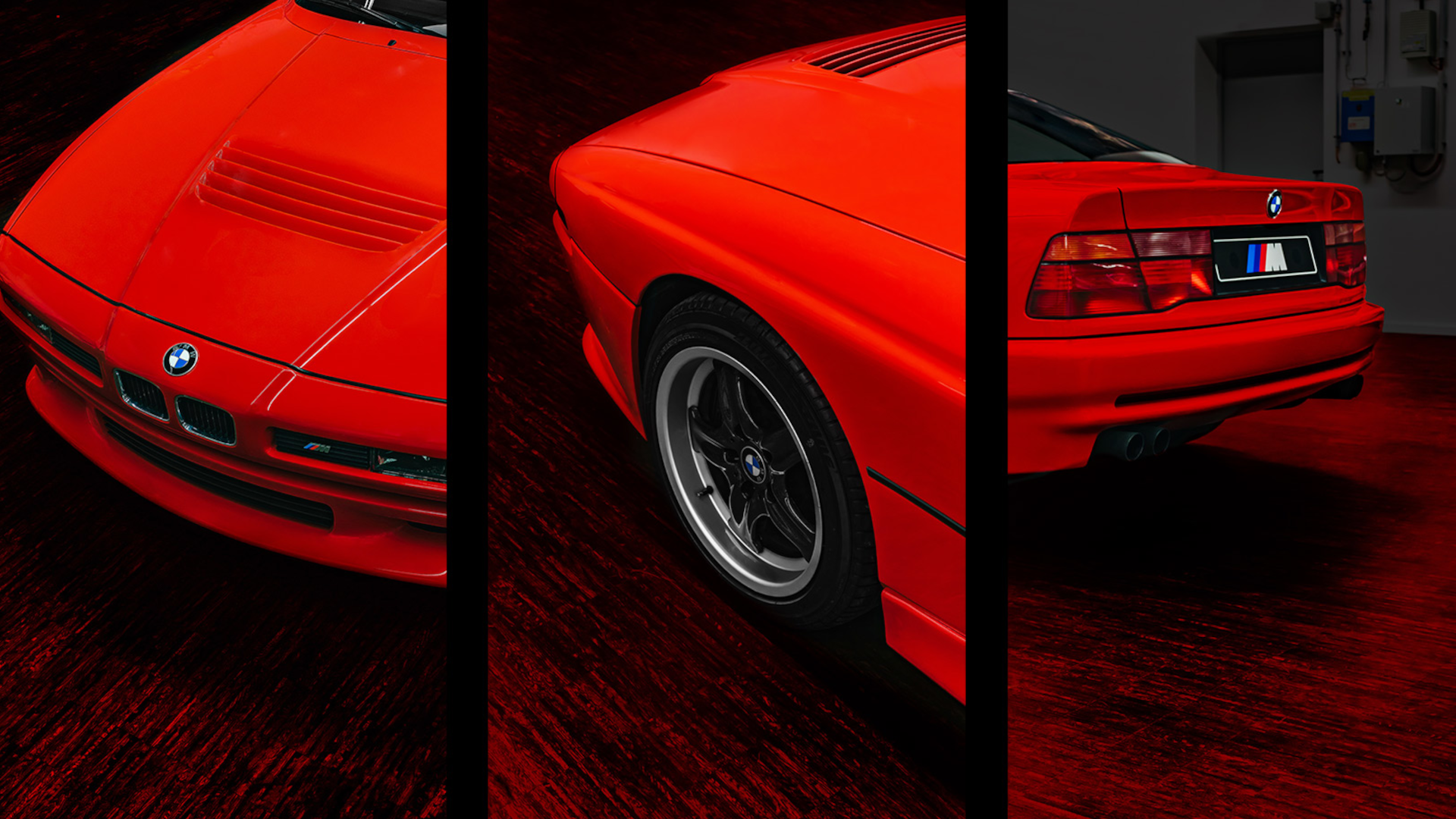
As cool as those prototypes were, one prototype that BMW toyed with truly stole the spotlight. That model was the BMW M8, which would only be released in the second-generation 8 Series. Even though it may be living on borrowed time, it would not be as cool as the prototype that BMW tried their best to keep under wraps. Reportedly, it was bred to contest with Ferrari which, at the time, was producing hits like the Ferrari 512 TR, the V12-powered successor to the F40, and the Ferrari 360 Modena. BMW subsequently conspired to produce a V12-powered German supercar with the already supercar-esque styling of the 8 Series.
The V12 engine in question was a prototype variant of BMW’s S70 V12, which would also be used to power the McLaren F1 and whose cousin would be used to power BMW’s McLaren F1 rival. However, that was a different rendition of the S70 V12 engine and an extreme offshoot from the powertrain used in the first turbocharged BMW. However, the proposed engine was a 6.0-liter variant instead of the standard 5.0-liter displacement and featured new throttle bodies, camshafts, intake manifolds, and more. It was one of the cooler offerings from BMW in the 90s, akin to the bullet-resistant models the automaker has produced for over 45 years.

Related
The Strangest BMW Ever Made Was Never Sold In The USA
BMW has always tended to keep driving pleasure at the core of every car it makes, but one weird model completely threw this approach out the window.
The heavily disturbed V12 would reportedly propel the BMW E31 M8 up to 199 mph and featured an output of roughly 631 hp and 479 lb-ft. It was an impressive concept from BMW. Compared to the standard 8 Series, the M8 had more cooling, a lower curb weight, bespoke bodywork, body reinforcements, a wider track, improved engine and differential cooling systems, and bucket seats. Ultimately, BMW decided against approving the prototype for production, much to the dismay of the automotive community. The reason is the same for many cool concepts which are snuffed out before their fires burn: cost. Reportedly, BMW couldn’t justify producing the M8 because it didn’t see a market for such a potent supercar with an equally potent price tag, with its more modern descendent dead in the United States.
It would be replaced by the BMW E31 850CSI, which still retained the S70 V12 engine, albeit with a significantly lower power output. The BMW M-Division still tuned it, and although not as potent as the prototype, it was a decent performance offering from the first-generation 8 Series. A single example was produced and kept hidden from the public for a long time. According to reports, the media would only lay their eyes on the M8 more than a decade after production of the BMW E31 generation ended, and it would be another few years before the BMW M8 prototype was unveiled to the world.
Sources: BMW

