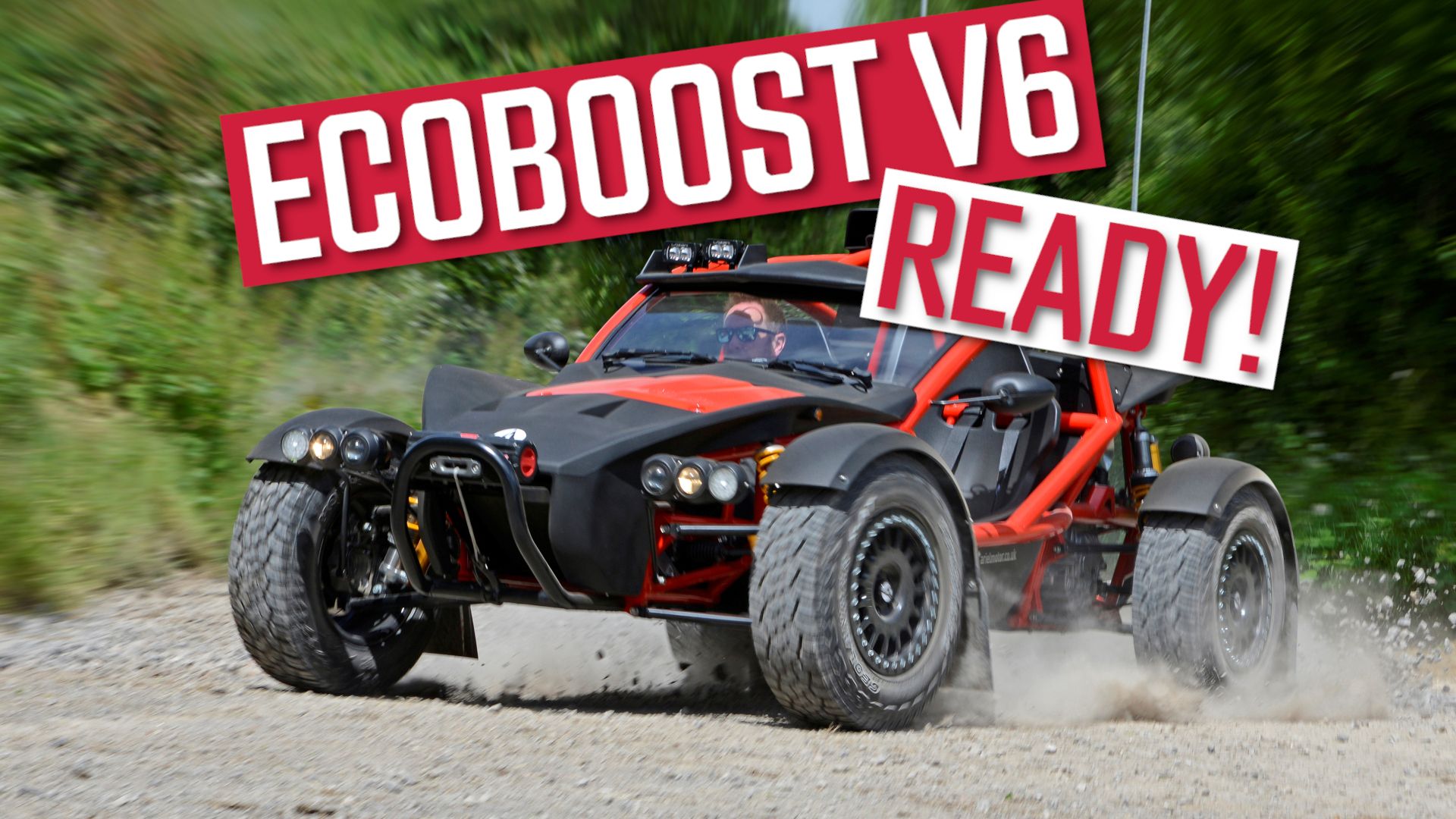
Ford’s Twin-Turbo EcoBoost V6 Will Fit Into Ariel Nomad, And Ariel Won’t Rule It Out
The Ford GT and Ariel Nomad 2 occupy opposite ends of the sports car/supercar spectrum. The GT is a bona fide supercar with Le Mans-winning pedigree and one of the finest track weapons of the modern era, while the Nomad 2 is an off-road exoskeleton sports car that weighs next to nothing and is more at home tearing up rally stages than it is at your local Cars & Coffee. But there’s a unique bit of overlap between these two, as Ariel founder and director Simon Saunders has told CarBuzz the EcoBoost V6 from the GT – and other Fords like the F-150 and Explorer – could fit into the chassis of the Nomad.
Related
This Is How Long You Have To Wait For Your Ariel Atom Or Nomad To Arrive
Since launching the Nomad 2 and Atom 4 and 4R, Ariel has seen immense demand for its niche sports cars. This is how long you’ll wait for yours.
The discussion stemmed from a recent interview with Ariel’s head honcho, where we asked about the reason behind switching from Honda to Ford as an engine supplier for the Nomad 2. The second-generation Nomad was revealed earlier this year with the 2.3-liter turbo EcoBoost four-cylinder from the Ford Mustang. Before this, it had relied on a K24 Honda four-cylinder, so the change was a fairly significant one.

Ariel Motor Company
Ariel Motor Company Limited was founded in 1991 by Simon Saunders with the goal of creating a modern interpretation of the Lotus Seven. The low-volume sports car manufacturer launched the Atom as its primary model before extending its lineup in 2014 with the Ace motorcycle and in 2015 with the Nomad off-roader. Ariel currently has a production capacity of approximately 100 cars per year.
V6-Powered Nomad Would Be A Spiritual Successor To The Atom V8
When asked if the agreement with Ford to use EcoBoost engines could mean the use of the EcoBoost V6 was in the cards, and if it could even fit in the Nomad 2’s chassis, Saunders laughed but gave us a surprising answer.
“I think it’s possible. It’s funny you should say that because somebody asked that a couple of weeks ago. So it’s possible, yes.”
– Simon Saunders, Founder and Director, Ariel Motor Company

Add CarBuzz to your Google News feed.
But there’s a difference between something being possible and something being worth pursuing, or even under consideration, and when asked if it would be something worthy of consideration in the same vein as the Atom V8, Saunders didn’t rule out the possibility.
“We’re always sort of looking around for other opportunities,” explains Saunders, adding, “Putting the V6 in, we’d have to do a study on the pluses and minuses, packaging, and so on and so forth.” But it wouldn’t necessarily be a straight plug-and-play development, as the Nomad has hardly got the most spacious chassis to try and package a big engine into. Saunders explains it as such:
“I mean, the one thing about both the Atom and the Nomad is they’re incredibly tightly packaged. So it’s not as if it’s a Ford Mustang where [you’ve] got this big empty space in the front of the car…”
It’s still something he’s willing to explore, though, admitting that “it’s certainly something we could have a look at. And we can look at the characteristics of the engine, how much power we can get from it in this thirst for yet more power that we always have.” Ford has a variety of V6 engines at its disposal, so it’s not only the big 3.5-liter V6 that could be considered; the 3.0-liter EcoBoost V6 from the Bronco Raptor is another consideration for something smaller, still capable of 418 horsepower.
Ariel as a company has seemingly found itself drawn to developing high-powered sports cars, or at least high power-to-weight-ratio sports cars. Compared to where it all started – the original Atom had 120 hp from a 1.8-liter Rover engine – the Nomad 2’s 305-hp Mustang motor in a package that weighs just 1,576 lbs is reaching supercar levels of power to weight, and its back-catalog includes the wild Atom V8 which had 500 hp on tap. This has left room for the potential of a new entry-level sports car below the current Atom, although for the time being, Ariel is quite happy with the base Nomad 2 remaining as is.
The Real Reasons Ariel Swapped From Honda To Ford Power
The new Nomad 2 may look familiar in concept, but beneath its exoskeleton lies a whole raft of changes. The chassis is all-new, and the Nomad 2 is both longer and wider than before with off-road specifications that shame traditional off-roaders. It’s got bigger brakes, more power, clever aero, new suspension, and an optional sequential gearbox from the Atom 4R. New really does mean new in the world of Ariel. Of course, the engine is one of the biggest departures, with the 2.3-liter EcoBoost four-pot from Ford taking pride of place behind the driver.
Ariel Nomad 2 Specifications |
|
|---|---|
|
Engine |
2.3-liter EcoBoost 4-cylinder Turbo |
|
Transmission |
6-speed manual (6-speed sequential optional) |
|
Power |
305 hp |
|
Torque |
382 lb-ft |
|
Weight |
1,576 lbs |
|
0-60 |
3.4 seconds |
|
Top Speed |
134 mph |
The decision to make this swap was two-fold, but it partly hinges on Ariel’s ambitions to expand into new markets and increase its production capacity beyond the current 75 cars a year. “We’re trying to expand Ariel,” says Saunders.
“The Ford engine is a world engine. [The decision to switch] was, from our point of view, on a sort of business basis […] because we’re looking at other markets and opening up other markets. The Ford engine was a natural choice for doing that.”
– Simon Saunders, Founder and Director, Ariel Motor Company

Related
Ariel E-Nomad Off-Roader Is Proof Electric Cars Can Be Fun
It’s just a concept for now, but Ariel intends to put the E-Nomad into production.
Another factor Ariel has to consider is the changing automotive landscape, where, as EVs are legislated into the mainstream, combustion engines are beginning to fade out of the supply chain. “It’s got continuity of supply,” says Saunders, which is pretty important “because the market is in a big state of flux, with unknown EV dates coming and going.” In Europe, which is a big target market for Ariel over the next few years, impending Euro 7 emissions legislation threatens to severely constrict what automakers can and can’t build, engine-wise, so a motor that is globally homologated and complies with various regulations is a bonus for Ariel.
There’s also the consideration of performance and fitness for purpose, with Saunders admitting that “we could get more torque” out of the Ford motor. “It seemed more suitable for the Nomad. So we thought we’d try the EcoBoost engine; it’s really good off-road.”
Ariel Still Committed To A Partnership With Honda
The choice to use a Ford engine, however, does not come at the expense of a relationship with Honda, which is still the powertrain supplier of choice for the Atom 4 and Atom 4R. “The Honda engine remains in the Atom,” Saunders reminds us, emphasizing that “we’re still very much tied to the Honda engine.”
However, as a small-volume manufacturer, becoming stagnant and not being able to shift suddenly to changing conditions is tremendously risky. “I think for a small manufacturer, it’s good for us to keep our options open,” says Saunders.