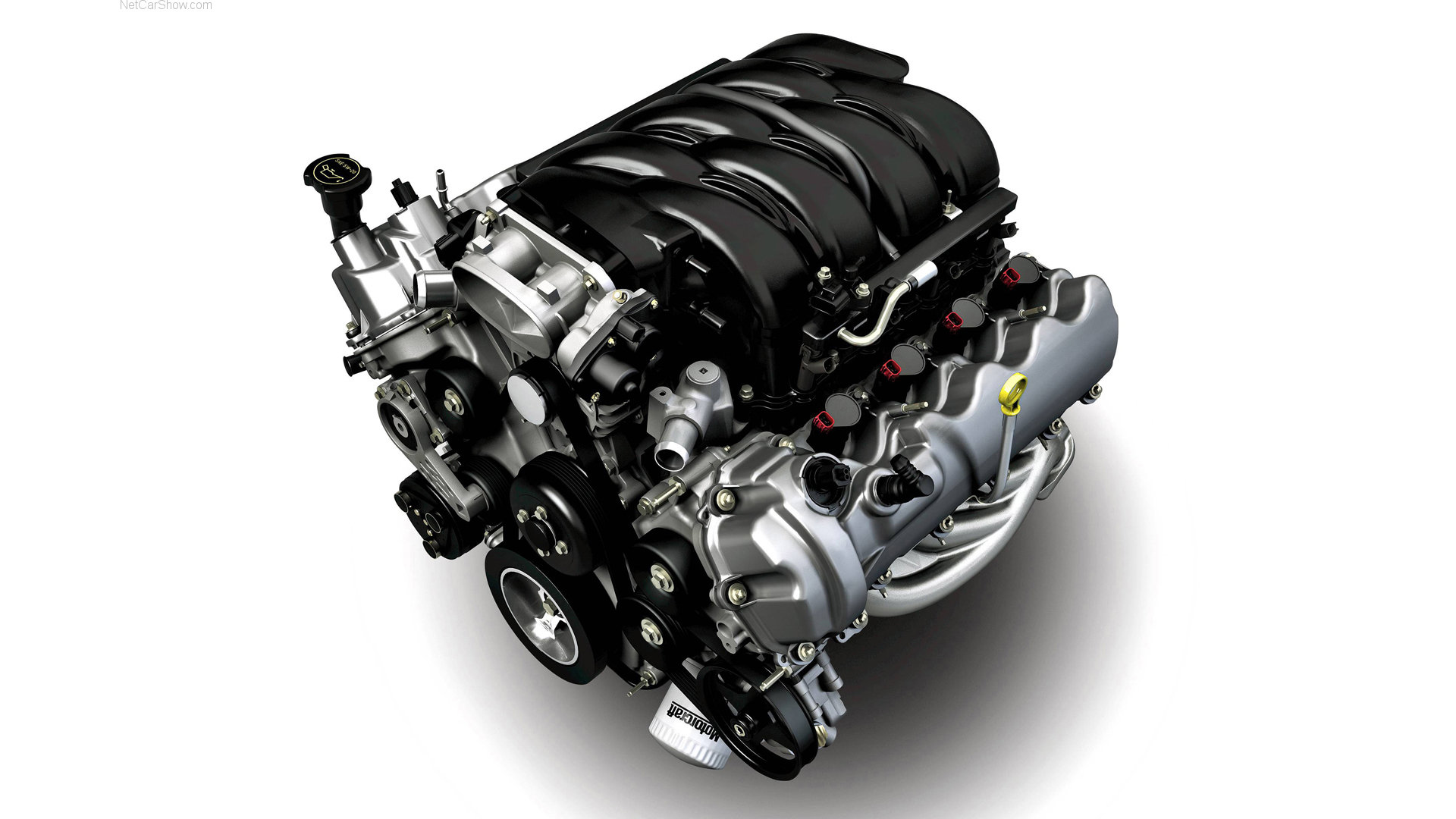
The 4.6-Liter Modular V8 Was Ford’s Unsung Hero (And Still Is)
Throughout automotive history, there have been very few engines outside the sports car or supercar realm that haven’t been tasked with powering multiple vehicles. Take the 1.5-liter Ecotec inline-four seen in several General Motors vehicles, ranging from small, economical cars to mid-sized SUVs. After all, it just wouldn’t make financial sense to create an entirely new engine for each model a mass-market manufacturer makes.
Ford
Ford is one of America’s oldest automakers and one of the oldest in the world, popularized for being the first to effectively mass produce the automobile under Henry Ford with the Ford Model T. In over 120 years, Ford has become a sales leader in a variety of segments, with popular nameplates like the Ford F-150, Transit, and Mustang.
Sometimes, these automakers create engines whose legacy lives on well after their demise. Whether it be due to their power, reliability, or sheer wackiness – like the VW VR engine family – some motors end up being the subject of discussion for quite a while. One such engine, and the topic of this story, is Ford’s 4.6-liter V8. It belongs to Ford’s modular V8 family, which still lives on to this day. But, unlike other Ford engines, the 4.6-liter has quite a rap sheet under its belt.

Related
The 10 Most Powerful Versions Of Ford’s Modular V8 Engine
Ford’s modular V8 engine is omnipresent within its ranks and has been for years. Here are the most powerful models to ever used the modular V8 enigne.
The 4.6-Liter Modular V8 Lived Several Lives
Fast Facts About The 4.6-Liter Modular V8
- Produced from 1991 to 2014
- Mostly saw use by Ford, Lincoln, and Mercury
- One application of the 4.6-liter had a power output of 806 hp
- Won Ward’s 10 Best Engines numerous times
The 4.6-liter V8 marked the first engine to be a part of Ford’s Modular engine family. At the end of the 1980s, Ford decided to streamline their V8 production, leading to the introduction of the Modular architecture. The new engine architecture allowed for much easier changeover between Modular engines, requiring only a minimal amount of casting and tooling changes at Ford’s engine plants for different configurations of the engine.
The change in V8 engine architecture paralleled Ford’s move from the boxy vehicle designs seen in the 1980s to a more round and sleek look, typical of cars from the 1990s. The creation of an entirely new V8 engine architecture was part of Ford’s then-Vice-president of Design, Jack Telnack’s orders from Ford’s then-Chief Operating Officer, Donald Peterson. Peterson also commissioned Telnack with the task of redesigning most of Ford’s lineup to fit with their vision regarding Ford’s new look for the ’90s.
1991 marked the first year of the Modular V8, and its first application was in the 1991 Lincoln Town Car, itself debuting an all-new design. This first iteration of the 4.6-liter Modular V8 produced 190 horsepower and 260 lb-ft of torque. Not impressive these days, but perfectly satisfactory at the time for an American luxury land yacht. Anyway, given its task to motivate the big car, it was tuned more for low-end torque than outright power, with its torque peak at 3,200 rpm.

Add CarBuzz to your Google News feed.
The next year, Ford began using the 4.6-liter in the Ford Crown Victoria, with the Ford Thunderbird following suit in 1994. The Thunderbird marked the first time the Modular V8 produced over 200 horsepower, with a maximum power output reaching 205 horses. Around this time, the 4.6-liter V8 was quickly proving itself as a durable engine in Ford Crown Victoria Police Interceptors, as many police precincts across the US were quick to order The Crown Vic after the new model debuted in 1992. Not only was the 4.6-liter V8 a durable motor, routinely achieving over 300,000 miles, it was also extremely easy to work on, with most of its major components in easy-to-reach spots.
The 4.6-Liter Modular V8 Could Make A Lot Of Power
There were several iterations of the 4.6-liter Modular V8 throughout its long life. The three main iterations were the two-valve, which was the most widely-used version and considered the most reliable. Then, there was a three-valve version which featured two intake valves and one exhaust valve per cylinder. Finally, a four-valve version rounded out the 4.6-liter Modular V8 family. The four-valve was used by a few car companies, and was even used in a couple of early Koenigsegg supercars, including the CCR, with boosted induction via dual superchargers.
All three iterations of the Modular V8 offered both iron and aluminum for its engine block casting material, and the use of each was dictated by what application each individual unit was destined for. For example, 4.6-liters destined for use in the Ford Explorer, Expedition, or F-Series received a cast-iron block and aluminum heads. E-Series vans were also given the same treatment. When it came to performance-oriented applications such as the Mustang, the Modular motor would come with aluminum blocks, for the most part. The Mustang Cobra R received a cast-iron block due to its better strength profile.
|
4.6-Liter V8 (2V) |
4.6-Liter V8 (3V) |
4.6-Liter V8 (4V) |
|
|---|---|---|---|
|
Most Powerful Application |
2001 Ford Mustang GT Bullitt |
2005 Ford Mustang GT |
2004 Koenigsegg CCR (Dual-Supercharged) |
|
Horsepower |
265 hp |
315 hp |
806 hp |
|
Torque |
305 lb-ft |
325 lb-ft |
679 lb-ft |
|
Block Material |
Iron/Aluminum |
Iron/Aluminum |
Aluminum (Except in the Mustang Cobra R) |
|
Head Material |
Aluminum |
Iron/Aluminum |
Aluminum |
|
Awards |
N/A |
Ward’s 10 Best Engines 2005–2008 |
Ward’s 10 Best Engines 1996, 1997 |
The 4.6-liter Modular V8 featured a nearly square cylinder geometry, meaning its bore and stroke were nearly identical, at 90.2 mm to 90.0 mm. A square engine typically lends itself to a smooth, balanced operation. The 4.6-liter is, indeed, virtually vibration-free in its stock form. It also featured narrow piston rings, making for a clean-burning engine, reducing emissions along with friction.
Other Engines Belonging To The Modular Family
In total, Ford’s Modular engine family is made up of six motors, including the original 4.6-liter V8. We’ll outline the rest of the family below:
5.0-Liter Coyote V8: 2010–Present
Arguably, the most popular of the Modular engine family today is the 5.0-liter Coyote V8. In a sense, it’s the spiritual successor to the Modular 4.6-liter, as it also sees applications across a wide range of vehicles. Its most popular use is in the Mustang GT, but it’s also widely used in the Ford F-150. And it wasn’t only found in Ford, but in a number of cars from other manufacturers, such as TVR and Panoz.

Related
10 Best Cars Powered By Ford’s Coyote V8
The 5.0L Coyote V8 has become Ford’s staple V8 in everything from its sports cars to its F-150 truck. Here’s our top-ten cars with the engine.
5.2-Liter Voodoo/Aluminator/Predator/Carnivore V8: 2015–Present
Ford’s 5.2-liter V8 has exclusively seen performance applications. Its first assignment in 2015 was in the Shelby Mustang GT350 and GT350R as the Voodoo V8, and featured a flat-plane crankshaft and a rev limit of 8,250 rpm. The Aluminator 5.2L V8 is a cross-plane crate engine with 580 hp. The Predator version is a supercharged cross-plane variant in the Shelby GT500, and found in its most powerful 815-hp form in the new Mustang GTD. The Carnivore variant is similar to the Predator, but tuned for more low-end torque in the F-150 Raptor R.

Related
How The Ford Mustang GTD Stacks Up Against America’s Most Powerful V8s
One of the most powerful Mustangs is set to take the stage soon, but how does its monstrous V8 compare to other titans of the American car industry?
5.4-Liter V8: 1997–2017, 2018–Present (Currently tuned under license by Brabham)
The 5.4-liter Modular V8 is better known as the Triton 5.4-liter V8. Its fame isn’t due to good things, however. The 5.4-liter V8 had quite a few problems, especially concerning its exhaust manifold that was prone to cracking. Its aluminum heads also made replacing the broken manifolds nearly impossible, as the bolts holding the exhaust manifold in place would snap off during removal. However, it was still able to make quite a lot of power, and was even used in a supercharged form in the 2004–2006 Ford GT. Versions with two, three, or four valves per cylinder were produced.
5.8-Liter Trinity V8: 2013–2014
The shortest-lived Modular engine, the 5.8-liter Trinity saw use in just one model, the Shelby Mustang GT500. It featured many components borrowed from the 5.0-liter Coyote V8. It came standard with an Eaton supercharger, and a unique over-rev function which could raise the rev limit from 6,250 rpm to 7,000 rpm for a total of eight seconds.

Related
Ford Mustang Shelby GT500 Generations: Everything You Need To Know In One Place
The Shelby GT500 label represents massive supercharged V8 power and has delighted fans for two generations, topping out at a crazy 760 hp in the S550.
6.8-Liter V10: 1997–2021
The largest of the Modular family wasn’t even a V8, but a V10. Its purpose was to be used exclusively for heavy-duty pickups such as the F-Series Super Duty variants and other heavy vehicles. It featured a balancing shaft to offset the vibration achieved by adding an extra two cylinders to the Modular engine’s design. It also featured a split-pin crankshaft and came in either a two or three-valve version.
Sources:
FordAuthority.com, CurbsideClassic.com, AutoEvolution.com.